NEWS

Lacrima Low 8B by Tristan Chouvy (11)
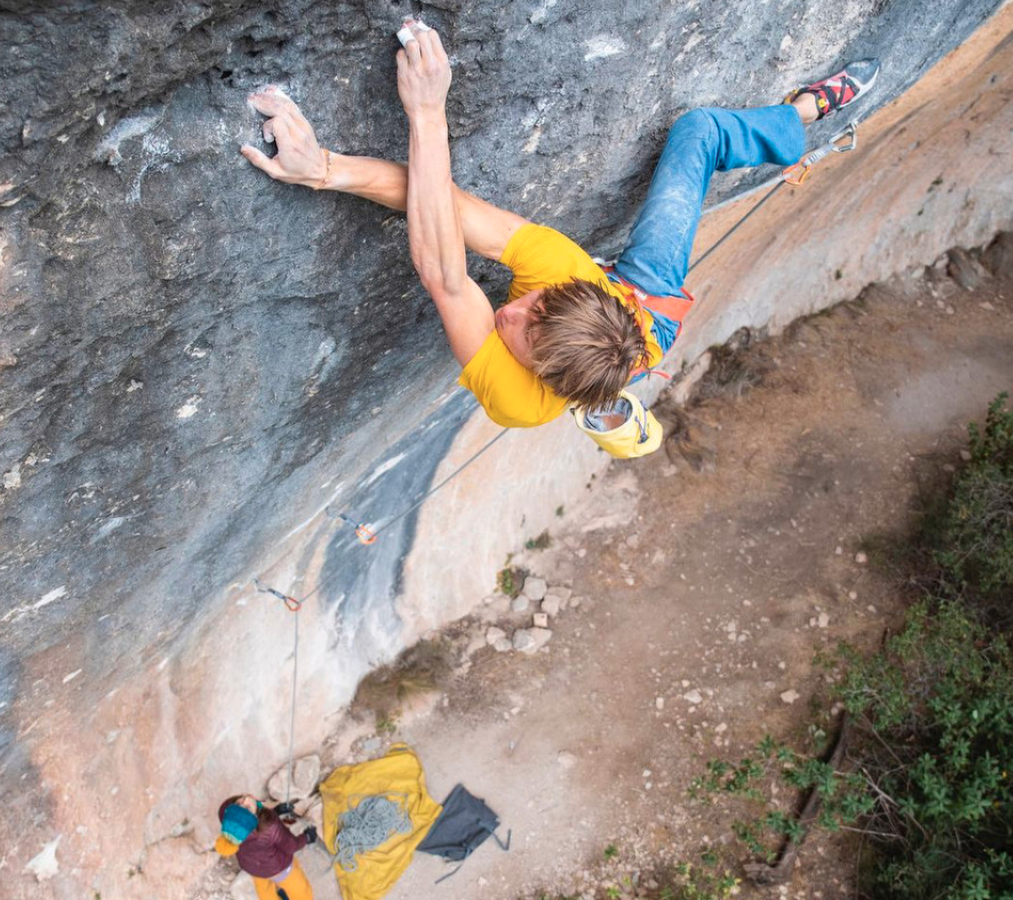
Tristan Chouvy, who previously has done 13 boulders 7C to 8A, reports with an Insta video that he has done the first repeat of Lacrima Low 8B in Fontainebleau. It was put up 20 years ago by Loรฏc Le Denmat and this was the first repeat. What is interesting is that there also exists a 7C+ high start of the problem that has only been climbed once, by Manuel Marquรจs, in 2002. Furthermore, the 11-year-old actually did a 7B+ finish instead of the original 7A+ top out. (c) Pierre-Arnaud Chouvy

"Needless to say, I'm unable to confirm the grade: no experience in that grade and very little experience in the 8a grade. All I can say is that it felt hard and painful. Hard all the way in fact, till the very top! ๐Ÿ˜." It should be noted that by looking at his Bleau.info profile we can see that most of his sends are 7A's. In any case, Tristan is the second youngest climber to have done an 8B boulder after Ashima Shiraishi who did it a couple of weeks before she turned eleven.

What is the climbing background of your family and what is your level?
My wife and I (Pierre-Arnoud) are long-time climbers and both of our children grew up climbing since they could walk. Living in the Fontainebleau Forest helps of course. Tristan has a twin sister who just did her first 7A. I have climbed 7C but have been climbing much less since I spot them all the time. I don't want them to fall too much at such a young age.

How come your son started trying an unrepeated 8B in Font?
Well, after he climbed Duel 8A, Philippe Le Denmat, who did Duel's first ascent, advised him to try Lacrima, whose first and only ascent had been done by his son Loรฏc twenty years ago. It became Tristanโ€™s somehow unrealistic project: when he first tried months ago it just felt impossible, especially the first move of the low start.

What do you think are the reasons Tristan has been able to climb so hard?
Tough question. He has always had a natural inclination towards climbing, even as a very young child. Climbing is just natural for him and he has an internal drive to progress and to push his limits. He doesn't doubt himself and is not deterred by a high grade. He clearly feels the moves and fine-tunes each step. So, altogether, I guess that makes a very good climber. In the end, he's lucky to have been exposed to the sport he was maybe made for. And living near the forest, he's lucky to be able to spend all his free time climbing. Which is not everybody's case.

Comparing different Boulder scoring methods
Here is a quick comparison of the current Bouldering scoring with Tops/Zones, the newly suggested IFSC 100 point system and the 11 point system I presented to an IFSC working group in Munich in 2017. The comparison is based on evaluating the three criteria; Understandable, Fair and Countback.

Understandable: How easy is it for the spectators and the commentators to follow and analyse the score? The best example describing how hard it is to understand the current scoring system is that in most events the commentators misunderstand and actually mislead the audience. On the contrary, when it comes to the 11 point system, it is super simple to do the maths as you only add 1, 3, 10 or 11 points together. In the IFSC 100 point system, you might end up in a situation where some of us need a calculator, i.e. 55 + 25 and 35 + 25 etc

Fair: In the current system, Tops always beats zones. In the 11 point system, in theory, 1 Top and 0 zones could be beaten by getting 8 zones. I think this is an interesting twist which some actually would think is fairer. I mean, if you just get one Top and do not reach even the lower zones on the remaining three problem, I think it is fair that a climber that possibly touches the top on all four problems could be ranked higher. In any case, in the suggested IFSC 100 point system, there is a much bigger risk/chance that zones win over Tops.

Countback: Today, if two climbers have done the same number of Tops and zones, we use the number of attempts to the Tops/zones as a tie-breaker. This is happening often as in practice there are just 25 different scoring possibilities. When it comes to the 100 point system, the risk for ties are even higher as there are just 18 different scoring possibilities. This can be compared with 40 different scoring possibilities for the 11 point system.

It should be mentioned that there are several other scoring possibilities and in practice, it is all about trade-offs. As an example, we could add 10.2 points for topping on the second go. This would mean that the 11 point system would be less understandable but at the same time, we would need fewer countbacks. On the other hand, we could decide to give two points for the second zone. This would make the system a bit more understandable, Tops would always beat zones but there would be many more ties, demanding countback. In practice, it is all about defining and giving weight to the three criteria and then applying different maths.

In order to create a Combined point system for the Olympics, we could instead work on a max score of 50 points in each discipline. This would mean giving 12.5 points for a flash instead of 11 points. This would possibly make it a bit less understandable but on the other hand, such a system would significantly reduce the risk for countback and many would say such a system would also be fairer.

It is also important for me to say that my counterpart developing the different point systems has been Reino Horak, team manager in Norway. As a matter of a fact, he will try the 11 point system in one of their comps in December. This comp will also include a new format with more climbers rotating allowing more climbers taking part in the final, just like in the suggested IFSC 100 point system.

King Capella 9b? (+) by Alex Megos
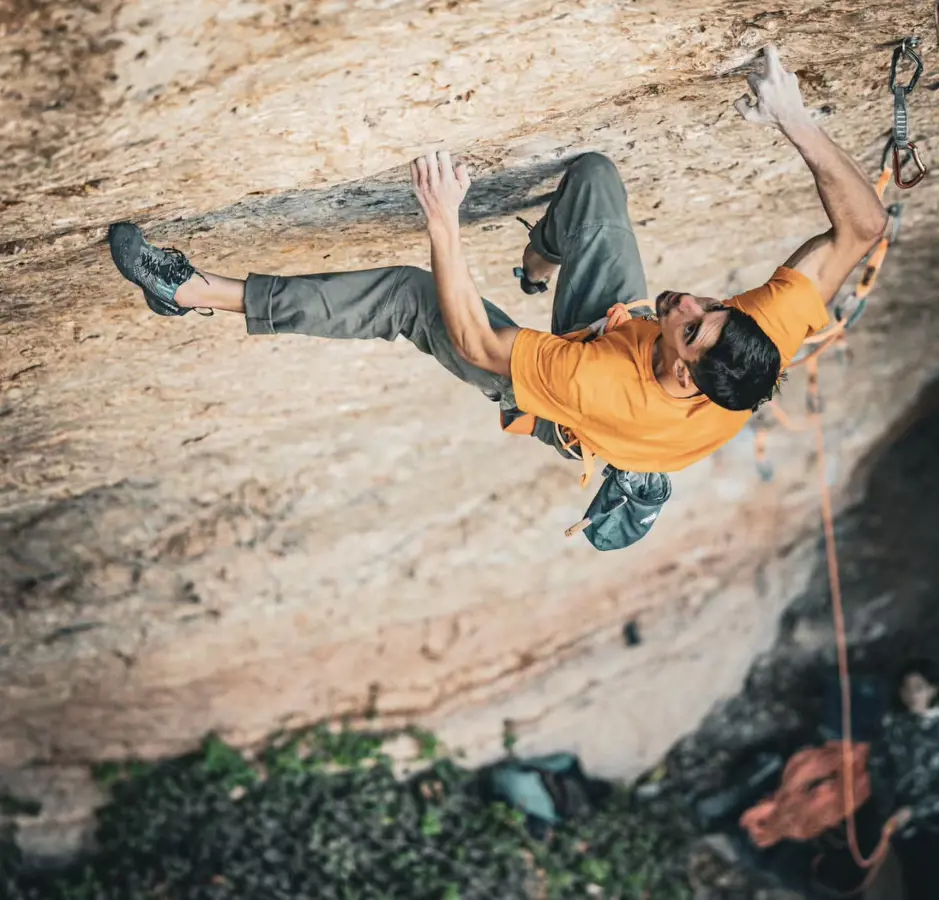
Alex Megos reports on Insta that he after some ten days of projecting has done the first repeat of Will Bosi's King Capella (9b+) in Siurana. The German do neither confirm or suggest a grade but he says, "I also used slightly different beta than Will taking a very wide pinch, which felt a little easier to me than what Will did. He couldn't do the move the way I did it though, so I guess it's personal preference." (c) Esteban Lahoz

Analyzing what grade Alex might opt for, we have his comments from this spring when he tried it for the first time. "I tried two of his FA's there and they are hard! Both of them 9b for sure. The one he thought was easier I couldn't do one move. On "King Capella" I did all the moves, but linking then will be very hard. I'd be super psyched to go and try to repeat his routes at some point! ๐Ÿ˜ Very strong lad ๐Ÿ’ช๐Ÿผ."

Furthermore, putting ten days in a fictive Time Comparison Grading table for Alex, 9b would probably fit better rather than 9b+, although he has said the route fits him rather well. "The grade time comparison doesn't work as well though because the route is so short. It's much easier to try a short route multiple times a day than a long one."

In total, Megos has now done 100+ routes 8c+/9a and harder, out of which five are 9b or 9b+.

Jorg Verhoeven, active competition climber since 1999 and overall World Cup winner in 2006, has sent us some comments in regards Marco Scolaris recently published thoughts on BMI and eating disorders.

"Scolaris' statement is very 'politically correct', unfortunately, this won't bring us much further. The IFSC has been monitoring for a long time - with the questionable methodology I can tell from my own experience - but has shifted the well-needed consequences to the national feds, which often don't care and don't act.

As an athlete representative, I've tried for years to get the IFSC to act responsibly. I've worked together closely with the medical commission, which has come up with several possible solutions, none of which have been implemented so far. Besides the awful consequences (both short- and long-term) being drastically underweight has to a person, I find the exemplary role of well-performing underweight athletes an even bigger issue. I've witnessed the negative effect it has on other - perfectly sane - athletes, who inevitably ask themselves if losing weight is the key to success. Imagine how a world cup winning role-model could influence young aspiring climbers, possibly leading them to short-term success and a lifetime of health issues. Since it's only an indicator, I think we should stop seeing BMI measurements as a way to determine a mental disease, and rather focus on accepting weight limits in international competitions. If the IFSC is serious about their athletes' health, it should send out a strong message simply defining a lower weight limit below which competing is not allowed, instead of saying 'we think you might have an eating disorder, so we're going to ask your national federation to help you with it'.

As a reference, with a height of 1,80 m, I weigh 65 kg (according to IFSC measurements 69 kg), so I could lose 5 (or 9) kg to attain a BMI below which I would be 'monitored'. Mind that I could lose 20 kilos and still participate at a WC. Out of my own experience, if I lose 1 kilo only, my body feels like it's breaking down - and yes, I try to gain weight, not lose it."

Gold and silver in the USA Nationals and Life Of Villains 9a and an 8c+ by Colin Duffy (17)
Colin Duffy, #7 in the Olympics, has done Flight Of The Conchords (8c+), on his second go, and Life Of Villains (9a) in Hurricave. "Amazing route! After not being able to finish it off on my first trip, I came back for more and got it done first redpoint burn of the trip after a quick review of the moves. Couldn't have picked a better route for my first 9a!"

How has the last week been and what is next?
Itโ€™s an amazing feeling to have accomplished both competition and outdoor goals in the span of a few days! Itโ€™s cool to see that my training throughout the year has payed off and it was the perfect way to end my competition season. Iโ€™m very psyched to have finished my first 9a!

I first tried life of villains last month on my first trip to the Hurricave. I got close on the route but my limited time plus low skin and energy stopped me from getting the send. This time around I came into the climb with a lot of psych and fresh skin and was able to take it down on my first redpoint burn of the trip. And to make the day even better I was able to snag a 2nd go send of flight of the conchords 8c+. It feels good to have finished my first 9a and I look forward to trying harder routes in the future! Up next Iโ€™m hoping to get outside more with no competitions in the near future.

Colin started the Olympics with a false start against Alberto Gines Lopez with 0.005 seconds. Without that false start, he would probably have gotten the gold and Alberto would have been #7.

Many more nice videos on his Youtube channel with currently only 86 subscribers!

New search for logbooks
19 November 2021

New search for logbooks

With the most recent update, we introduced a search feature for logbooks, and adapted the layout to resemble the other ascent lists on 8a. We hope you like it! For those who have been keeping a log for a while, this can yield some funny results that were so far quite hidden, such as the double onsight in the screenshot which, on the first entry at age 18 got the note "no chalk no shoes" and 12 years later, there is only a note about how the first bolt is too high ;-) We hope this facilitates some enjoyable trips down the memory lane!

Marco Scolaris thoughts on 2 zones, route setting and eating disorder
Marco Scolaris has been the President of IFSC since it was founded in 2007. He has been very active in making Climbing getting into the Olympics. Here is part of a chat we had two weeks ago. The questions I put forward related mainly to two zones in Bouldering, route setting failures and Eating disorder.

โ€We have not yet reached consensus when it comes to two zones and points. IFSC will not be a top government organisation as long as I am running it. I think that in the end, we will score by points in bouldering and our working group are discussing the two zones possibilities. Topping out is what counts in bouldering and there are different calculation possibilities with two zones.

There will always be comps where the setters were not spot on, due to humidity, coincidences but also due to mistakes. Possibly, you can have some pre-runners testing the boulders.

The IFSC is constantly monitoring Athletes' Health, through its Medical Commission. In this perspective, we regularly proceed with BMI testing of the athletes during our events. We have worked hard with the eating disorder issue and we had fewer cases for several years. For some reason, it picked up again and we are discussing new ways to deal with it but there are also legal problems. Since BMI low values might be an indicator of eating disorders, we are improving our system of monitoring, studying actions to be taken, including, for sure, preparing educational programs. The health of the athletes is something which is very important for us. For sure we will start an educational program as I read on 8a that Stasa Gejo suggests. We all probably know or have seen climbers having had problems with eating disorder. Today, our sport is getting exposure through lifestreaming and television, therefore we have even more responsibility to lead the sports community by example. Eating disorders are a serious issue in our society, affecting more commonly adolescents and young adults, but not only. We have to do our part to protect the climbers' health.

I cannot talk of eating disorders as I am not a doctor and that is diagnosis. What I can say is the above regarding BMI measurement."

La thรฉorie des cordes 8c and two 8b+' by Manon Hily
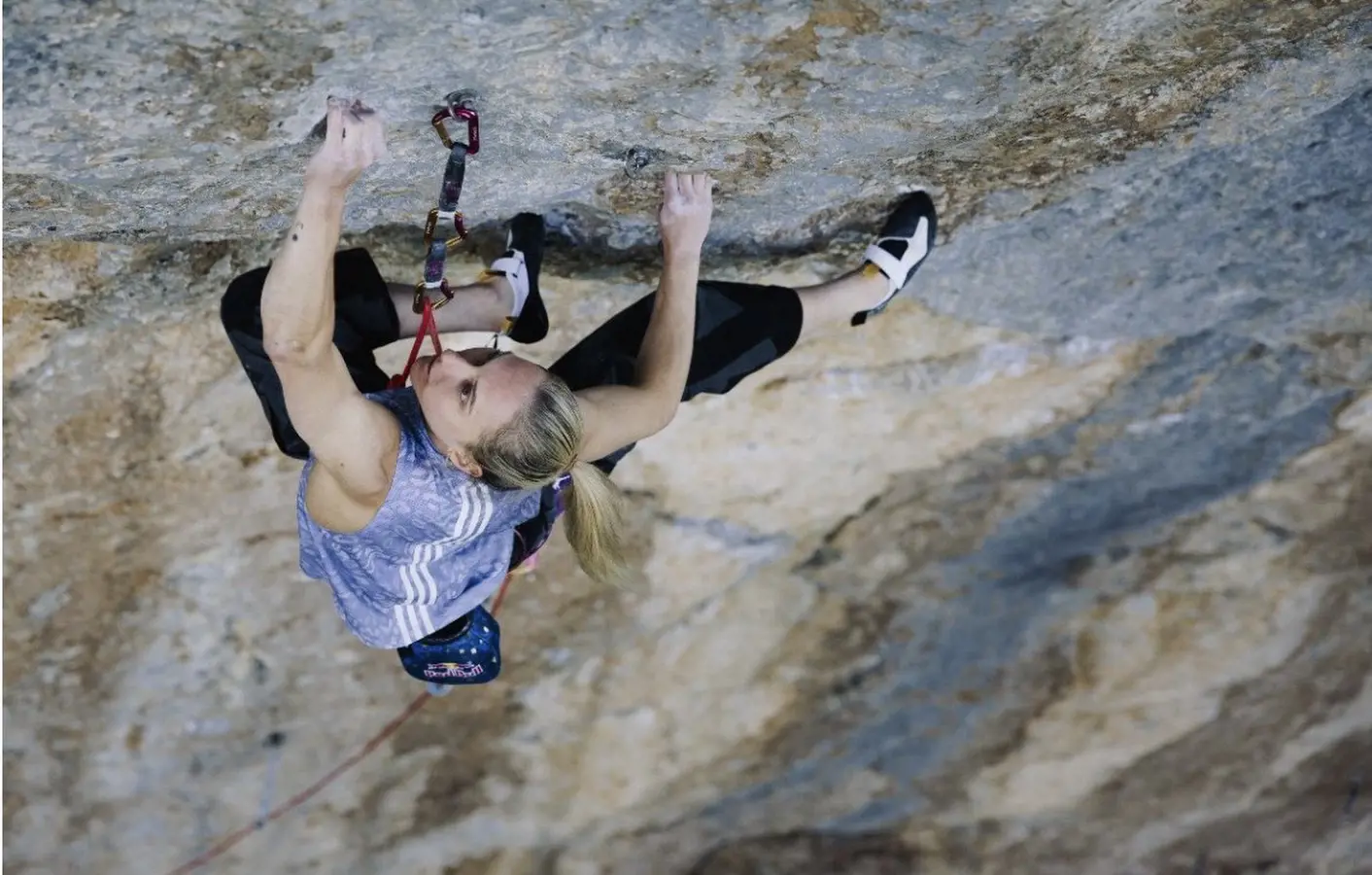
Manon Hily has done La thรฉorie des cordes (8c) in St Lรฉger. In the picture by (c) Theo Cartier, the 27-year-old does Le sonnet croisรฉ (8b+) in Buoux, on her second go. In Buoux she he has also lately done Les brillants sonnaient (8b+).

"La theorie des cordes is one of the most beautiful lines of Praniania the sector in Saint Leger. It is like 30-35 metres with 2 different parts with different rocks. The first part is very powerful with tufas in an overhang on yellow rock and the second part is black vertical rock with small holds and you need a lot of resistance. I choose this line because of its beauty and because it is famous. I tried it last year in less than 10 days but I wasnโ€™t in a good shape and my balance between power and endurance was bad. The holds are somewhat painful so you have only like one go per day. So I trained this year for the world cup.

About the two 8b+', the two lines are like 100 % my style, a big overhang with mono or two-finger pockets and powerful moves and you need a lot of endurance but there is always rest in between the different sections. Very beautiful to climb. These two lines are in diagonal of the wall and they are crossing."


Hily has been an active competition climber since 2009, having won Euro Youth Cups in both Lead and Boulder. In 2018, she was #4 in the Overall World Cup and did Era Vella 8c+/9a but then she had a pulley injury. Last year she had another one working on Biographie. Her next project is possible, La ligne claire 8c+ in Saint-Leger.