
NEWS
8 February 2021
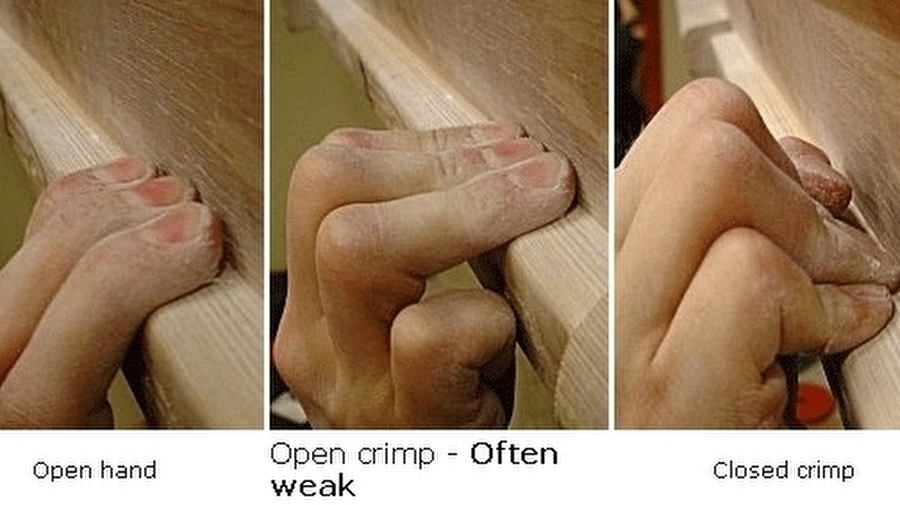
Train all three gripping positions
The optimum finger position varies for each climber and hold. Most climbers have one preferred gripping position, meaning that they use and train this position as much as possible. Thus, the other positions are less used and get relatively weaker. In general, a climber mainly climbing vertical granite will become very good on closed crimps but will have difficulties on slopers or overhang. A climber enjoying bigger holds and finger pockets on limestone will develop their open hand technique. Indoor and competition climbers are more often best in the open crimp position. The best and most advanced climbers are the ones mastering all three positions.
The goods news is that you can quickly improve your weaker positions through recruitment training, which can temporarily make them up to 100% stronger in 30 minutes! Recruitment means that you actually start using more muscle fibres of a finer position seldom used.
1. Hang on your fingerboard and identify your weakest positions - Normally this should be 3-finger open crimp.
2. Make five 0.5 seconds hangs - This should be quite easy.
3. Rest 30 seconds and make three intervals.
Once you feel you are getting stronger, choose smaller holds and repeat it again 3-4 times. Then you are getting closer to maximum recruitment and you can start doing five seconds hang and rest for 30 seconds. This you can repeat for up to 10 times or as long as you feel at your prime.
The goods news is that you can quickly improve your weaker positions through recruitment training, which can temporarily make them up to 100% stronger in 30 minutes! Recruitment means that you actually start using more muscle fibres of a finer position seldom used.
1. Hang on your fingerboard and identify your weakest positions - Normally this should be 3-finger open crimp.
2. Make five 0.5 seconds hangs - This should be quite easy.
3. Rest 30 seconds and make three intervals.
Once you feel you are getting stronger, choose smaller holds and repeat it again 3-4 times. Then you are getting closer to maximum recruitment and you can start doing five seconds hang and rest for 30 seconds. This you can repeat for up to 10 times or as long as you feel at your prime.
Read more
0
118 February 2021
Ghisolfi's daily training routine
Read more
0
07 February 2021
Charlie Boscoe stops as IFSC commentator
Charlie Boscoe will not be commenting IFSC comps in 2021 as he has been doing since 2016. During five years he covered some 70 events all around the globe getting familiar with both the athletes as well as the audience. Most of the times he was assisted by an athlete who had not made it to the next stage. "Could you please take over. I will run down and try to get some quick words with the winner" and three minutes later the interview was up and running in any language. (c) Eddie Fowke
What were the most intensive periods and how hectic were they?
The first 6 weeks I did at IFSC (in 2016) were brutal - I was starting this huge new job and learning so much every day that I thought my head would explode! And in the first 6 weeks, we had 6 World Cups - Meiringen, Kazo, Chongqing, Nanjing, Mumbai and Innsbruck. Plus, the whole broadcast team was just 3 people (including me) so we'd set up all the cameras, microphones and cables, do the broadcasts and then work all night taking all the equipment down. When all that was done, we'd make the highlights video at about 3 am and put it online before crashing into bed at 4 or 5am. I also had 2 other major work projects that year, both of which finished in autumn, so any spare minute I had I was trying to work on them. In December 2016 I remember being so exhausted that I couldn't do much other than eat, sleep and drink beer! Luckily the broadcast team grew, so we could share the workout, and the calendar became a bit easier - I couldn't have done 5 seasons as intense as 2016.
Any suggestions in regards format and entertainment?
Rather than specific ideas, I just think that we (the competition climbing industry) need to focus on putting on entertaining sporting contests. As the IFSC commentator, I often felt like I had to fill a lot of "dead" time, where not much was happening. Sometimes it's easy to think about the crowd in the venue and put on a show for them, but in reality, there are 100 times more people watching the events on tv than watching them live in the venues. If we take a break from the action so that the MC can pump up the crowd, that's just dead time for the people watching at home. I remember one time we paused the show so that a sponsor could throw t-shirts to the crowd! It took about 10 minutes, and for the whole time there was nothing for the tv audience to watch, and I just had to talk for 10 minutes about anything I could think of. I feel like the events just need to be tightened up and the tv audience should be prioritised ahead of the venue audience - 4000 people attended the 2019 Munich final, but nearly 1 million have watched the livestream of it. At all times during the event, we should be asking "how is this for the tv audience"? If we start doing that more, the solutions will be obvious. But the sport is in a good place - I'm not being negative, I'm just looking at how we can make it even better.
Could you please suggest any ideas when it comes to format or result service that could make commentators job easier?
I think we need a predictive scoring system for Boulder (so that the audience can see exactly what a climber needs to do to move up the rankings) and a progress bar in Lead. As the commentator, it's really hard to keep talking coherently while doing maths in a Boulder final, and it can be easy to forget exactly where each climber got to in Lead, so showing potential scores on screen in Boulder, and marking where each climber got in Lead would be great. I think the formats are OK, we should just try to move things along quicker. I also preferred when the 2 boulder finals ran simultaneously - 4 hours is a long time for the audience to watch a boulder final and it means that if there are a couple of boulders which don't work, there can be a lot of dead time.
What do you like scoring with points and have two bonuses?
I think that scoring with points is a good idea, but it would take a lot of research and testing to find a system that works. On many boulders it would work to have 2 bonuses, but there are some boulders where you can only really have one, so a system where some boulders have one bonus and some boulders have two would be ideal.
Why did you stop as IFSC commentator and what are you working with now?
When I started at IFSC the Olympics was 5 years away, and I just always had in my head that I'd do it for 5 years - it just seemed a logical timetable. Obviously, the Olympics got postponed but I'd already decided I was going to stop and had made other plans. I've always liked a challenge and feeling like I'm making progress, so as the 5 years passed and I felt increasingly comfortable doing the IFSC job, I got more excited by finding new. The job was still hard, but I felt like I knew how to do it, and didn't want to just do it for 20 more years because I couldn't think of anything else to do. I've worked for a long time for an awesome company called FATMAP, and I'm still doing lots of work for them, and I also do freelance broadcasting work - last year I commentated a ski competition, presented some tourist videos in Switzerland and did a big video/voiceover project for a climbing brand. I enjoy the variety of having lots of different work. I'm also working on a couple of new projects which are top secret (!) but check back in 6 months and hopefully, I'll be able to tell you all about them!
What were the most intensive periods and how hectic were they?
The first 6 weeks I did at IFSC (in 2016) were brutal - I was starting this huge new job and learning so much every day that I thought my head would explode! And in the first 6 weeks, we had 6 World Cups - Meiringen, Kazo, Chongqing, Nanjing, Mumbai and Innsbruck. Plus, the whole broadcast team was just 3 people (including me) so we'd set up all the cameras, microphones and cables, do the broadcasts and then work all night taking all the equipment down. When all that was done, we'd make the highlights video at about 3 am and put it online before crashing into bed at 4 or 5am. I also had 2 other major work projects that year, both of which finished in autumn, so any spare minute I had I was trying to work on them. In December 2016 I remember being so exhausted that I couldn't do much other than eat, sleep and drink beer! Luckily the broadcast team grew, so we could share the workout, and the calendar became a bit easier - I couldn't have done 5 seasons as intense as 2016.
Any suggestions in regards format and entertainment?
Rather than specific ideas, I just think that we (the competition climbing industry) need to focus on putting on entertaining sporting contests. As the IFSC commentator, I often felt like I had to fill a lot of "dead" time, where not much was happening. Sometimes it's easy to think about the crowd in the venue and put on a show for them, but in reality, there are 100 times more people watching the events on tv than watching them live in the venues. If we take a break from the action so that the MC can pump up the crowd, that's just dead time for the people watching at home. I remember one time we paused the show so that a sponsor could throw t-shirts to the crowd! It took about 10 minutes, and for the whole time there was nothing for the tv audience to watch, and I just had to talk for 10 minutes about anything I could think of. I feel like the events just need to be tightened up and the tv audience should be prioritised ahead of the venue audience - 4000 people attended the 2019 Munich final, but nearly 1 million have watched the livestream of it. At all times during the event, we should be asking "how is this for the tv audience"? If we start doing that more, the solutions will be obvious. But the sport is in a good place - I'm not being negative, I'm just looking at how we can make it even better.
Could you please suggest any ideas when it comes to format or result service that could make commentators job easier?
I think we need a predictive scoring system for Boulder (so that the audience can see exactly what a climber needs to do to move up the rankings) and a progress bar in Lead. As the commentator, it's really hard to keep talking coherently while doing maths in a Boulder final, and it can be easy to forget exactly where each climber got to in Lead, so showing potential scores on screen in Boulder, and marking where each climber got in Lead would be great. I think the formats are OK, we should just try to move things along quicker. I also preferred when the 2 boulder finals ran simultaneously - 4 hours is a long time for the audience to watch a boulder final and it means that if there are a couple of boulders which don't work, there can be a lot of dead time.
What do you like scoring with points and have two bonuses?
I think that scoring with points is a good idea, but it would take a lot of research and testing to find a system that works. On many boulders it would work to have 2 bonuses, but there are some boulders where you can only really have one, so a system where some boulders have one bonus and some boulders have two would be ideal.
Why did you stop as IFSC commentator and what are you working with now?
When I started at IFSC the Olympics was 5 years away, and I just always had in my head that I'd do it for 5 years - it just seemed a logical timetable. Obviously, the Olympics got postponed but I'd already decided I was going to stop and had made other plans. I've always liked a challenge and feeling like I'm making progress, so as the 5 years passed and I felt increasingly comfortable doing the IFSC job, I got more excited by finding new. The job was still hard, but I felt like I knew how to do it, and didn't want to just do it for 20 more years because I couldn't think of anything else to do. I've worked for a long time for an awesome company called FATMAP, and I'm still doing lots of work for them, and I also do freelance broadcasting work - last year I commentated a ski competition, presented some tourist videos in Switzerland and did a big video/voiceover project for a climbing brand. I enjoy the variety of having lots of different work. I'm also working on a couple of new projects which are top secret (!) but check back in 6 months and hopefully, I'll be able to tell you all about them!
Read more
6
17 February 2021
The Big Island 8C (B+) by Antonie Kaufmann
Antoine Kaufmann, whose previous best is No Pain No Gain 9a+, has done The Big Island 8C (B+) in Fontainebleau. Last week, Lucien Martinez was the first of 20+ repeaters calling it 8B+, and Kaufmann agrees on his Insta. "About the grade, it would be easy to achieve one of my biggest dreams taking it as an 8C but it wouldn't be fair... I think it’s more appropriate to grade it 8B+." (c) Gilles Charlier
How many sessions did it take and what about the sit start?
I have not taken the count for the session but definitely way to much. 15 to 20? Actually, I felt at the very last move for the edge at my 7-8th session but then the troubles began. The weather turned bad, I ripped my skin, had to find new beta, felt after the crimp where it supposes to get easier 29 times, etc. Finally, conditions improved and I could send it. The sit is more about a future goal for the next season. I have seen many tries in the sit by my friend Simon Lorenzi, and by the two strong French guys, Camille Coudert and Nico Pelorson. It gave me a lot of motivation to try the sit next year because it suits my style really well. But first I need to train!
What is the hardest boulder you have done before and what is next?
The hardest boulder I send before Big island was General disarray an 8B in Brione (last year). I see bouldering as a way to get stronger in lead, that’s why it’s quite new for me to push myself in bouldering.
I go to Flatanger this summer, I would like to try a long term project. Move (9b+) is the main goal because this line made me dream for years now and I think it suits me really well. Maybe it’s too ambitious for this year maybe not... we will see in September!
How many sessions did it take and what about the sit start?
I have not taken the count for the session but definitely way to much. 15 to 20? Actually, I felt at the very last move for the edge at my 7-8th session but then the troubles began. The weather turned bad, I ripped my skin, had to find new beta, felt after the crimp where it supposes to get easier 29 times, etc. Finally, conditions improved and I could send it. The sit is more about a future goal for the next season. I have seen many tries in the sit by my friend Simon Lorenzi, and by the two strong French guys, Camille Coudert and Nico Pelorson. It gave me a lot of motivation to try the sit next year because it suits my style really well. But first I need to train!
What is the hardest boulder you have done before and what is next?
The hardest boulder I send before Big island was General disarray an 8B in Brione (last year). I see bouldering as a way to get stronger in lead, that’s why it’s quite new for me to push myself in bouldering.
I go to Flatanger this summer, I would like to try a long term project. Move (9b+) is the main goal because this line made me dream for years now and I think it suits me really well. Maybe it’s too ambitious for this year maybe not... we will see in September!
Read more
5
127 February 2021
Downgrades not by average opinions but also by facts
Grades are based on subjective opinions but potential downgrades are normally not based on averages of these opinions. Instead, in practice, there is often an element of “The Emperor’s New Clothing”. The reason for this is that most climbers avoid giving personal grades but instead just go use the "topo grade", which is just fine. Other possibilities are of course that a new sequence has been found, the use of knee pads or a broken hold.
The latest example of this is The Big Island in Fontainebleau, which until two weeks ago was the most repeated 8C with 20+ ascents. Then Lucien Martinez did it calling it 8B+ and now also Antoine Kauffmann said the same thing. Basically, both of them used the fact that they had never done an 8B+ before as part of their logic saying it could not be 8C.
Here is the first 8a grading article from 2002. "Rating is based on individual subject suggestions and confirmed by facts and results by the climbing community.
In other words, in some cases, individuals and the media could actually suggest downgrades even if they have never been on the site. 8a has done this for the last 20 years in order to try to present as correct news as possible. If the next repeater of The Big Island calls it 8B+, we will start reporting it as such.
The latest example of this is The Big Island in Fontainebleau, which until two weeks ago was the most repeated 8C with 20+ ascents. Then Lucien Martinez did it calling it 8B+ and now also Antoine Kauffmann said the same thing. Basically, both of them used the fact that they had never done an 8B+ before as part of their logic saying it could not be 8C.
Here is the first 8a grading article from 2002. "Rating is based on individual subject suggestions and confirmed by facts and results by the climbing community.
In other words, in some cases, individuals and the media could actually suggest downgrades even if they have never been on the site. 8a has done this for the last 20 years in order to try to present as correct news as possible. If the next repeater of The Big Island calls it 8B+, we will start reporting it as such.
Read more
3
35 February 2021
Boscoe's Best Comp Memories
Read more
0
05 February 2021
Sleepwalker 8C+ by Matt Fultz, #1 in the game
Matt Fultz has done Trieste Sit 8B+, Squoze 8B+ and Sleepwalker 8C+ in Red Rocks, the latter two put up by James Webb. Amazingly the 183 cm tall did them all within 24 hours and he is now the new #1 in the 8a ranking game. He did his first 8C less than two years ago and has now done 13 of them, as well as two 8C+. Only two years ago he was around #15 in the ranking game, meaning that this 74 kilo heavy guy is a great example that late blooming is possible in rock climbing.
"Thankfully the process was a bit faster and more fun than I had expected! 8 sessions for Sleepwalker and 2 mini-sessions for Squoze. There is a fantastic crew in Red Rocks right now, and I expect we will see a few more ascents of Sleepwalker this season."
How have Covid-19 affected your climbing life?
Covid has affected my climbing pretty dramatically. We’ve moved into a 35 feet long RV so we can travel as safely while still staying “at home”. Also, since competitions have been pretty much dead, I’ve been able to get outside more days than ever before, which has been a giant blessing. I’m not sure I’ll ever want to do comps again!
How can you explain being able to step up your game so significantly?
Honestly, I think a lot of my progress has come from my nutrition. My wife, Hailey, is a nutrition coach for climbers. She has guided me on a nutrition journey that has been life changing. It’s been excellent for my recovery, energy, and longevity.
Are you fully professional now?
My wife and I own a strength and nutrition coaching company called Off the Ground. Besides that I am lucky to be on salary with a few brands.
"Thankfully the process was a bit faster and more fun than I had expected! 8 sessions for Sleepwalker and 2 mini-sessions for Squoze. There is a fantastic crew in Red Rocks right now, and I expect we will see a few more ascents of Sleepwalker this season."
How have Covid-19 affected your climbing life?
Covid has affected my climbing pretty dramatically. We’ve moved into a 35 feet long RV so we can travel as safely while still staying “at home”. Also, since competitions have been pretty much dead, I’ve been able to get outside more days than ever before, which has been a giant blessing. I’m not sure I’ll ever want to do comps again!
How can you explain being able to step up your game so significantly?
Honestly, I think a lot of my progress has come from my nutrition. My wife, Hailey, is a nutrition coach for climbers. She has guided me on a nutrition journey that has been life changing. It’s been excellent for my recovery, energy, and longevity.
Are you fully professional now?
My wife and I own a strength and nutrition coaching company called Off the Ground. Besides that I am lucky to be on salary with a few brands.
Read more
7
55 February 2021
Alex Megos Olympic preparation interview
Alex Megos was one of the best youth competitors until 2012. Then he started focusing on rock getting outstanding results including the first ever 9a onsight in 2013. In 2017, he was back at the comp scene and almost immediately finished #2 in the Boulder Euro Champs as well as in a Lead WC. The saga continued, and in 2019 he qualified for the Olympics and claimed the silver in the Lead World Champs. Last year he did the FA of Bibliographie 9c and was voted the 8a Climber of the year.
What are your training and competition plans prior to Tokyo?
You can follow all my training on my board account on Instagram. 😅😂 that's pretty much it 🤷🏼♂️. I think on average I spend about 15h only on boards every week divided into five sessions. I do a lot of yoga and some exercises too. I also do some climbing on commercial boulders too from time to time. I did do a comp simulation with the German team last weekend. That was the first time since the CWIF in March 2020. I haven't done speed for almost one year now and let's see how many comps will actually happen 🤷🏼♂️.
Do you currently follow any program prescribed by your trainers, or do you just climb whatever motivates you? Who do you normally train with?
Mostly climb what motivates me. No plan yet when lead and speed will be picked up again. I'll see how it goes in the next few months 😊. Climbing mostly with Jenya (Kazbekova) and also some friends from time to time.
Who do you think have the greatest chances of getting a medal in Tokyo?
I don't want to make any predictions about the male Olympic medalists. Anybody could win one 🤷🏼♂️.
What are your training and competition plans prior to Tokyo?
You can follow all my training on my board account on Instagram. 😅😂 that's pretty much it 🤷🏼♂️. I think on average I spend about 15h only on boards every week divided into five sessions. I do a lot of yoga and some exercises too. I also do some climbing on commercial boulders too from time to time. I did do a comp simulation with the German team last weekend. That was the first time since the CWIF in March 2020. I haven't done speed for almost one year now and let's see how many comps will actually happen 🤷🏼♂️.
Do you currently follow any program prescribed by your trainers, or do you just climb whatever motivates you? Who do you normally train with?
Mostly climb what motivates me. No plan yet when lead and speed will be picked up again. I'll see how it goes in the next few months 😊. Climbing mostly with Jenya (Kazbekova) and also some friends from time to time.
Who do you think have the greatest chances of getting a medal in Tokyo?
I don't want to make any predictions about the male Olympic medalists. Anybody could win one 🤷🏼♂️.
Read more
4
14 February 2021
Bouldering-caused disc replacement for Robinson
Paul Robinson, world record holder with 1 008 boulders 8A and harder, has just had a double disc replacement during a three-hour surgery through his throat. The 33-year-old has been an enthusiastic boulderer since age 15 and has put up FAs all over the globe. Last summer he did his 22nd 8C, but then he more or less quit.
Could you please tell us why you had the surgery?
I lost 50’percent of the strength in my right arm about 6 months ago and tried P.T. etc but nothing helped because the nerve was impinged by the herniated disc. So they do they had to take 2 discs out in my neck and replace them with fake ones. It happened from so many years of falling from bouldering. This is something that I think we will start to see more of in the future with more people bouldering.
I am not sure how long I have had the herniations for but they slowly got worse and worse until one day I woke up in the night in really bad pain. I tried to climb the next day and my arm did not work. I think that big falls are the main issue. They are really demanding on your spine. I will probably not be able to climb many highballs anymore. I think if people have more pads that will be good to make the fall softer.
When will you start climbing again and will you be fully recovered?
I will be able to start top roping in 6 weeks. They said I should be to 100 percent within 6 months.
Here is an 8a interview from 2010 when he was one of the pioneers creating climbing films. He also has a Youtube channel where his latest video is titled I'm Back! Road To Recovery. It should be mentioned that other boulderers too have undergone the same surgery caused by too much bouldering falls.
Could you please tell us why you had the surgery?
I lost 50’percent of the strength in my right arm about 6 months ago and tried P.T. etc but nothing helped because the nerve was impinged by the herniated disc. So they do they had to take 2 discs out in my neck and replace them with fake ones. It happened from so many years of falling from bouldering. This is something that I think we will start to see more of in the future with more people bouldering.
I am not sure how long I have had the herniations for but they slowly got worse and worse until one day I woke up in the night in really bad pain. I tried to climb the next day and my arm did not work. I think that big falls are the main issue. They are really demanding on your spine. I will probably not be able to climb many highballs anymore. I think if people have more pads that will be good to make the fall softer.
When will you start climbing again and will you be fully recovered?
I will be able to start top roping in 6 weeks. They said I should be to 100 percent within 6 months.
Here is an 8a interview from 2010 when he was one of the pioneers creating climbing films. He also has a Youtube channel where his latest video is titled I'm Back! Road To Recovery. It should be mentioned that other boulderers too have undergone the same surgery caused by too much bouldering falls.
Read more
7
24 February 2021
Big sendings and personal grades by Flor and Andrada (40)
During 13 days in Crevillent and Tarbena, Dani Andrada reports on Insta that he has done 23 routes 8a to 8c/+ including personal grades up to three grades lower than the official ones. His hardest was Ataxia, in the picture, which he thought was 8c/+ although graded 9a. "I would like to say that these are not downgrades but an opinion and it is only mine."
Jonathan Flor has given the same message on his Insta and for the hyperextension of Ataxia, originally a 9b, he thought it was 8c+/9a."These grade adjustments are not a war of egos or anything like that as has been said, I simply give my opinion, I don't like to be misled by these things."
Dani has previously done some 75 routes 8c+/9a and harder and Jonathan some 40. It should be pointed out that history shows that downgrades are rather common, especially in Spain.
Jonathan Flor has given the same message on his Insta and for the hyperextension of Ataxia, originally a 9b, he thought it was 8c+/9a."These grade adjustments are not a war of egos or anything like that as has been said, I simply give my opinion, I don't like to be misled by these things."
Dani has previously done some 75 routes 8c+/9a and harder and Jonathan some 40. It should be pointed out that history shows that downgrades are rather common, especially in Spain.
Read more
4
2 Favorites
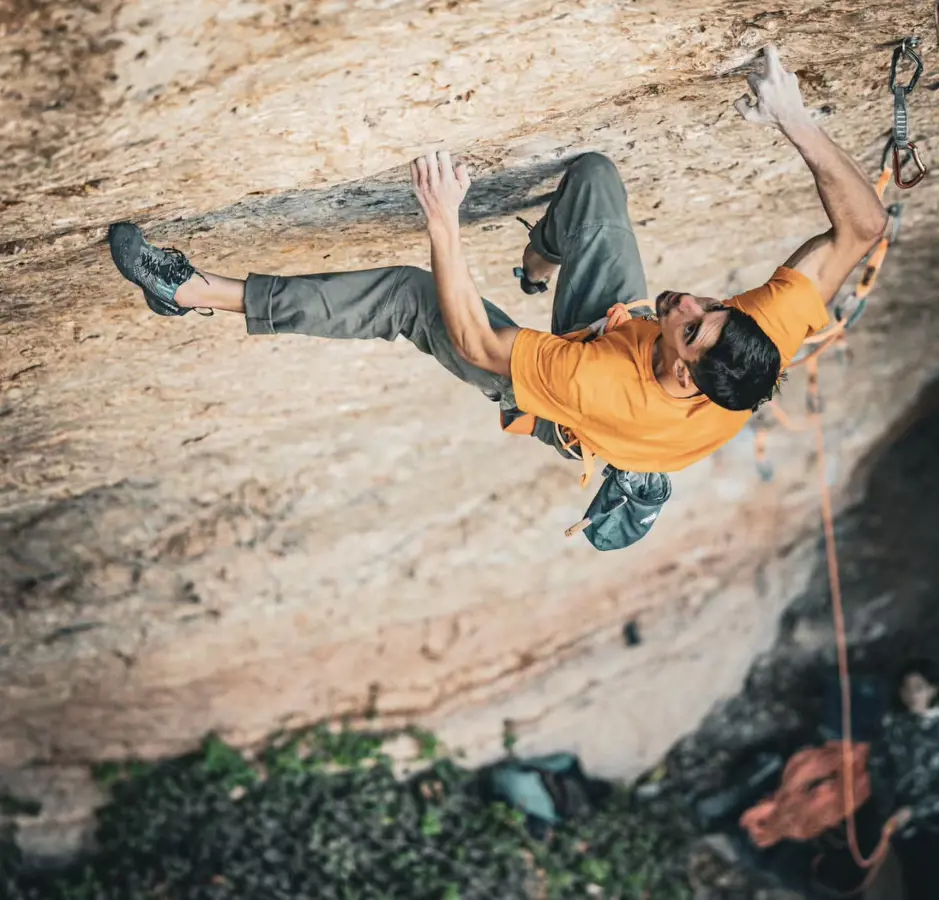
Jorge Diaz-Rullo reports on Instagram that he has made the first ascent of Cafe Colombia in Margalef. At 27, he’s already stacked four 9b+ sends and now he’s ad…
285
81
”I stopped focusing on competition bouldering after last year’s World Cup in Prague, partly because I can already feel it on my body, especially in my shoulders. The modern competition style, with a lot of jumping from one hold to another, is very demanding for the shoulders.
Outdoor bouldering is…
189
13Sean Bailey reports on Instagram that he has done the first ascent of Duality of Man (9c) in Dry Canyon. ” After four total years and three seasons of climbing,…
163
69 Most commented
Jorge Diaz-Rullo reports on Instagram that he has made the first ascent of Cafe Colombia in Margalef. At 27, he’s already stacked four 9b+ sends and now he’s ad…
285
81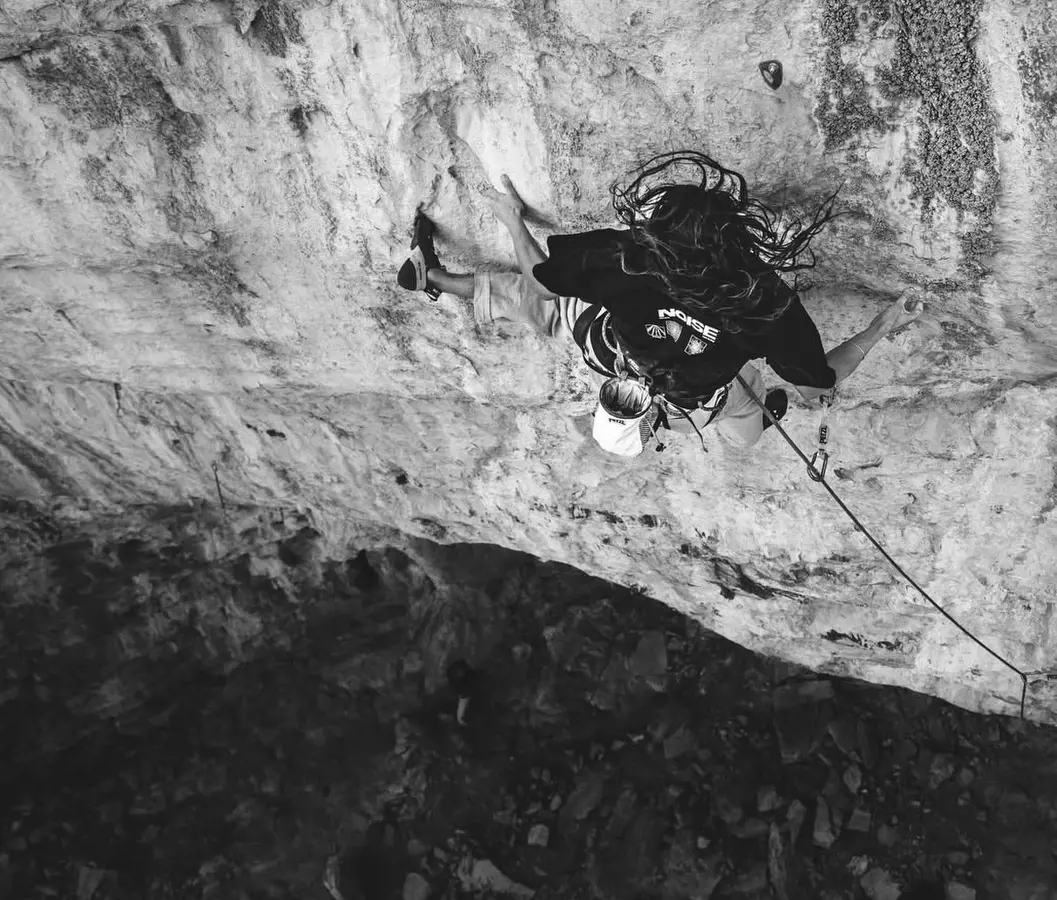
Sean Bailey reports on Instagram that he has done the first ascent of Duality of Man (9c) in Dry Canyon. ” After four total years and three seasons of climbing,…
163
69Jorge Diaz-Rullo elaborates on the reasons for him to suggest 9c for Café Colombia on Instagram, which he took down last week after projecting it for 240 sessio…
119
63