NEWS
24 December 2021
Lena Mรผller and the ecological crises
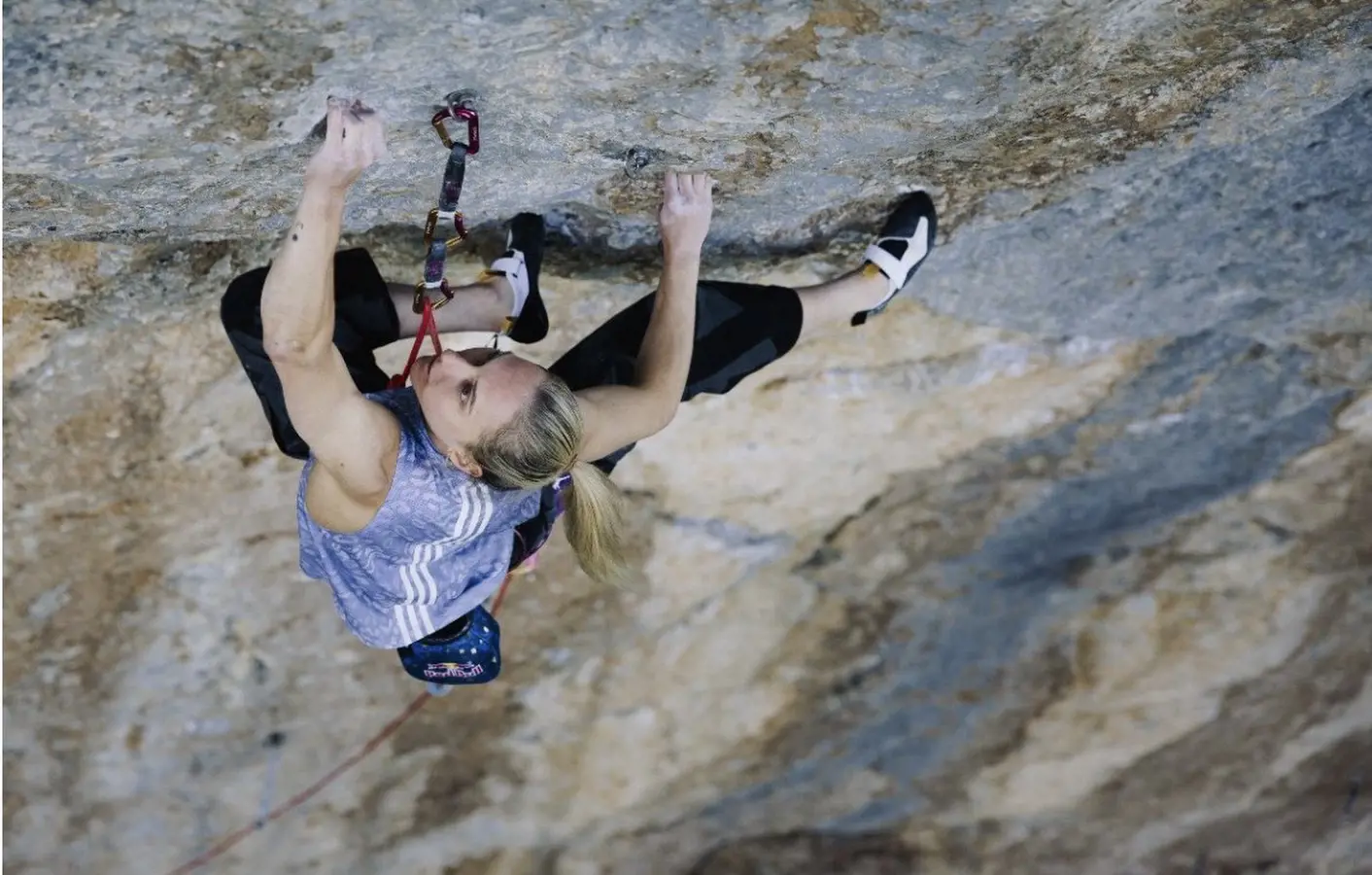
Lena Marie Mรผller is currently doing a PhD at the University of Innsbruck about the effects of climate change on mountain ecosystems. In 2020, she became the first German woman to climb an 8b+ trad (E9/E10) by repeating the route โPrinzip Hoffnungโ, which she mostly reached from Innsbruck by train. (c) Paul Lewandowski
What can the climbing community do to reduce their carbon footprint?
The carbon footprint for everyone, as well as us climbers, is composed of what we eat, our mobility, how we live (heating our house, electricity), and what we consume. So, to reduce our footprint we can address all those aspects. For example, we can change our diet to regional and organic products and consume little meat and dairy products. Further, we can change our mobility by reducing the time spent in the car/plane but instead use public transport and the bike. In our home, we can switch to sustainable, clean energy. Further, we can change the consumption to sustainable products and simply consume less. Another aspect is how we invest our money, here we can change to a greener bank.
Besides the changes we can implement in our personal lives, I think it is inevitable that we put pressure on politicians by collectively going to the streets and demanding climate action. Because ultimately, climate protection is a question of political will. Every one of us can join the climate movement and stand up for climate protection. On top of that, I think itโs important to spread awareness about our climate crisis. The more people know about the climate crisis, the more personal change will take place, and the more people we are to put pressure on politicians by striking and voting.
Do you know how to measure like one flight to Kalymnos compared to travelling to the crag, what is worse?
Roughly speaking, the same emissions are produced if one person flies to Kalymnos or the same person drives more than a hundred times to a crag which is 30km away. Hence, flying does have a huge impact. To put these emissions from travelling for climbing into perspective, I would like to introduce the concept of the โclimate-friendly carbon footprintโ. This footprint is in accordance with the Paris Agreement in 2015 with the target to limit global warming to 1.5ยฐC by the end of this century. While we must acknowledge that is difficult to achieve this climate-friendly footprint, either flying to Kalymnos once a year or travelling to climbing by car for a year basically depletes the carbon available from our annual climate-friendly footprint. Hence, we have no emissions left for other carbon generating aspects in our lives (as mentioned above) if we want to live sustainably.
So basically, the thing we should tell the community, in regards to the climbing activity, is to travel less, especially by plane, commute and climb more locally.
Regarding our sport, I agree that emissions are mainly caused by how we travel for climbing, and what/how much we consume for it.
I guess everyone must decide this on her/his own. But it would make a big impact if we as a climbing community would step away from that much travel. Thatโs why we introduced the โecopointโ โ a term that describes climbing by public transport or bike. By giving this concept a name and reality, we hope to enhance sustainable climbing in the face of the climate crisis. More in her Insta
In the end, we must acknowledge that we live in a world where our actions affect people on the other side of the world or those who will be living at the end of the century. We are living from the CO2 budget of other people (to come). I think we must ask ourselves, how far we want to take our freedom. Being a climber often means we have a lot of freedom. The freedom of time, the freedom of resources, the freedom of doing something we love. So instead of defending this ecological exploitation under the guise of freedom - why not use some of our time and resources to reconsider how we can live more sustainably and be part of demanding political change?
Because the good news is, we still have the chance to stay below 1.5ยฐC of global heating if we act now and we also have the means to achieve a brighter climate reality.
What can the climbing community do to reduce their carbon footprint?
The carbon footprint for everyone, as well as us climbers, is composed of what we eat, our mobility, how we live (heating our house, electricity), and what we consume. So, to reduce our footprint we can address all those aspects. For example, we can change our diet to regional and organic products and consume little meat and dairy products. Further, we can change our mobility by reducing the time spent in the car/plane but instead use public transport and the bike. In our home, we can switch to sustainable, clean energy. Further, we can change the consumption to sustainable products and simply consume less. Another aspect is how we invest our money, here we can change to a greener bank.
Besides the changes we can implement in our personal lives, I think it is inevitable that we put pressure on politicians by collectively going to the streets and demanding climate action. Because ultimately, climate protection is a question of political will. Every one of us can join the climate movement and stand up for climate protection. On top of that, I think itโs important to spread awareness about our climate crisis. The more people know about the climate crisis, the more personal change will take place, and the more people we are to put pressure on politicians by striking and voting.
Do you know how to measure like one flight to Kalymnos compared to travelling to the crag, what is worse?
Roughly speaking, the same emissions are produced if one person flies to Kalymnos or the same person drives more than a hundred times to a crag which is 30km away. Hence, flying does have a huge impact. To put these emissions from travelling for climbing into perspective, I would like to introduce the concept of the โclimate-friendly carbon footprintโ. This footprint is in accordance with the Paris Agreement in 2015 with the target to limit global warming to 1.5ยฐC by the end of this century. While we must acknowledge that is difficult to achieve this climate-friendly footprint, either flying to Kalymnos once a year or travelling to climbing by car for a year basically depletes the carbon available from our annual climate-friendly footprint. Hence, we have no emissions left for other carbon generating aspects in our lives (as mentioned above) if we want to live sustainably.
So basically, the thing we should tell the community, in regards to the climbing activity, is to travel less, especially by plane, commute and climb more locally.
Regarding our sport, I agree that emissions are mainly caused by how we travel for climbing, and what/how much we consume for it.
I guess everyone must decide this on her/his own. But it would make a big impact if we as a climbing community would step away from that much travel. Thatโs why we introduced the โecopointโ โ a term that describes climbing by public transport or bike. By giving this concept a name and reality, we hope to enhance sustainable climbing in the face of the climate crisis. More in her Insta
In the end, we must acknowledge that we live in a world where our actions affect people on the other side of the world or those who will be living at the end of the century. We are living from the CO2 budget of other people (to come). I think we must ask ourselves, how far we want to take our freedom. Being a climber often means we have a lot of freedom. The freedom of time, the freedom of resources, the freedom of doing something we love. So instead of defending this ecological exploitation under the guise of freedom - why not use some of our time and resources to reconsider how we can live more sustainably and be part of demanding political change?
Because the good news is, we still have the chance to stay below 1.5ยฐC of global heating if we act now and we also have the means to achieve a brighter climate reality.
Read more
7
4223 December 2021
Joe Cita 9a by Anak Verhoeven
Anak Verhoeven reports on Insta that she has done Joe Blau 8c+ and Joe Cita 9a in Oliana. "Probably the 9th grade send-attempt Iโve enjoyed the most so far. ๐ โจA route with lovely climbing from the very beginning, lots of cool moves and a super spicy slab ending.
Iโm particularly grateful for this send because my right pinky has been bothering me for the last 2 months." (c) Toni Mas Buchaca
The Belgian is a previous very successful competition climber and when it comes to outdoors, she has done 12 routes 8c+/9a and harder. In other words, although being just 25-years-old, she is one of the best female climbers in history.
How was the process taking it down and what is next?
I first spent some time figuring out the beta for the upper part โ a slab with a deadpoint move. The first time I managed to do the deadpoint was in the dark with a headlamp. Once I had that dialled, I made sure I knew exactly how to climb the lower part of the route. The day I did a first attempt, I was pretty tired, but decided to give it a go anyway. I passed the hardest sections as well as the slab crux at the end, but fell at the very top with a foot slip, right before going to a jug. I rested for two days and on my next try (my second redpoint attempt) I topped the route. As for the number of sessions: I canโt really tell, because I had already figured out the beta for the first part when doing Patxitxulo last October. But itโs somewhere around 6 sessions during this trip.
Whatโs next? Well, I have several options in mind for routes Iโd like to try, but I donโt have a new project yet. So I wonโt say more for now. :)
The Belgian is a previous very successful competition climber and when it comes to outdoors, she has done 12 routes 8c+/9a and harder. In other words, although being just 25-years-old, she is one of the best female climbers in history.
How was the process taking it down and what is next?
I first spent some time figuring out the beta for the upper part โ a slab with a deadpoint move. The first time I managed to do the deadpoint was in the dark with a headlamp. Once I had that dialled, I made sure I knew exactly how to climb the lower part of the route. The day I did a first attempt, I was pretty tired, but decided to give it a go anyway. I passed the hardest sections as well as the slab crux at the end, but fell at the very top with a foot slip, right before going to a jug. I rested for two days and on my next try (my second redpoint attempt) I topped the route. As for the number of sessions: I canโt really tell, because I had already figured out the beta for the first part when doing Patxitxulo last October. But itโs somewhere around 6 sessions during this trip.
Whatโs next? Well, I have several options in mind for routes Iโd like to try, but I donโt have a new project yet. So I wonโt say more for now. :)
Read more
9
023 December 2021
Christmas time is climb time - 12 new crags unlocked!
Holiday season is here and we come to you bearing gifts and celebrating the achievements of our community.
The 8a community has logged a stunning total of 524 971 ascents in 95 countries which is 3.5% more than in 2020. The spot with the most logged ascents was Geyikbayiri (TUR) with 6 924 ascents, but the route which 8a members logged most often was in Spain, Siurana - Crosta pร nic (7a+) with 78 ascents.
We think that these are not โonlyโ bare numbers. They also show how resilient your passion is. Hopefully this helps to look back at 2021 in a happy way.
To fuel your motivation for 2022 - and because it's Christmas - we have unlocked topos of 12 crags around the globe on the Vertical-Life App. These include such hidden gems as bouldering in Ireland and sport-climbing in Lebanon. A selection worth checking out!
To redeem the code open the Vertical-Life app (you can download it for free), hit the โRedeem Codeโ - button on the welcome-page and type in the code "12months12crags" to get all the topos. Once you redeemed the code, you'll find the collection in the "My content" section.
Merry X-mas & have fun climbing!
The 8a community has logged a stunning total of 524 971 ascents in 95 countries which is 3.5% more than in 2020. The spot with the most logged ascents was Geyikbayiri (TUR) with 6 924 ascents, but the route which 8a members logged most often was in Spain, Siurana - Crosta pร nic (7a+) with 78 ascents.
We think that these are not โonlyโ bare numbers. They also show how resilient your passion is. Hopefully this helps to look back at 2021 in a happy way.
To fuel your motivation for 2022 - and because it's Christmas - we have unlocked topos of 12 crags around the globe on the Vertical-Life App. These include such hidden gems as bouldering in Ireland and sport-climbing in Lebanon. A selection worth checking out!
To redeem the code open the Vertical-Life app (you can download it for free), hit the โRedeem Codeโ - button on the welcome-page and type in the code "12months12crags" to get all the topos. Once you redeemed the code, you'll find the collection in the "My content" section.
Merry X-mas & have fun climbing!
Read more
7
023 December 2021
Stefano Ghisolfi comments Bibliographie 9b+
Read more
3
023 December 2021
Kids should not hang-dog too much
Hang-dogging means that you multiple times hang in the rope and also use quickdraws in order to get to the top. It is a common practice that also the second try is done in a hang-dog mode in order to refine the beta. At the beginning of the sport climbing era, this was not allowed. Lynn Hill explains the very old school ethics. "If a climber fell on a route, they were immediately lowered back down to the ground. It was considered cheating to hang on the rope and practice the upcoming moves. If you hung on the rope even just to look at the up-coming moves, you were called a "hang-dogger".
The disadvantage of hang-dogging too much, directly after you have failed an onsight attempt, is that you lose a great opportunity to train to be in the onsight mode and also training being in the zone. In the short run, obviously, it is best to practice all moves and hang on every quickdraw several times before going for the second go attempt. In any case, especially the youngsters should not hang-dog too much as for them, what is most important is to train the tactical and technical skill. Short time progress based on extensive hang-dogging will just increase the mental pressure.
Adam Ondra, the best onsight climber in the world, and Alex Megos, who onsighted the first 9a, did not hang-dog much being youngsters. Their focus was the climbing challenge instead of starting a long hand-dog process in order to optimize the beta. From Megos latest Insta we can see it is often still the quest. "I really enjoy trying routes second go. It usually ends up being a big fight with not very refined beta and feels great when it works out."
The disadvantage of hang-dogging too much, directly after you have failed an onsight attempt, is that you lose a great opportunity to train to be in the onsight mode and also training being in the zone. In the short run, obviously, it is best to practice all moves and hang on every quickdraw several times before going for the second go attempt. In any case, especially the youngsters should not hang-dog too much as for them, what is most important is to train the tactical and technical skill. Short time progress based on extensive hang-dogging will just increase the mental pressure.
Adam Ondra, the best onsight climber in the world, and Alex Megos, who onsighted the first 9a, did not hang-dog much being youngsters. Their focus was the climbing challenge instead of starting a long hand-dog process in order to optimize the beta. From Megos latest Insta we can see it is often still the quest. "I really enjoy trying routes second go. It usually ends up being a big fight with not very refined beta and feels great when it works out."
Read more
4
023 December 2021
The rationale behind soft FA grades
Based on all the recent suggested downgrades in Siurana here is a possible explanation of the rationale behind soft FA grades in general. I guess that at least 25 % of all the hard climbs that have been set up during the last 20 years have been or are subject tof being downgraded. This is especially the case in Spain at the same time as few of the hardest routes in Germany and Austria have been considered soft. When it comes to bouldering, very few downgrades are found in Fontainebleau meanwhile plenty of inflated grades have been found in SA, Switzerland and Australia.
1. Different style: The first time the FA tries a climb, he/she is probably already optimized for different moves and types of holds from an old project. It just might be that he spent five days doing an endurance-based challenge on slopers and the new project has a powerful crux on crimps. Logically, he will feel that this new crux "is another level", when it is in fact mainly just about recruiting new strength.
Back in the old-school days, the FA did not face so much diversity of climbing styles around the globe. Instead, they were busy developing new climbs of similar style at their local crags. Furthermore, the new generation gym climbers climb and train on smooth comfortable problems on big holds, which is the opposite style of most of the old school routes.
2. Early grade confirmation: Bernd Zangerl is one of the guys that have had a high proportion of his FAs downgraded. He has explained that the main reason for this is that all his FA were confirmed by the first repeaters so he thought he was spot on. It should also be mentioned that he was among the first putting up steep boulders and at that time, they and the first repeaters, had had very little exposure to training on steep terrain. The gyms had very few steep walls and the same goes for the old-school routes. In other words, this goes back to #1 - Different styles.
3. A grade range is wide: "This is harder than the neighbouring route", does not have to mean that there is one grade difference. If the FA add an extension or a sit start that makes the climb harder, logically another grade is added. However, it just might be that the extension has just made the climb go from a soft 8a to a hard 8a.
4. New sequences: It is very hard to find the best optimal sequence for every move for the FA. Furthermore, in relation to #1, it just might be that it is better to go for a pinch instead of carrying on and trying to optimise a crimper move. Possibly the pinch move feels harder but it would just take 15 minutes of recruiting that strength in order to understand that it is easier compared to the chosen crimp move.
5. Knee pads: A crux of a climb can turn into a no-hands rest with the use and the best technique of a knee pad. This also relates to #1. In order to take full advantage of a knee pad, you also need to train physically and mentally. As it takes years to become a kneebar expert, it is likely that there are several more climbs that will be downgraded in the future as climbers will improve their skills.
6. Using extra equipment: Boulderers have found out that the conditions can be improved by letting a portable fan blow air. Crash pads can be brought in order to skip a clip. Putting a book under your knee pad in order to extend the leg length and bringing a portable hangboard are also examples of innovations to make it possible to climb routes faster.
7. Fame and sponsors: Twenty years ago, climbing was a niche sport and even the best were lucky if they could get free equipment from their sponsors. Social media did not exist and the exposure for the best climbers was very limited. Today, you can make a living just by climbing and part of it is that you send hard graded routes.
8. Opinions instead of Facts: Often the FA let their friends try the project in order to get a grade opinion that just might be friendly. Everyone training and climbing hard expect that they are progressing and are always going for the next level. If the FA makes the project in a much shorter time than expected it is easy to think that it is his perfect style and that he is in his peak performance. Time Comparison Grading could assist in keeping the grades conservative.
9. Old neighbour/benchmark climbs are soft: It is a general saying that the climbs in a sector should have conformity, meaning that the new FA should adapt their grades to the level of the crag. All around the globe there exist several areas with soft grades like in Kalymnos or Chulilla. At the same time there exist crags also in Spain with super hard grades.
10. "Holiday grades": Almost all hard routes and boulders in Germany have been put up by local climbers that have plenty of time for extra training at home or in the gyms, meanwhile waiting for the best conditions and skin. In other words, the hardest climbs are usually put up by climbers in their prime. When it comes to Spain, a high proportion of the hardcore FAs are done by visitors that possibly in some cases were not in their prime on the day of the FA.
11. Different ethics/Missunderstandings: It should also be mentioned that in some cases, the FA graded was spot on and the reason for the suggested downgrade is due to different ethics were used by the repeaters. Possibly they have used more pre-clipped carabiners or have stacked stones and pads to start higher. Another option is that the repeaters did not use the same starting holds or that they started in a crouched position although the FA started sitting. It might also be that the FA, in fact, did an elimination and that the (taller) repeaters found bigger holds on the side.
1. Different style: The first time the FA tries a climb, he/she is probably already optimized for different moves and types of holds from an old project. It just might be that he spent five days doing an endurance-based challenge on slopers and the new project has a powerful crux on crimps. Logically, he will feel that this new crux "is another level", when it is in fact mainly just about recruiting new strength.
Back in the old-school days, the FA did not face so much diversity of climbing styles around the globe. Instead, they were busy developing new climbs of similar style at their local crags. Furthermore, the new generation gym climbers climb and train on smooth comfortable problems on big holds, which is the opposite style of most of the old school routes.
2. Early grade confirmation: Bernd Zangerl is one of the guys that have had a high proportion of his FAs downgraded. He has explained that the main reason for this is that all his FA were confirmed by the first repeaters so he thought he was spot on. It should also be mentioned that he was among the first putting up steep boulders and at that time, they and the first repeaters, had had very little exposure to training on steep terrain. The gyms had very few steep walls and the same goes for the old-school routes. In other words, this goes back to #1 - Different styles.
3. A grade range is wide: "This is harder than the neighbouring route", does not have to mean that there is one grade difference. If the FA add an extension or a sit start that makes the climb harder, logically another grade is added. However, it just might be that the extension has just made the climb go from a soft 8a to a hard 8a.
4. New sequences: It is very hard to find the best optimal sequence for every move for the FA. Furthermore, in relation to #1, it just might be that it is better to go for a pinch instead of carrying on and trying to optimise a crimper move. Possibly the pinch move feels harder but it would just take 15 minutes of recruiting that strength in order to understand that it is easier compared to the chosen crimp move.
5. Knee pads: A crux of a climb can turn into a no-hands rest with the use and the best technique of a knee pad. This also relates to #1. In order to take full advantage of a knee pad, you also need to train physically and mentally. As it takes years to become a kneebar expert, it is likely that there are several more climbs that will be downgraded in the future as climbers will improve their skills.
6. Using extra equipment: Boulderers have found out that the conditions can be improved by letting a portable fan blow air. Crash pads can be brought in order to skip a clip. Putting a book under your knee pad in order to extend the leg length and bringing a portable hangboard are also examples of innovations to make it possible to climb routes faster.
7. Fame and sponsors: Twenty years ago, climbing was a niche sport and even the best were lucky if they could get free equipment from their sponsors. Social media did not exist and the exposure for the best climbers was very limited. Today, you can make a living just by climbing and part of it is that you send hard graded routes.
8. Opinions instead of Facts: Often the FA let their friends try the project in order to get a grade opinion that just might be friendly. Everyone training and climbing hard expect that they are progressing and are always going for the next level. If the FA makes the project in a much shorter time than expected it is easy to think that it is his perfect style and that he is in his peak performance. Time Comparison Grading could assist in keeping the grades conservative.
9. Old neighbour/benchmark climbs are soft: It is a general saying that the climbs in a sector should have conformity, meaning that the new FA should adapt their grades to the level of the crag. All around the globe there exist several areas with soft grades like in Kalymnos or Chulilla. At the same time there exist crags also in Spain with super hard grades.
10. "Holiday grades": Almost all hard routes and boulders in Germany have been put up by local climbers that have plenty of time for extra training at home or in the gyms, meanwhile waiting for the best conditions and skin. In other words, the hardest climbs are usually put up by climbers in their prime. When it comes to Spain, a high proportion of the hardcore FAs are done by visitors that possibly in some cases were not in their prime on the day of the FA.
11. Different ethics/Missunderstandings: It should also be mentioned that in some cases, the FA graded was spot on and the reason for the suggested downgrade is due to different ethics were used by the repeaters. Possibly they have used more pre-clipped carabiners or have stacked stones and pads to start higher. Another option is that the repeaters did not use the same starting holds or that they started in a crouched position although the FA started sitting. It might also be that the FA, in fact, did an elimination and that the (taller) repeaters found bigger holds on the side.
Read more
0
023 December 2021
Hanabi 8c+ FA by Yuji Hirayama (52)
Yuji Hirayama, one of the true climbing legends, reports on Insta that he has done the FA of Hanabi 8c+, which means firework, Mt Futago. (c) Shinta Ozawa
Since 1986, when Yuji did Le Specialist 8b+, the now 52-year-old has been on the cutting edge. In 1991, he won his first World Cup and in 1998, as well as in 2000, he won overall. After his competition career, he made the FA of Flat Mountain 9a/+ in 2003 and the next year he onsighted White Zombie 8c. A few years later he did Cobra Crack 8c trad and the FA of an MP in Borneo including one 9a pitch. In his resume, being one of the best multi-discipline climbers in history, he has also made boulders up to 8B+, DWS up to 8b+, several big walls including also several times have had the Speed record up on El Cap. Since 2010, he runs Climb Park Base Camp which over the years have organized several competitions. He has also been active in the Japanese Federation and helping out IFSC getting climbing into the Olympics.
Read more
21
122 December 2021
Kimera 8C by Niccolรฒ Ceria
Niccolรฒ Ceria has published the full story of sending Christian Core's Kimera (8C) 8C in Rifugio Barbara - Lowrie. In 2007, Ceria watched a DVD video when Core made the FA and since then it has been on his mind. Previously, only Elias Iagnemma had repeated it although it was put up in 2006.
So did you spend like 40 sessions on it or even more?
I think less. I would say nearly 40 check-days. In most of these times, I returned back to the car for humid/wet holds. On other occasions, I only tried the dry part.
Is this the most you have ever worked a boulder?
Yes. Considering the whole experience it was definitely my longest journey on a boulder, even if I only had a couple of moments in 8 years when it was potentially fully climbable. I spent a lot of sessions just repeating the first half because of the complicate conditions which are anyway part of the story :)
So did you spend like 40 sessions on it or even more?
I think less. I would say nearly 40 check-days. In most of these times, I returned back to the car for humid/wet holds. On other occasions, I only tried the dry part.
Is this the most you have ever worked a boulder?
Yes. Considering the whole experience it was definitely my longest journey on a boulder, even if I only had a couple of moments in 8 years when it was potentially fully climbable. I spent a lot of sessions just repeating the first half because of the complicate conditions which are anyway part of the story :)
Read more
5
022 December 2021
Ondra beyond focus trained in a sauna before the Olympics
In the last episode of Beyond Focus with Adam Ondra, he shows us how he trained in a sauna, how he dealt with pressure and the media and says that he sacrificed two years of outdoor climbing.
Read more
1
022 December 2021
Paris 2024 points scoring in China WC event 2022
IFSC informs that the China World Cup event in Chongqing 6-9/10 will be run in the same point scoring format as for the Olympic Games in Paris 2024. It should be mentioned that this event is outside the World Cup series. Here is a sum-up of the rules that also will be used during the Combined European Championship during 11-21 August.
1. Boulder scoring:
The maximum score of the Boulder phase is 100;
There will be four boulders in each round, all featuring two zones and one top;
The maximum score of each problem is 25 points โ athletes will earn 3 points by securing the first zone, then move to 6 points if they secure the second zone, and claim the full 25 points if they secure the top;
0.1 point will be deducted for each fall while attempting to top*.
(In the IFSC news it says 1 point but that must be a typo.)
2. Lead scoring:
The maximum score of the Lead phase is 100;
There will be one Lead route per round, and only the final 30 moves of each route will award points;
Counting back from the top of the route, the last 15 moves will earn the athlete 5 points each, the previous 10 moves will earn the athlete 2 points each, and the previous five moves will earn the athlete 1 point each;
Any moves prior to the last 30 will earn the athlete 0 points.
In practice, based on an example that a route includes 50 moves, here are the number of points that will be received:
Hold 10 = 0 points
Hold 20 = 0 points
Hold 25 (midways) = 5 points
Hold 30 = 15 points
Hold 35 = 25 Points
Hold 40 = 50 points
Hold 45 = 75 points
Hold 50 (Top) = 100 points
This new point scoring system will increase the pressure of the route setters. If the boulders or the routes are made too easy or too hard, the Combined medals could be based on the results in just one discipline. One good point of this format is that before every climber in Lead, the commentators can say exactly which the climber needs to achieve in order to make Top-3 etc.
1. Boulder scoring:
The maximum score of the Boulder phase is 100;
There will be four boulders in each round, all featuring two zones and one top;
The maximum score of each problem is 25 points โ athletes will earn 3 points by securing the first zone, then move to 6 points if they secure the second zone, and claim the full 25 points if they secure the top;
0.1 point will be deducted for each fall while attempting to top*.
(In the IFSC news it says 1 point but that must be a typo.)
2. Lead scoring:
The maximum score of the Lead phase is 100;
There will be one Lead route per round, and only the final 30 moves of each route will award points;
Counting back from the top of the route, the last 15 moves will earn the athlete 5 points each, the previous 10 moves will earn the athlete 2 points each, and the previous five moves will earn the athlete 1 point each;
Any moves prior to the last 30 will earn the athlete 0 points.
In practice, based on an example that a route includes 50 moves, here are the number of points that will be received:
Hold 10 = 0 points
Hold 20 = 0 points
Hold 25 (midways) = 5 points
Hold 30 = 15 points
Hold 35 = 25 Points
Hold 40 = 50 points
Hold 45 = 75 points
Hold 50 (Top) = 100 points
This new point scoring system will increase the pressure of the route setters. If the boulders or the routes are made too easy or too hard, the Combined medals could be based on the results in just one discipline. One good point of this format is that before every climber in Lead, the commentators can say exactly which the climber needs to achieve in order to make Top-3 etc.
Read more
0
4 Favorites
Jorge Diaz-Rullo reports on Instagram that he has made the first ascent of Cafe Colombia in Margalef. At 27, heโs already stacked four 9b+ sends and now heโs adโฆ
285
81
โI stopped focusing on competition bouldering after last yearโs World Cup in Prague, partly because I can already feel it on my body, especially in my shoulders. The modern competition style, with a lot of jumping from one hold to another, is very demanding for the shoulders.
Outdoor bouldering isโฆ
189
13Sean Bailey reports on Instagram that he has done the first ascent of Duality of Man (9c) in Dry Canyon. โ After four total years and three seasons of climbing,โฆ
163
69 Most commented
Jorge Diaz-Rullo reports on Instagram that he has made the first ascent of Cafe Colombia in Margalef. At 27, heโs already stacked four 9b+ sends and now heโs adโฆ
285
81Sean Bailey reports on Instagram that he has done the first ascent of Duality of Man (9c) in Dry Canyon. โ After four total years and three seasons of climbing,โฆ
163
69Jorge Diaz-Rullo elaborates on the reasons for him to suggest 9c for Cafรฉ Colombia on Instagram, which he took down last week after projecting it for 240 sessioโฆ
119
63