NEWS
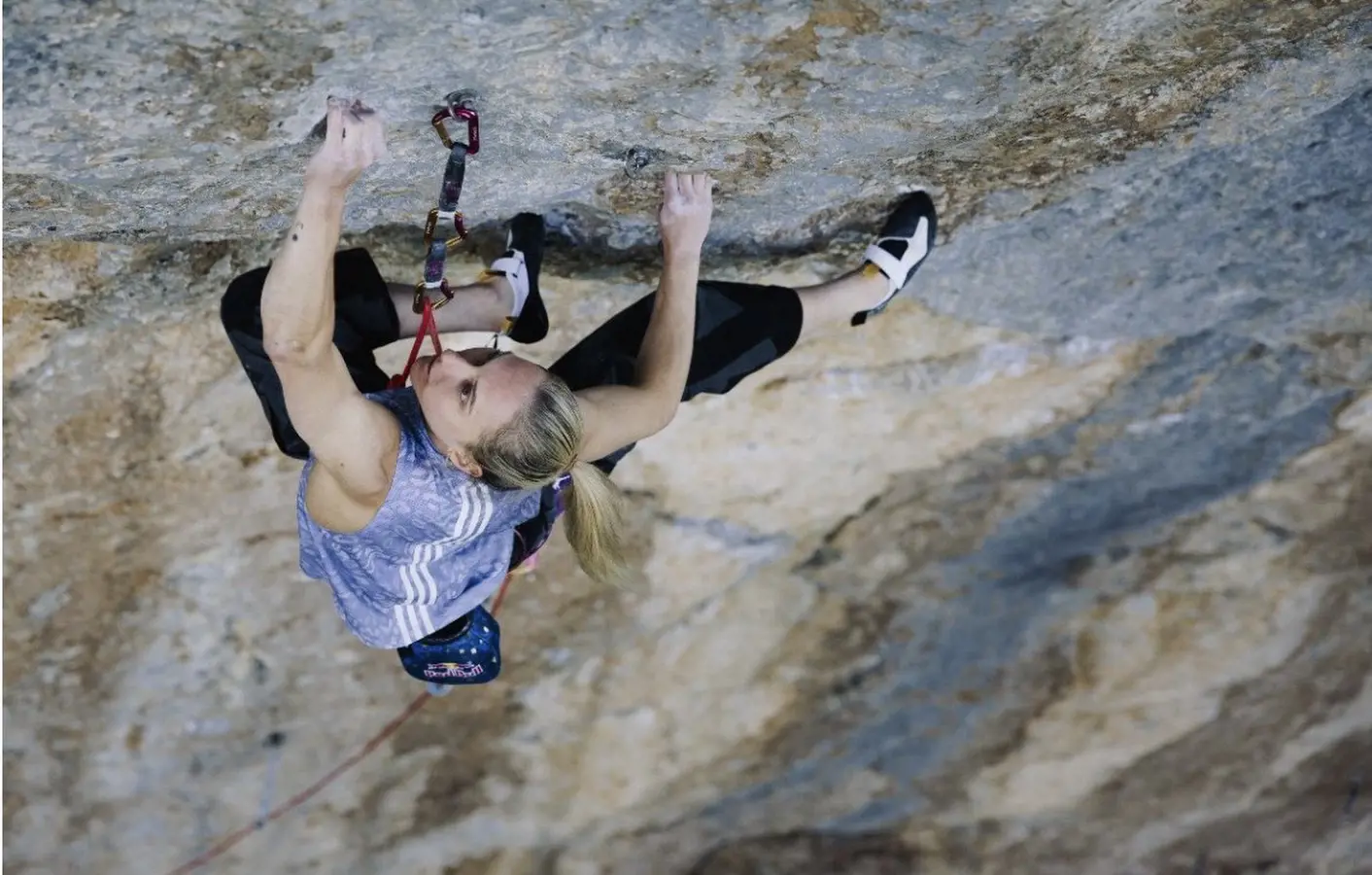
Ainhize Belar Barrutia (17) does her fifth 8c
Can you tell us more about your trip to Margalef and doing your fifth 8c?
I was in Margalef for a week The first days I tried L, espiadimonis 8c and I was able to do it the third day. Then, we change the crag and we went to Finestra, where I sent Via del kim 8b+, niรฑa mala 8b and freeman 8a.
What does your typical week of climbing look like?
Iโm studying first year of high school. When I finish class I train every day from 2 to 4 hours and on weekends I usually go out to the rock here in the Basque Country.
What are your plans for 2023?
This year Iโm going to focus more on rock and lead competitions. For this, I have the help of the Sputnik team, who supports me and do everything possible for me to improve (trainers, psychologists, nutritionist, physios...).
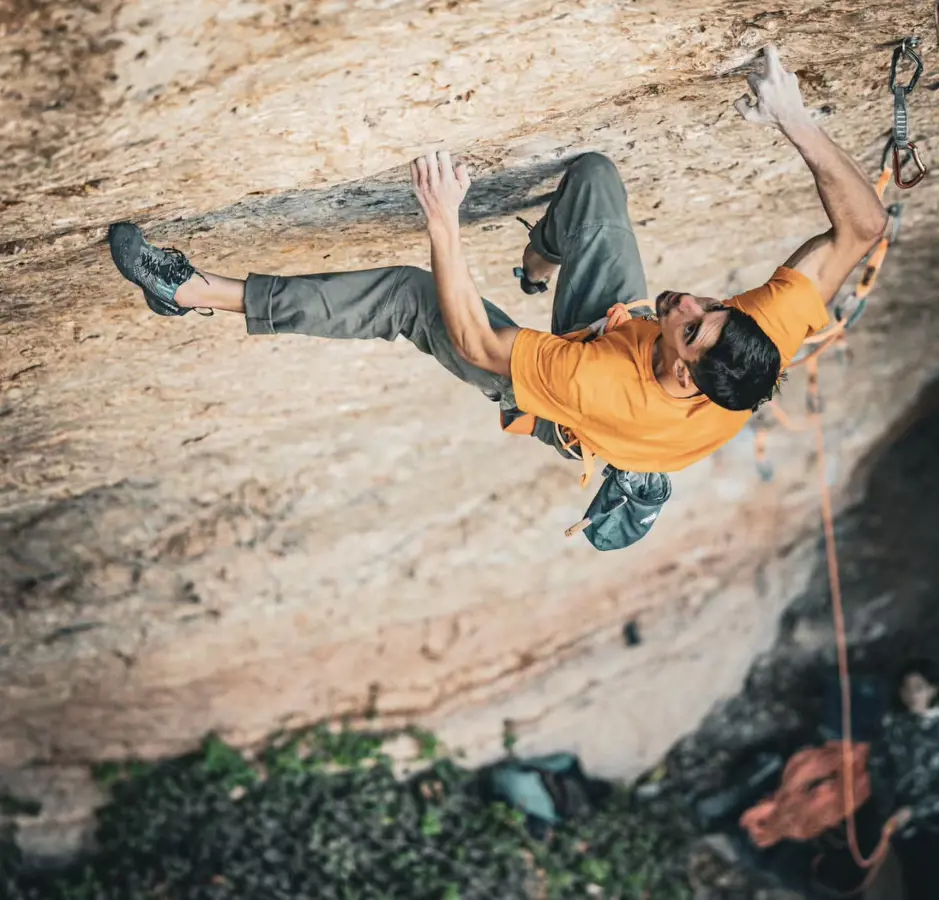
Sven Lempereur does Supercrackinette (9a+)
Can you tell us more about sending Supercrackinette?
After my 21 birthday, I decided to focus on outdoor climbing, and I really wanted to find a big project that would motivate me and would make me progress on the projecting process. So, I decided to go four days on the route during the autumn 2021 to check what it was like to climb a 9a+ and what I needed to accomplish it. I chose this route because one of my best friends, Sรฉbastien Berthe, did it a couple of years ago. I know that the route suits my style, with lots of crimps and resistance. This route is on a corner in the middle of the St-leger crag. I really like this place because it is not too far from my home (8 hour's ride), so it is possible to come here just for one week and there are always some strong guys to share my climbing days with.
For me, it was important to climb as fast as possible so I could be fresh for the top section. A fun fact is that I shared the progress with Jules Marchaland. We timed our attempts, and we tried to set a record between the first move and the mono movement. This fun thing helped me a lot to arrive as fresh as possible to the last part of the route. For me, the mono movement was not too hard because itโs perfectly my style. After this move, there are just 5 movements left to the final jug. I fell on this part more than 35 times. Most climbers donโt fall after the mono movement, but I didnโt manage to hang on the resting hold, and I fell a lot on the last move. For this, an important challenge for me was not damaging the skin on the side of my finger. In this resting hold, my finger was compressed against the rock, and I opened it every time, because of my big fingers and soft skin.
This route was a real mental battle because I was close to sending pretty quickly, but I just kept falling so many times in this last move. I was not able to find the solution in this last move from the ground, and I knew that I wasnโt able to do the move when I was tired. I remember calling my coach or my friends every trip and saying, "ok, I give up and I come back home", but they helped me each time to find the motivation to try again.
The game changer for me was that after my last trip in January, I decided to focus not just on trying hard boulders or hard routes but on the main goal of sending. In order to do that I chose some classic 8c routes in Belgium and just continued to try them until I sent them. The day before my send, I decided to retry an old beta for the last move and I train to do it 10 times in a row. The result is that work and I didnโt doubt or hesitate in this last move. After this send, Iโm a little bit lost because the process that motivate me all this time is finished, but I have some nice projects in my mind like hard multi-pitches or the objective to be the first Belgian guy to do 9b.
Burden of Dreams is characterised by a pure style moving through tiny crimps and crystals on a 45 degree angled boulder and has repelled some of the very best climbers in the world who have attempted it until Bosiโs ascent. Will spent fourteen days on the boulder as well as ten days on the replica back in Sheffield at the Lattice Headquarters so twenty-four days in total spent working on the problem. This is the longest Will has spent on a single boulder problem and he confirmed the grade as 9A/V17 as well as being the biggest bouldering challenge he has undertaken to date.
Commenting on the second ascent, Bosi said โIt feels unbelievable right now! I came to the boulder today thinking it would be too hot to climb but the warm up felt incredible and on the send I flew through the bottom section and after dropping the top hold previously, this time it all came together!โ On the grade of the problem: โFrom the overall experience on this boulder from working the replica to finally sending it, I think itโs a step up from everything else I have done and it is a huge step up from any 8C/+ Iโve done. Therefore I think it definitely deserves 9A!โ
What was most challenging about projecting a 4-5 move 9A boulder?
I think the hardest thing is being patient. As each move is so hard you need good skin and to be rested. So you have to take a lot of rest days and have short sessions. Which can definitely be frustrating as I just want to keep climbing.
How much did you benefit from the replica training?
I benefited so much from the replica training! I feel like every replica session was as good training as a session on the actual boulder. Therefore I got an extra ten sessions.
How was the cooperation and camaraderie with the other guys projecting along with you?
It was extremely useful and like my Alphane experience, it helps you learn so much micro beta and the psych you get off each other is incredible.
What lessons have you learned and what does the ascent mean to you?
The ascent means so much to me as I never thought I would ever climb a boulder like this. So, I think Iโve learned that I am capable of more than I thought I was and Iโm looking forward to finding my own BODs in the future.
Asagamidara (8C) as WC preparation for Hannes Puman
Can you tell us more about your first 8C and your comp plans for 2023?
I went to Japan a little before the World Cup in order to adapt to the time difference and get a few training sessions in the great gyms in Tokyo. Iโm also happy about getting out climbing in Mizugaki and seeing such a classic area. I was guided by my friends Kaito and Motoki and almost the first boulder they took me to was Asagamidara, I checked the top with a rope and climbed it after a couple of tries. Beautiful boulder with a tricky heel hook in the beginning and rather consistent climbing followed by an easy section but itโs quite high so falling there is not good.
My plan is to compete at most World Cups this year, but skipping the one in Salt Lake City.
Claudia Ghisolfi's road to recovery and 9a
"The route is in Gravere a crag near Turin, my hometown! It was freed by my brother Stefano in 2014. It's a connection between an 8c (you have to do the entire 8c) and the end of the route is an 8b+ (10 hard moves). I did the 8c in 2018 (it was my first 8c) and I did the 8b+ this august so I decided to try the 9a and I did it after another five sessions! So happy! I had shoulder surgery 14 months ago, I can't believe I can climb a 9a after that big injury!"
Cody Roth (39) repeats Corvo Morto (8c+/9a)
"Corvo Morto combines two 8c's, Il Corvo (The Crow) and Die Hard, two regionally historic lines from sport climbing's dark age of 1994 (also the year I started climbing). I did Corvo a year ago and Die Hard on Christmas day. To be honest, Corvo Morto wasn't on my radar but my wife and I were in the area for a truffle festival and with the weather being colder than we expected the conditions were good for Gabbio (the sector this climb is at). If you've already done Corvo and Die Hard then you have a pretty massive "home-field advantage" on this one. The connection move is hard and I broke a foot, which made it a little tougher, but it's mainly just a question of having that extra bit of fitness. After checking out the connection move and applying a pretty creative sequence, it took me four further tries. Credit to Laura for reimagining these two as it makes for just over 30 moves with very little opportunity to rest. The aesthetics are low but the flow (as well as the beauty of the place) is high."
What does climbing look like for you nowadays and how is it to be peaking at age 39?
I'm not sure if I'm peaking... I'd say I've managed to adapt and not get much worse thus far with age, while everyone around me and younger than me has gotten better! I climbed my first 8c (assuming it hasn't been downgraded) when I was 17. In retrospect, I probably could have climbed more 9a's when I was in my 20's had I been less of a raging bull. I didn't really understand tactics and I didn't have much patience at that time. I also lacked the financial resources and independence that I have now, which makes it a lot easier for me to climb as I want without feeling any extra distraction or worry. I don't regret experiencing it, but I'm happy to not feel that extra pressure and angst that I felt at times in my 20s when I was trying sustain myself through climbing.
It's a bit of a relief knowing now that any climb that I do, or don't do, doesn't change much of anything; and doesn't change my worth as a person, for better or for worse. As far as what climbing looks like for me nowadays, I try to climb at least two times a week, three whenever possible. I climb pretty much only on rock, I do less than 10 gym sessions in a year. I wouldn't mind doing more but it's hard for me to fit in, alongside my work, other hobbies and desire to be social. I hangboard a couple times a week (I just started doing weighted hangs this winter) and I use a rowing machine and run here and there. Over the last year I've also gotten really into white water paddle boarding. I spend a couple days a week doing that or surfing a standing wave near our condo in Arco. There's times when it bangs me up and makes the next day climbing challenging, but it helps my overall physical and mental fitness.
Since moving to Italy, four years ago, I've also made it a point to not limit my climbing to trying just one project. Zeroing in on one climb I've found kills my fitness and slows down my progress. I've found I do much better and enjoy climbing more if I have a couple things going at any given time plus days where I onsight climb as well as casual sessions with my wife where we set up top ropes on a couple of climbs and just playfully run laps.
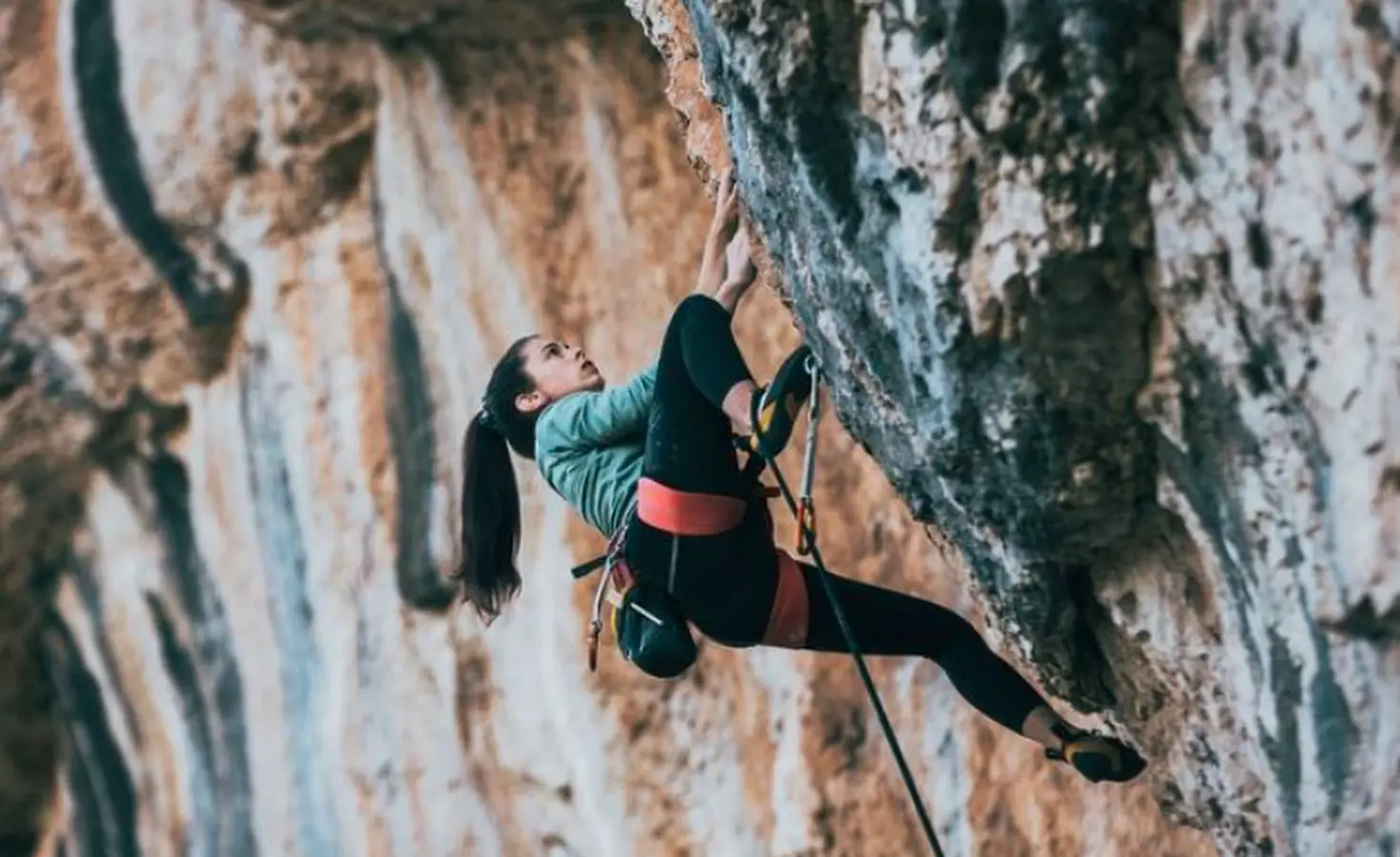
Katherine Choong does Les Nerfs ร Vifs (8c+)
Can you tell us more about Les Nerfs?
Before the start of the multi-pitch routes season, I really wanted to find a project to get back in shape after a little winter break where I couldn't go to the crag because of the weather in Switzerland and my job. Finding an 8c+/9a route that fits my small size is always a bit complicated. Fortunately, Cรฉdric Lachat is the best climbing partner to find a good project for me, he is the one who told me about a hard route which could suit me located in La Verriรจre, not far from Millau (France). Indeed, no morpho movement, physical sections on tufas, underclings, crimps, and a long fight of resistance until the end, the perfect route for me! So we spent 7 days there in February, at the end of which I fell in the very last hard moves. I really wanted to finish this route so I came back as soon as I could in April. When I arrived, several key holds in the crux sections were wet and on my first day, I got a split on my finger that wouldn't stop bleeding. It was pretty hard mentally but fortunately, I really managed to just focus on my performance, no matter the conditions or anything else.
Last Monday, on my first attempt of the day, I fell at the very first crux, my hand slipped on a wet hold. I tried again, but I fell again at the very top. The sun was coming up, I only had time for a short break before a last try, I fought on every move, close to falling on the last moves before the belay, not being able to see the holds anymore because of the sun that had reached the top of the route, until finally clipping the anchor! What a fight! Many thanks to Pierre Soulรฉ and Julien Mayet for bolting this amazing line, and Matteo and all his family for their kindness, the betas and the precious support.
March Gallery recap and April beta
Close to 700 images were uploaded from roughly 300 members, covering close to 500 crags around the globe, in the inaugural March Gallery Raffle. The images shared highlight climbingโs diversity, and remind us that itโs hard to beat a good day cragging! This month's raffle winner was Lotte Lies, who took this solid pic of, Sapiens (7c)
In addition to rewarding a lucky raffle winner with one year of Vertical-Life Premium + Friends weโve also given the same prize to the image that earned the most Vengas, Tillmann Fรผnfstรผck redpointing his long term project La lune de la miel (8a+):

Everyone who participated also scored one month of Vertical-Life Premium for their uploading efforts. If you were one of the 300, check your inbox if you haven't already!
The Gallery raffle for April is already on, and this month three lucky winners will find themselves with a new pair of La Sportiva Mantras! To get in on this giveaway go to the gallery, and upload some of your favorite moments climbing. The more Vengas your uploaded photo gets, the higher your chances of winning, as each Venga earns you an additional ticket in the raffle draw. At the end of this month, we will announce three lucky winners. Make sure to upload your shots before the 30th so that you donโt miss out!
Mathieu Miquel and Robbie Phillips, who took the picture of Sรฉb.
Berthe: "I thought about trying this route since the first time I saw info from Jame Pearson doing the first ascent back in 2017. The wall and the route looked so perfect. Then when Jacopo, Siebe and Babsi did it not long ago, I thought it would be nice and challenging to give it a ground-up attempt. At the beginning of this week, I went for a short trip to Annot (France) in order to give a ground-up attempt. I knew I was in great shape and I took the opportunity of having my Scottish friend Robbie Phillips working the route so I could have good info about the route and the betas.
I spent one entire day looking at the route, collecting betas and info from Robbie and Mathieu Miquel (a french young climber who also sent it this week). I also spent quite some time watching videos and pictures from all the previous ascensionists. I had to remember everything: footholds, handholds, gears, ... There is so much info to keep in mind... How and where to put the gear? Where to rest? What beta to choose depending on my fatigue? I am really proud of the work I made there, a true studying mission.
On the day of the ascent, I woke up a bit nervous... Always the case with flash attempts: you only have one chance ahah. I warmed-up (which didn't start that well actually because I fell on my second 7a ๐ ๐), organized my harness with gears put in the good side of the harness and the right order, revisualised the route in my mind,... and went for it in the middle of the afternoon. The conditions were not that good, it was warm, but there was a small and nice breeze and I was too excited to wait for another day.
On the first easy part, I didn't climb very well: I was shaky and nervous. But as soon as the hard part began I felt better and climbed really fast with a great flow. I didn't make many mistakes (apart from one moment where I almost fell, on an easier section), until the crux where I gave everything to make it happen... And it happened! I was through the boulder, still on the wall, shaking my forearms to recover for the last section. The final bit isn't that hard but is still a bit tricky. I climbed really slowly and carefully on the final crack!
It is the first flash-ascent of this route, and maybe, as far as I know, the first time someone flashes a trad route of that grade. It was a great moment in my climbing life, and I am really happy I dared try it flash. About the grade, it is hard for me to give an opinion as I was flash and don't have much experience on E-grade, but I have the feeling that the route is quite easy for 8b+. But I also have to admit that I feel in really good shape. Future will tell."
Mathieu: I started trad climbing about a year ago but not regularly. At first just some limestone routes around Grenoble and a few easy multipitch routes in Chamonix. I liked this style of climbing immediately because it adds a new thing to climbing, it's not just about working the moves and the route but with trad it's also about finding the right gear to protect yourself, and you have to be quick about this when you're onsight. So I had the feeling to discover a new discipline in climbing and be a beginner again and that was really motivating. I also liked the purity of this style, it's really incredible when you can protect yourself in a hard route because in a hard route, you don't have many big holds.
For the grade, I think it could be easier than an 8b+ especially if you are strong in this style of climbing. It's really technical with some little handjam and footjam (even if it's not crack climbing) so the first time I climbed in it I found it hard but the more I climbed in it the more I found little tricks and beta so when I send it I have the feeling to climb something around 8b but with the gear to place in the same time it was not so easy ahah. For the British trad grade system, I think it was graded E10 7a, I don't have experience in this grading system but I could discuss it with the British climber Robbie Phillips, who sent the route the day after me, and he thinks that could be more an E9 6c. In any case, that is in agreement with our feeling of the route being more 8b than 8b+.
I want to say that I don't want to downgrade it because I don't have the experience and legitimacy to do that, it's just some personal reflections.