NEWS

How to gain flexibility and climb like Ondra
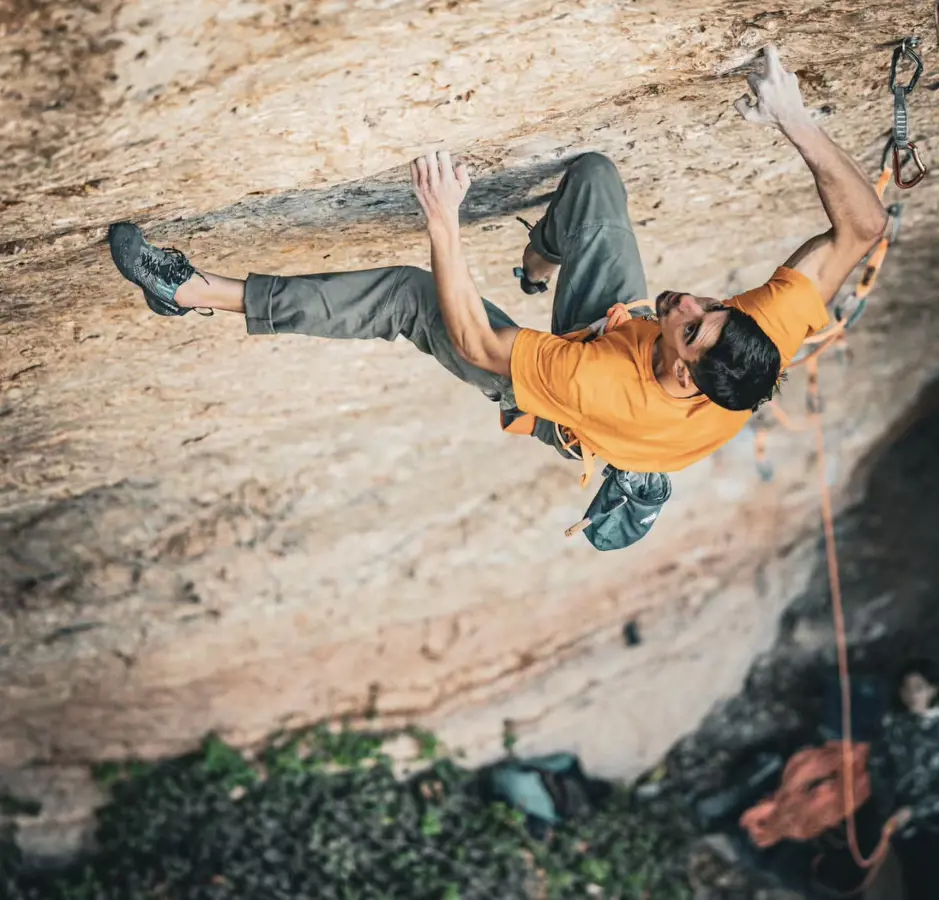
Talking about flexibility and that the top Japanese boulderers stretch four hours a day, we have asked Klaus Isele, MSc D.O. Physiotherapeut and Osteopath of the Austria National Climbing Team and Adam Ondra, for some advice. Adam has been stretching systematically since he was a kid and is probably the top climber with most flexibility, which is part of his success. The picture is taken during the stretching preparation just some minutes before Ondra did the world's first 9c, Silence in Flatanger. "If itโ€™s the case that you always fall off your slab project just because your hips canโ€™t stay close enough to the wall stretching exercises could maybe help. If you do proper stretching you might achieve your goals faster and better. Bodyweight and stretching have something in common. You might not have the perfect bodyweight for climbing. Nature puts you somewhere but with some effort you can gain or loose some kilograms. What I still monitor is that some climbers believe that it is enough to stretch for 40 seconds in order to get โ€œlongerโ€ = forget it. You need to hold a stretching position for two minutes (I often recommend three times the same position with that holding time). That works! To really gain length you have to repeat it every day. Your results will be visible after approximately 14 days. Afterwards depending on what you want to achieve keep going. If youโ€™ve forgotten to stretch one day, you are thrown back for about four days, especially at the beginning. The so called hysteresis phenomenon is the base of this, if you want you can say that it is the โ€œsupercompensationโ€ of stretching. Conclusion: There is no wrong or right stretching, it just depends on what you wanna achieve with it. If you prepare yourself for climbing it might be sufficient for you to stretch for 30 seconds. But if you are really interested in gaining length in some muscular areas then you need to work on every section for two minutes in every stretching position."

Second 9a by Julia Chanourdie
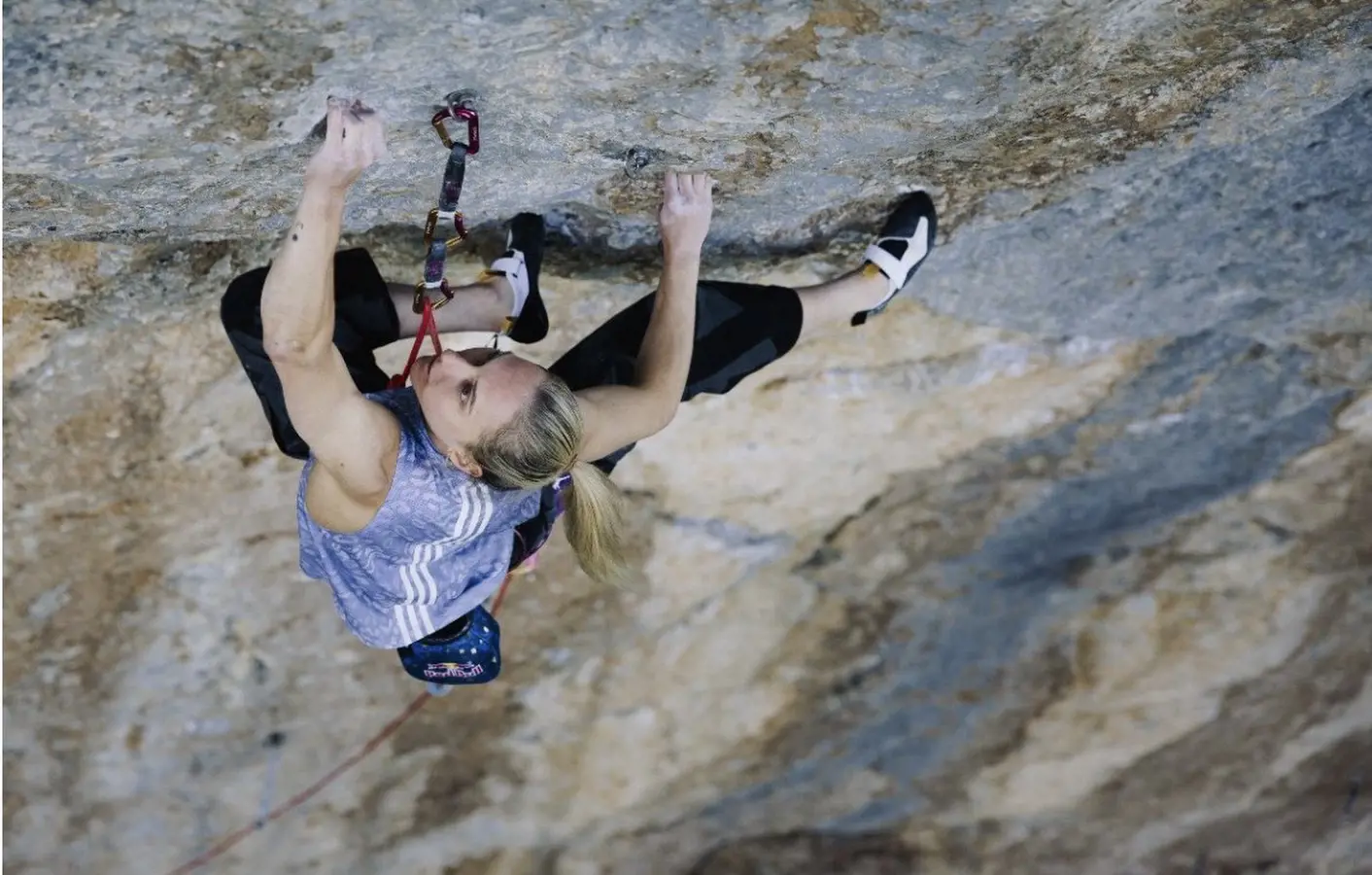
Fanatic Climbing reports that Julia Chanourdie, #5 in the World Cup last year, has done her second 9a, Molasseโ€™son in Mollans. Photo: Jocelyn Chavy "It has been a while some people were speaking to me about this crag of Mollans. I was there for the first time last October. from the beginning, โ€œMollasseโ€™sonโ€ inspired me a lot. This route is in a 45ยฐ overhang and maybe more in some parts. It could be broken in very intense parts of finger resistance between few rests. The hardest part is for me the start, very bouldery."

The graph shows the Google Trend female statistics based on Sports. Alex Puccio is rather superior and surprisingly Lynn Hill is second, well above Ashima Shiraishi and Janja Garnbret.

28th 8A+ by Isabelle Faus
Isabelle Faus has done Second Life 8A+ in Chironico and in the All Time Ranking game, she is #3. (c) Chad Greedy "First try second day, thought I would be able to do this quick, but its super long and the end gets hard! the first day was a bit cold and I kept numbing out, but yesterday was warm, and it felt a lot better ! psyched its awesome!!! did all the moves of great shark hunt in the dark afterwards... sharp but cool... the list is always growing."

Vertical-Life challenges with great prizes
Dani Me from Tyrol was the Vertical-Life raffle winner of a Rockbuster training camp with Klemen Becan. In total, 1 846 participated zlagging 36 399 climbs from one of the 38 gyms or 82 guidebooks that have published their topos in the VL App. In the April challenge you need to register 300 meters or 66 boulders to take part in the raffle with great prizes from Tendon. In the near future, all 8a users can take part in the raffle by recording climbs in their scorecards.

Zander Waller (14) jumps from 8b to 8c+
Zander Waller, #4 in the Youth WCH in 2017, skips 8b+ and 8c and does his first 8c+ through Lucifer in Red River Gorge and it only took him three sessions and seven tries in total. Here his Insta. "For the past few months I have been training very hard in the gym, and my jump from 8b to 8c+ actually took me by surprise. I've tried a couple of 8b+'s recently, but haven't put much effort into them. I feel like since I don't climb outside very consistently, that everytime I go, I get stronger from the weeks (or even months) of training in the gym. I'm not sure there is a certain way to jump from 8b to 8c+, but for me it took a lot of training and motivation. I think this year I would like to focus a lot of my attention into outdoor climbing, but my main focus is still on competitions."

Based on the official Similarweb statistics, we can see a very strong development in traffic for 8a during the last months since Vertical-Life started optimizing 8a.nu. What is unique with the 8a.nu traffic is that 88 % is direct meaning that the visitors have actually written 8a.nu in the browser. This figure is normally below 50 % for similar websites, meaning they get most of their traffic through Google Search or Facebook.

In 2016, you needed to participate in all three disciplines in order to get a Combined ranking and 44 points was enough to be #10 among the male. In 2017, 278 points was needed to be #20 as only one discipline was good enough to get a Combined ranking. Among the Top-20 male, six Speed climbers made the cut even if they just did Speed events. For 2018, it is not clear if you need to take part in one or three disciplines to take part in the Combined ranking. The Top-20 in the Combined World Cup in 2019 will participate in a qualification event where the Top-6 makes it to the Olympics. Based on previous World Cups, we can say that for sure 350 points will be good enough to be Top-20. In practice this means that possibly the Top-5 Speed specialists will make it through to the qualification event. Before the qualification event, there will be a Combined World Championship where the Top-7 (but max 2 from one country) will get their Olympic ticket. In practice, this could mean that almost all (non-Japaneses) that have gotten 350 points will make it to Tokyo. (Male: There might be 7 Japaneses and 3 Italians, Austrians or Russians etc in the Top-20 Combined World Cup 2019). With an increased number of participants in Lead and Boulder it could be that even 300 points is good enough for Top-20, increasing the number of Speed specialists getting an Olympic ticket. On the other hand, the Speed specialist will not have a chance to make it Top-7 in the Combined World Championship, meaning that, based on country quota, they are at greater risk for not making it. We assume that there are, in comparison, less Speed specialists that share the Top-5 results giving them a high overall score. On the other hands, among the boulderers and lead climbers, the results usually are far less uniform throughout the events also because the styles vary.

With a strong correlation in the results among the best in the three disciplines in Tokyo 2020, the best male Speed specialist could in theory get the silver just by touching the first hold in Boulder and Lead. The results from the last Combined Youth World Championships confirms the chance/risk for this to happen, although it is more likely that the best Speed specialist will become #7 or 8. The prediction is based on that there will be a couple male Speed specialists in Tokyo 2020. They will qualify through getting at least 300-350 points in the World Cup 2019 and then, in the Top-20 qualification special event, these guys could get their Olympic tickets by scoring 1 * 18 * 20 etc, as Japan and another country will fill their country quota already in the World Championship. In the Olympics, the multiplication score will be the same meaning that the speed winner might be Top-6. In the final, he would actually have a great chance of getting the bronze and he/she could in theory get the silver through scoring 1 * 6 * 6. In other words, in practice, the Speed specialist could totally skip training Boulder and Lead what so ever and still get a medal in Tokyo.