NEWS

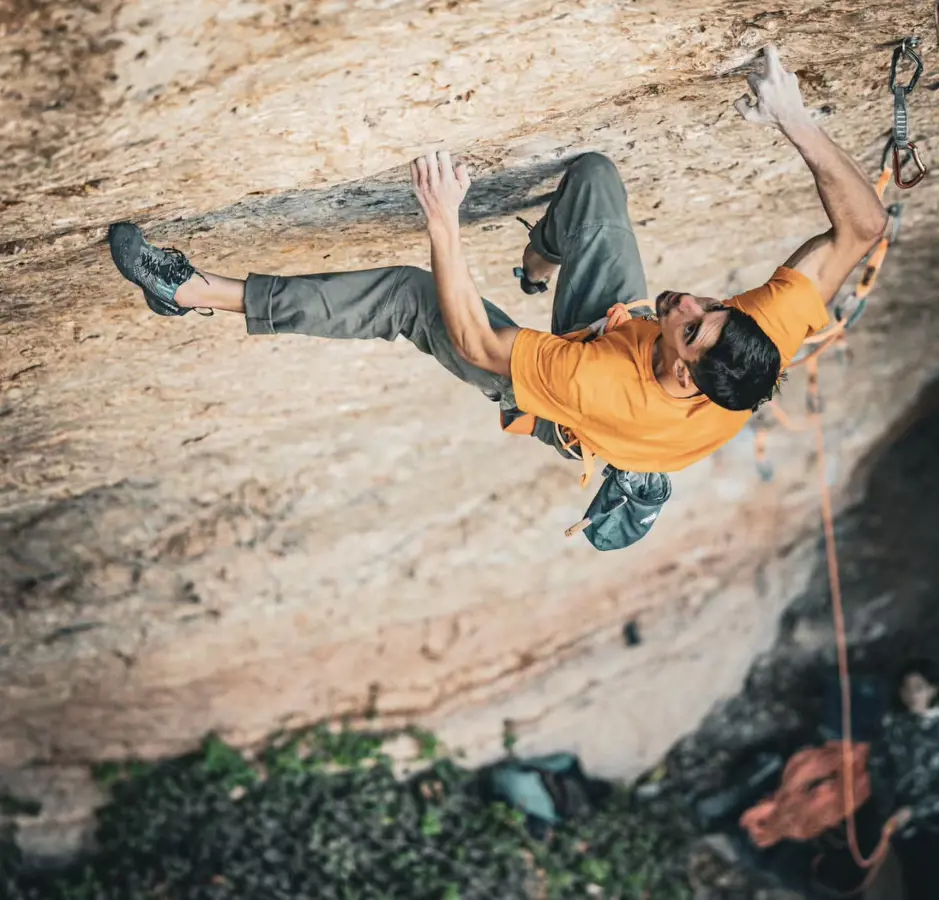
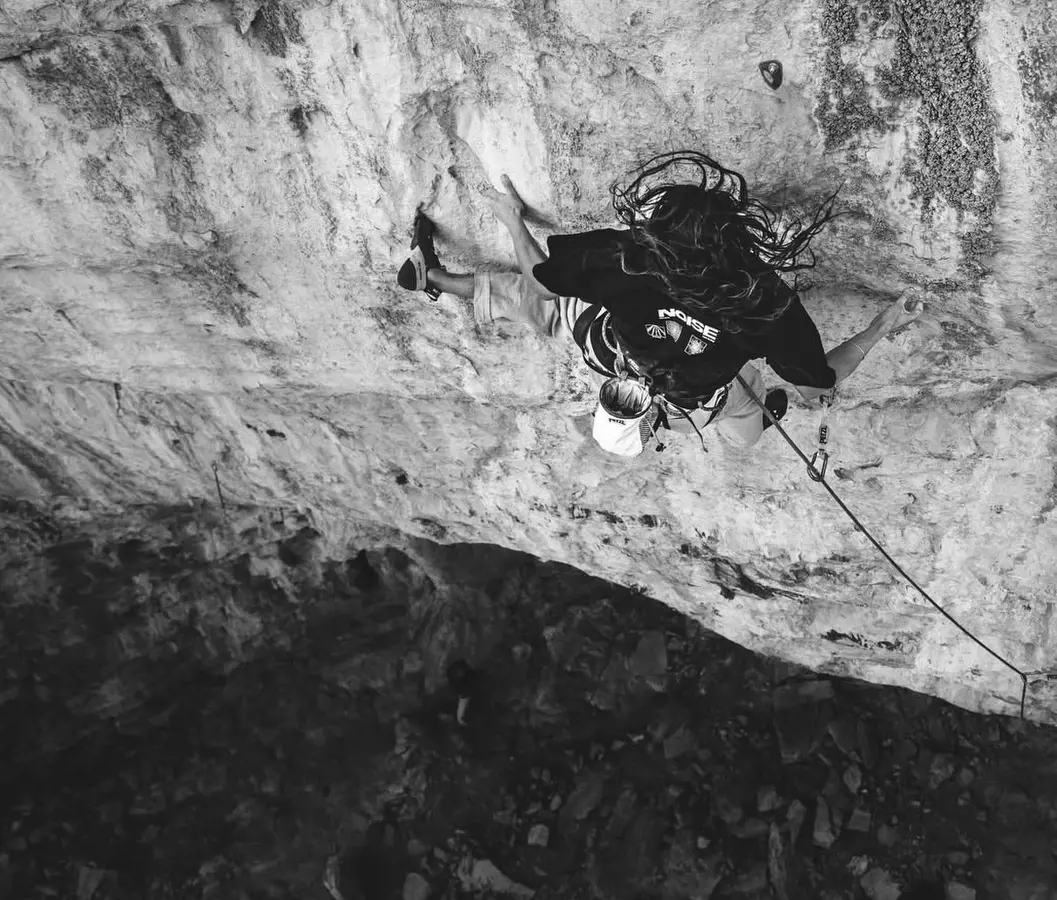
Pete Whittaker has done the second repeat of Nicolas Favresse's Recovery drink 8c+ in Jรถssingfjord, Norway after some 25 sessions. He started working on the big overhanging crack in 2015 and did it on his fourth trip. "I think it's generally considered to be 8c+, which seems to sit in line with all the other 5.14 trad routes I've done." Full story on Pete's Facebook. "Miraculously I found myself mid crux with some power in the tank. Not much, but some, and albeit feeling the sag, some is always enough for something extra to happen. Left heal went on for the match and it didnโ€™t come off, which was a surprise, because I was milking it much more than the hold really allowed. I realised I better carry on, so shut my eyes to try harder and fondled for the jam doughnut. I then realised I couldnโ€™t see a bloody thing, so opened them again, found I was still connected to the wall, flipped my hand the โ€˜correct wayโ€™ and unbelievably found myself established beyond the crux. Blimey!" What is next? I have the launch of my book 'Crack Climbing' this winter, so very focused on that. I also heard 'Silence' has a foot jam on it, so I might go and see if I can hang the move.

Four male Japaneses in Top-8
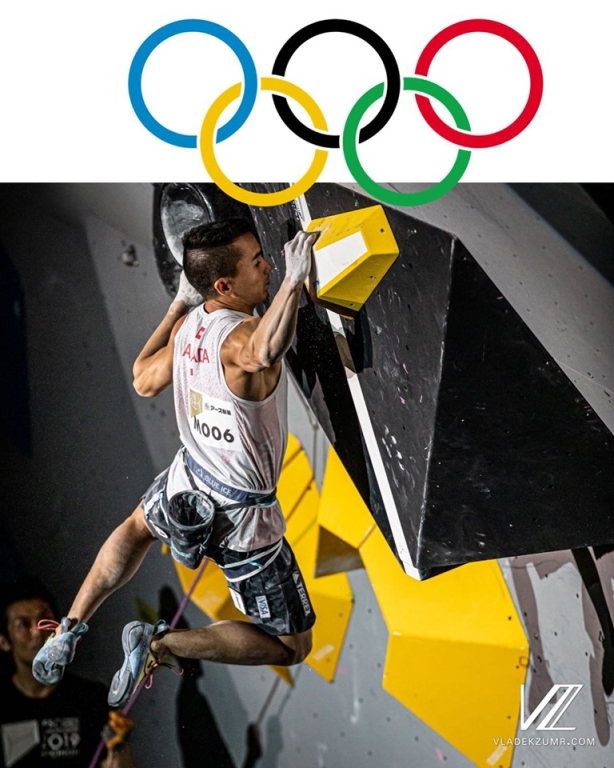
Big drama with the Ondra bolt incident in the end that including the multiplication format, as well as four Japanese into the final, just made it almost too much. Further more the commentators keep saying that Japan will select two to Tokyo which they can not know. In the end, it was Sean McColl who had a very poor round in both Speed and Boulder, who was the biggest lucky winner of an Olympic ticket. Sean started of with a Z-clip but kept on fighting and looked not so pleased falling being #3. Then every result of the remaining climbers did go exactly as they should. (c) Vladek Zumr Very lucky indeed was indeed also Ludovico Fossali, who although being dead last in both Lead and Boulder he got himself a ticket to Tokyo. 1. Alex Megos 17 - 1 - 1 = 17 2. Jakob Schubert 15 - 2 - 2 = 60 3. Tomoa Narasaki 4 - 4 - 7 = 112 4. Kokoro Fujii 5 - 7 - 5 = 175 5. Kai Harada 6 - 3 -13 = 234 6. Rishar Khaibullin 1 - 17 - 16 = 272 7. Meichi Narasaki 8 - 5 - 10 = 400 8. Mickael Mawem 83 - 8 - 18 = 432 Also getting an Olympic ticket 9. Ludovico Fossali 2 - 20 - 20 = 800 10. Sean McColl 18 - 15 - 3 = 810 Complete results

The commentators are doing a very great job describing the climbing and doing interviews etc. They are just improving and it is nice to see that they are so familiar with the athletes. What makes their job super hard is the lack of a digital scoreboard, especially with the multiplication format in Combined. The number of times they mislead the viewers are just endless, talking about what is needed to make the final etc. The Top-8 selection out of 20 will be around 400 points. This means that any winner of any discipline are almost certain to advance to the Top-8. Using this estimation it is quite easy to share speculations what is needed etc. When it comes to getting a bronze in the Top-8 final, we are talking like 24 - 64 points. This means that 1 * 8 * 8 most likely would make you fourth. The commentators should also talk to IFSC officials explaining rules and the format procedure so they do not continue to mislead the viewers.

During the Combined Speed Final there are 12 races out of which the battle of the #7 position has the least impact, i.e. a factor 1.14 difference in your overall score. This can be compared to the final battle in between #1 position where the difference is 2. During the first round where you are decided to become 1 - 4 or 5 - 8 the average result is 2.5 verses 6.5, i.e. 2.6 factor difference. One example of this is the race in between Futaba Ito, #2 in the qualification and Shauna Coxey #7. Futaba was ahead until she slipped and Coxsey was the lucky winner. In all other rounds, Futaba was much quicker compared to Coxsey, however Futaba ended #5 and Shauna #2, i.e. 2.5 difference in the multiplication format. It is kind of strange that when the Ai Mori and Akiyo Noguchi were about the battle of the #7 position, the commentators marketed it to have "massive impact of the rankings" at the same time this superlative was not used for any other of the 12 races. The commentators said that if you made a false start in any of the rounds but the last run, you would end up as #8. This should not be true but if it is, the rule must be changed.

The big sensation in the Speed was that Shauna Coxsey was second and being third in Boulder she is currently #1. "Incredible unexpected" was Shauna's first word in IFSC mini-interview. 1. Shauna Coxsey 2 - 3 = 6 2. Akiyo Noguchi 7 - 1 = 7 3. Aleksandra Miroslaw 1 - 8 = 8 4. Janja Garnbret 6 - 2 = 12 5. Miho Nonaka 4 - 4 = 16 6. Petra Klingler 3- 7 = 21 7. Futaba Ito 5 - 6 = 30 8. Ai Mori 8 - 5 = 40 Unfortunately, the route setters made a big mistake again and on the third and last boulder nobody were not super close to secure the zone. As a matter of a fact, most did actually struggle to move of the ground and only few times we saw the first big mantle move being done. In total, there were almost 45 minutes with just minimal action including also the Speed specialist trying to do the first move on boulder 2. It should be mentioned that the two first boulders were perfect with plenty of action separating all climbers. As it stands, if we assume that Janja will win Lead, she will win at 12 points. In theory, all the others can get on the podium excluding Aleksandra who realistically needs some miracle like disqualification etc.

Based on the Olympic selection rules, Akiyo Noguchi will be Japan's selection. "The seven (7) highest placed athletes per gender at the World Championships will be allocated one (1) quota place, respecting the maximum quota per gender per NOC." The quota place is allocated to the athlete(s) by name. For some reason the commentators think that Japan could select another female just because they also were among the Top-7. However, as Akiyo is the "highest" ranked Japanese, then the runner-up can not be chosen as Japan has only only max quota gender per quota. Further more, Japan has one host spot meaning that they can pick anyone they want.

Janja Combined World Champion being faster
Janja Garnbret is the Hachioji Combined World Champion after topping out the Lead route faster than Ai Mori. Also Akiyo Noguchi touched the top but could not hold it meaning she lost the title as she had climbed faster than Janja. Third was Shauna Coxsey who has become also one of the best route climbers in the world. Repeating Adam Ondra's mistake standing on a bolt, Coxsey dropped from fourth to seventh in Lead which in practice did not change her overall score. Fourth was Speed specialist Aleksandra Miroslaw who understandably was dead last in both Boulder and Lead. It should be mentioned that it is most likely that also during the Olympics, she or another Speed specialist will be fourth although being dead last in both Boulder and Speed. (c) Vladek Zumr 1. Janja Garnbret 6 - 2 - 1 = 12 2. Akiyo Noguchi 7 - 1 - 3 = 21 3. Shauna Coxsey 2 - 3 - 7 = 42 4. Aleksandra Miroslaw 1 - 8 - 8 = 64 5. Miho Nonaka 4 - 4 - 5 = 80 6. Ai Mori 8 - 5 - 2 = 80 7. Futaba Ito 5 - 6 - 4 = 120 8. Petra Klingler 3 - 7 - 6 = 126 Complete results

As has been said before, two zones would create a better Boulder competition during the Olympics and Hachioji just confirms this. 1. The Speed specialists performances are understandably very weak. However, it becomes almost embarrassing when they have problems moving from the start hold and are a miles from even getting close to get a zone. As there will most likely be at least two male and two female Speed climbers in Tokyo scoring zero, surely they as well as the spectators would very much benefit from a second zone. 2. As there is just three boulders in the Combined final, it is very hard to separate the remaining seven climbers especially as we can see that the route setters are having a greater time finding the right level. 3. Ai Mori performed the best on the over-cooked boulder but did not score anything for that. If she would have gotten an extra zone for this, she had moved from #5 to #2 in bouldering and from #6 to the bronze

Big technical incident decided one Olympic spot?
Rishat Kaibullin, who set a personal best being #7 in Speed last week, slipped as he went for the buzzer and hit the wall like 30 cm below the electronic device which anyhow recorded 6.075. The Kazakhstan understood he failed so he went up again and hit it like one second later. It was decided that this was a technical incident and five minutes later he run again and set a personal best at 5.863. Then the big pressure was on the Speed World Champion Ludovico Fossali, who executed but was 0.026 slower. It should be mentioned that also during the standard Speed event, Rishat was super lucky as he was #7 at 7.013 just because his opponent, Bassa Mawem the World Cup leader, did fall. At the same time, Fossali was even more lucky becomming the World Champion as in all his four runs, his opponents did either fall or make a false start. The twist of the whole story is that even if Rishat, #34 ranked in the Speed World Cup, is dead last in both Boulder and Lead he will most likely get an Olympic ticket as he luckily won Speed. On the other hand, being #23 as a personal best in a Bouldering WC and #41 last week, he is possibly the most overall talented climber among the best Speed climbers.