NEWS

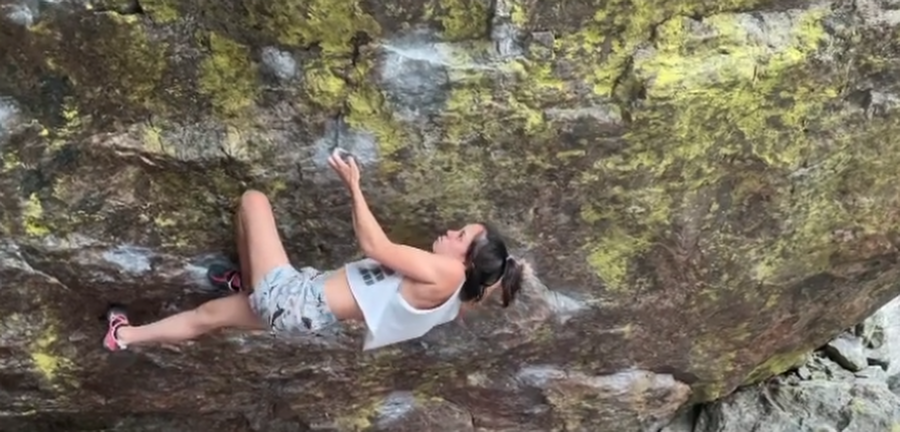
Jade 8B+ by Katie Lamb
Katie Lamb has repeated Daniel Woodsโ€™ Jade 8B+ in RMNP after some seven sessions and she is #4 in the female ranking game." I came to Colorado with weak fingers but a strong mind. I knew I could ramp with the moon cycle and then it would be my jah day on Jadรฉ. So heppy! Holy shit. A final gift from the alpine. Battling another crimping testpiece with duke... special mems." The picture is from a screenshot from a video published on her Insta. (c) Duke Lettieri, who sent it a couple of days ago.

Several of the Speed specialists have skipped all or most of the World Cups in 2021. Probably, they have never trained and focused on Speed as much as in the last year. At the same time, we have seen several male world records and very fast times by the females, and most have set PBs. When it comes to the lower-ranked in Lead and Bouldering, it is easiest and fastest to progress in Speed. Almost all guys have pushed their personal best to at least 6.5 seconds and for the females, many have done below 8.5 during practice.

On the other hand, making a false start on the first run means that you are disqualified also for the second run so most will make sure to wait more than 0.1 seconds after the signal before they start. If you start earlier than 0.1 seconds after the signal, you will automatically be disqualified. This is kind of strange as there is, as opposed to in for example running 100 meters or swimming, no randomness in when the signal comes. Instead, the starting signal has rhythmic pre-signals which make it possible to predict exactly when the signal is coming - hence, it should be feasible to climb before 0.1 seconds after the signal without cheating.

Here are some examples of best-case scenario happenings that would showcase sport climbing and make also non-climbers watching future World Cup live-streaming.

Janja Garnbret doing a triple dyno in Bouldering swinging out facing the camera could become one of the highlights of the Olympic. This clip would be shown over and over again in television and would quickly get 10 million views on YouTube.

If she later in the final is the only female topping out, she could be crowned one of the very big stars in Tokyo, especially if she is Top-2 in Speed.

For the males, one best case scenario could be if the last climber out needs to Top out faster in order to win overall. Imagine Adam Ondra pushes hard and screams his way to the Top making some extreme knee-drops, and tops out one second faster.

In Speed, there will be new world records set in the qualification heat where two Speed specialists run neck on neck.

In bouldering, the setters create boulder where the climbers face the camera doing spectacular moves and the last guy out secure the win on the last boulder.

The big dilemma for the Lead route setters is that the audience, especially the non-climbers, want to see Tops. For climbers who top, however, ranking is decided by who climbed faster. From a fairness perspective, it is good that there will be no spectators at the venue, meaning that the climbers waiting will hopefully not know if the route was topped. In any case, most probably some Olympians will climb faster than normal as also ties earlier on the route will be ranked based on who reached the scoring fastest.

I have asked the chief route setter, Adam Pustelnik, if they have gotten any instructions from IFSC for how to deal with the โ€œTops/Tiesโ€ dilemma. Adam said, logically, that he cannot comment on internal matters.

โ€œI would say that weโ€™ve already had combined competitions and weโ€™ve experienced how it works, but from the route setting I would just repeat itโ€™s not like 1+1. You can never know what will happen and itโ€™s the athletes who are the key players here. They perform and showcase our sport. We try to prepare the stage for them the best we can. In general in Lead, we always try to have a good split between the competitors. As the nature of the job is that itโ€™s hardly predictable, itโ€™s not always that we arrive with such. But we always try our best.โ€

It should be mentioned that in the Combined Championships, the Olympic selection was often decided by who climbed fastest to the top.

1 August 2021

Nonaka documentary

Great 36 min interview with Adam Ondra where he says Tomoa Narasaki is the favourite to win as he says he has no talent for Speed Climbing. Interestingly, Adam also says that he will not do any competition for a year after the Olympics as he has sacrificed so much only been training and being programmed for Tokyo for over two years.

The multiplication format creates dramatic preconditions for Climbing in the Olympics. After only some 30 minutes of the first qualification day, it will pretty much be decided who among the Speed specialists will be #4 or #5 in the final. Such an overall score, you will mathematically get by multiplying 1*20*20 in the qualification and 1*8*8. In theory, Tomoa Narasaki could beat all Speed specialists and if so, he will most certainly also win Speed in the final, creating a crucial advantage over Adam Ondra & Co.

It is expected that most Olympians will play it rather safe in the first Speed run as a false start means you are disqualified from doing a second run. On the other hand, especially the Speed specialists starting last will probably partly base their strategy on what is needed to be #1. directly from the first race.

When it comes to Bouldering, the starting order is probably set up by the reversed order to the qualification seeding, i.e. Narasaki and Janja Garnbret will start last. This is normally a disadvantage as the friction will deteriorate due to the chalk etc. Viktoria Meshkova starts #2 which is an advantage. Among the males, Colin Duffy starts as #3 and Adam Ondra as #10.

The biggest chance for an outsider to make good results occurs in bouldering. Sometimes the route setting benefits certain athletes and there is a bigger element of luck in bouldering compared to Speed and Lead. In the final, there will be only three boulders and thus many will score the same number of tops.

Finally, the uncertainties of the athletes' current shape must be mentioned. Almost all of the 40 Olympians have just done a limited number of comps, or none at all, in 2021. It would be sensational if any of these would take a medal as just training is not ideal preparation.

The biggest chances of creating a surprise are; Great Speed progress by Ondra, Coxey back in great shape in Bouldering, YueFei Pan progress in all three disciplines and of course any of the lower-ranked having focused on Speed challenging the specialists.

Team USA brought a mobile wall
During the last five days before the competition starts, the Olympians are allowed some practising in all disciplines. In Lead, there are four training routes and for three days the athletes have two tries with a six-minute time limit until Saturday. Then the routes are taken down.

Every day until Monday, the climbers have also some time slots to try the Speed wall and some set boulders. It should be mentioned that several athletes, including the Russian except Rubtsov, have chosen to fly in just two days prior to the comp.

Interestingly is also that team USA brought a mobile wall which they have set up inside their Olympic village. With kind of limited climbing training during the last days, this could be an advantage for the athletes used to climb for several hours a day, also few days prior to a comp.

Janja Garnbret the big favourite to win
Janja Garnbret was 2 - 2 - 3 in her three first Lead World Cups at age 16 in 2015. Since then she has won most of the comps she has entered in Lead and Bouldering. In Speed her PB is 7.92 which is best among all the non-Speed specialists. (c) Daniel Gajda/IFSC

Most probably the 22-year-old Slovenian will score 2 * 1 * 1 = 2. It will be sensational if her multiplied score is 10 or more. Her biggest risk would be doing a false start or slip in the first final race in Speed meaning her best result will be #5.

In bouldering anything can happen but even so, only an injury could put her outside the Top-3. In Lead, there are always a risk standing on a bolt or forgetting a clip etc and that would be her only risk not being Top-3.

In other words, she could score 5 * 3 * 3 = 45 points but then we are talking a mental break down due to some very bad luck in the qualification. What strongly talks against this is that it seems she has handled defeats great before. She just loves climbing and the challenging it creates and are happy even if she does not top out.

In reality, the only way Janja will only be runner-up is probably some bad luck in combination with Chaehyon Seo does her best Bouldering and Speed of her life. In Lead, she won over Janja four times out of six in 2019 when the Korean was 15-years-old.