
NEWS
29 March 2022
Babsi Zangerl and trad ethics
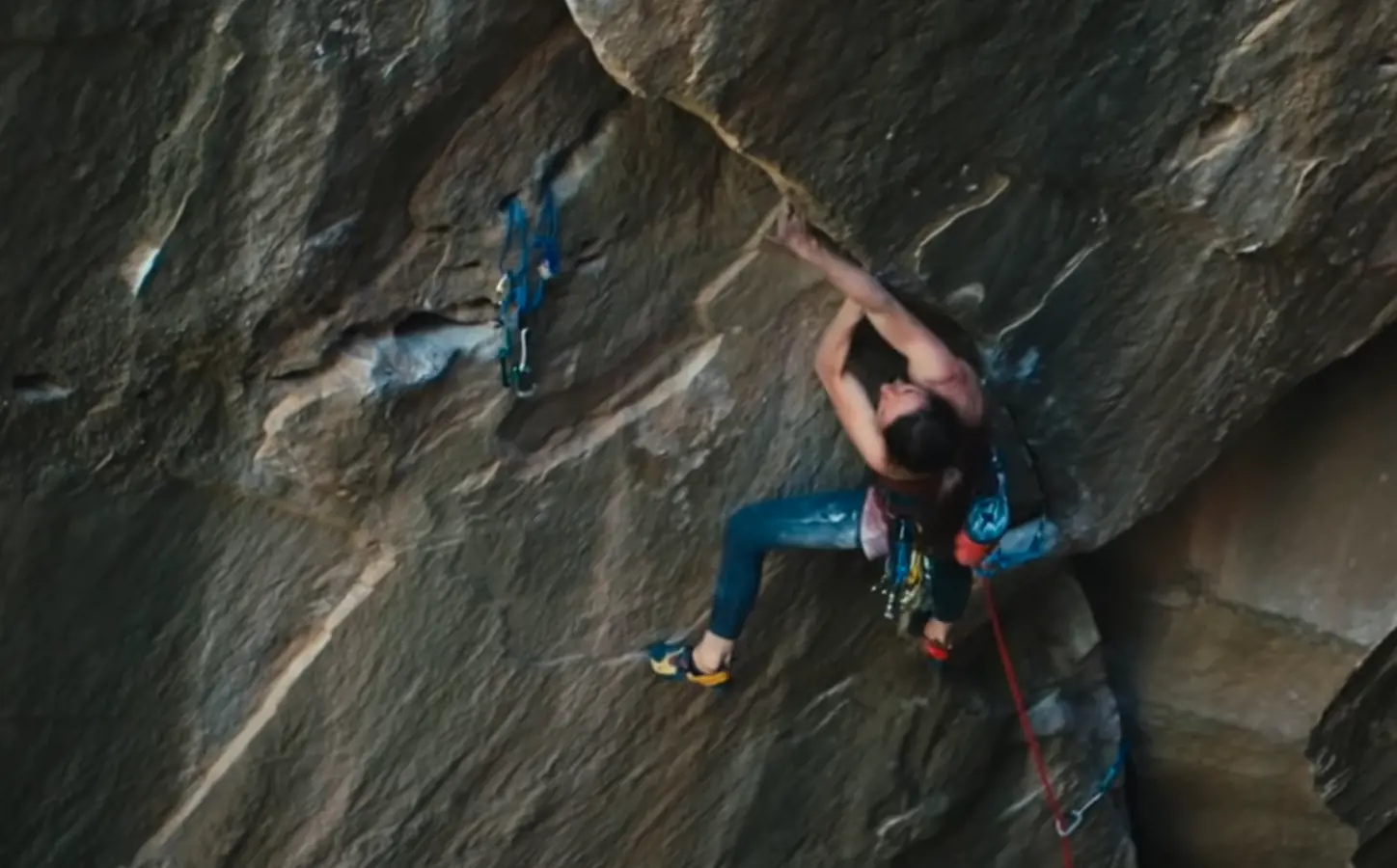
Barbara Zangerl has been one of the leading female trad climbers for 10+ years and when it comes to multi-pitch climbing the 33-year-old Austrian is among the most accomplished, independent of gender. Trad ethics have been developed and shared over the years but there are no fixed rules etc. Ethics can often vary between different locations and there is also a grey zone of what is allowed. Babsi was kind enough to share her opinion on the sometimes delicate questions. The origin of the talk comes from her latest video where she does Le Voyage 8b+, using the pre-placed threads (slings) that FA James Pearson left. "In general I think… all options are open you just have to be honest about how you approached a climb…"
How do you create such fixed slings and why?
You put a sling through two connecting pockets and then a knot 🪢. It is called sanduhr in german. Like connecting holes in the rock, where you put a sling through. You can do that while climbing as well, but often that kind of protection is fixed on some routes. I guess it was James who put them there. Also on Muy Caliente and some other routes in Pembroke or other places, there are fixed slings like that… especially on face climbs. Of course, on crack climbs you don’t need or find anything like that
Everybody should decide on their own! I repeated „Le Voyage" with the same ethics that the FA used. It is not a hard sequence where you clip the fixed slings on Le Voyage—it is where you can take a big rest.
What about pre-placed cams and nuts?
I think that a clean ascent should be without pre-placed gear. Placing gear takes time and sometimes it can be even tricky to place gear while climbing. So it adds some difficulty to a route I would say. If everything is pre-placed, you are faster and don’t lose any power for taking the time to place gear. So it makes a difference if you climb a line pre-placed or place all the gear while climbing.
What about placing gear and then down climb and then continue to use this as fixed protection?
I start climbing and place the gear while climbing. I never tried down climbing to have the gear placed before I do a real try. But I guess that is ok as well. But I think it doesn’t really help. It even makes it more complicated, I would say. It depends if the down climb is hard or super easy.
What about fixed pitons and removable beaks etc? Does it make it a "mixed" route?
I know there are some routes in Europe/US where there are old rusty pitons. They are still called trad lines… so I guess that is ok. As long as you don’t hammer in a new one, which is questionable. Beaks are aid climbing gear and trad climbers often use them as protection. You can put them into very small cracks… You can place it while climbing on a clean line… or you can hammer it into the crack.
Would such protection still be included in the clean trad ethics?
Yes, if you place them while climbing, not using a hammer. If they are pre-placed it is not clean anymore. But, probably still a trad climb if there is one old beak or piton from back in the days.
What about replacing an old rosty piton?
I would say no… but there are lines that are mixed… and you should ask the people who put up the route…. Before you change anything. In the Dolomites, there are many alpine routes with super old gear on them. Some stay like that forever and some get new pitons. In the past they were safe routes but now, probably not anymore. You can take a hammer and hammer lose pitons in again; I think that is ok… but for placing new ones you should always discuss with people who put up the line.
What about having a safety rope on the side or at the top ready if the climber wants to bail out?
Nope… this is not something that you want to use on trad.
What about protecting trad climbs with crash pads?
I think it is all fine… you just have to mention it.
8a.nu is about to publish an article about an 8c+ route in which you, on relatively easy terrain, clip two bolts but then it goes on natural gear. Should this be considered trad or mix... I mean, let us say somebody makes the first 9a+ "trad" climb in such style, I do not think you should call it the hardest trad route in the world? It is a grey zone again? Should it be published as a trad or a mixed climb ;) ?(Journalist dilemma)
It can be a trad line… but I would definitely say that there are two bolts and it is not completely clean. It is mostly trad but there is a sequence where you clip bolts.
How do you create such fixed slings and why?
You put a sling through two connecting pockets and then a knot 🪢. It is called sanduhr in german. Like connecting holes in the rock, where you put a sling through. You can do that while climbing as well, but often that kind of protection is fixed on some routes. I guess it was James who put them there. Also on Muy Caliente and some other routes in Pembroke or other places, there are fixed slings like that… especially on face climbs. Of course, on crack climbs you don’t need or find anything like that
Everybody should decide on their own! I repeated „Le Voyage" with the same ethics that the FA used. It is not a hard sequence where you clip the fixed slings on Le Voyage—it is where you can take a big rest.
What about pre-placed cams and nuts?
I think that a clean ascent should be without pre-placed gear. Placing gear takes time and sometimes it can be even tricky to place gear while climbing. So it adds some difficulty to a route I would say. If everything is pre-placed, you are faster and don’t lose any power for taking the time to place gear. So it makes a difference if you climb a line pre-placed or place all the gear while climbing.
What about placing gear and then down climb and then continue to use this as fixed protection?
I start climbing and place the gear while climbing. I never tried down climbing to have the gear placed before I do a real try. But I guess that is ok as well. But I think it doesn’t really help. It even makes it more complicated, I would say. It depends if the down climb is hard or super easy.
What about fixed pitons and removable beaks etc? Does it make it a "mixed" route?
I know there are some routes in Europe/US where there are old rusty pitons. They are still called trad lines… so I guess that is ok. As long as you don’t hammer in a new one, which is questionable. Beaks are aid climbing gear and trad climbers often use them as protection. You can put them into very small cracks… You can place it while climbing on a clean line… or you can hammer it into the crack.
Would such protection still be included in the clean trad ethics?
Yes, if you place them while climbing, not using a hammer. If they are pre-placed it is not clean anymore. But, probably still a trad climb if there is one old beak or piton from back in the days.
What about replacing an old rosty piton?
I would say no… but there are lines that are mixed… and you should ask the people who put up the route…. Before you change anything. In the Dolomites, there are many alpine routes with super old gear on them. Some stay like that forever and some get new pitons. In the past they were safe routes but now, probably not anymore. You can take a hammer and hammer lose pitons in again; I think that is ok… but for placing new ones you should always discuss with people who put up the line.
What about having a safety rope on the side or at the top ready if the climber wants to bail out?
Nope… this is not something that you want to use on trad.
What about protecting trad climbs with crash pads?
I think it is all fine… you just have to mention it.
8a.nu is about to publish an article about an 8c+ route in which you, on relatively easy terrain, clip two bolts but then it goes on natural gear. Should this be considered trad or mix... I mean, let us say somebody makes the first 9a+ "trad" climb in such style, I do not think you should call it the hardest trad route in the world? It is a grey zone again? Should it be published as a trad or a mixed climb ;) ?(Journalist dilemma)
It can be a trad line… but I would definitely say that there are two bolts and it is not completely clean. It is mostly trad but there is a sequence where you clip bolts.
Read more
2
029 March 2022
Emilie Gerhardt doing Wrestling... 8B
Read more
2
029 March 2022
Nick Bradley does The Game 8C
Read more
1
029 March 2022
Ondra does an 8b+ slab
Read more
1
0Pierre Délas has been an influential climber on the french climbing scene for 20+ years, although just being 41-years-old. He started out by writing articles in Grimper magazine and later wrote on the internet for Kairn.com. In 2015, he started Fanatic Climbing mainly covering the french climbing scene. For 15 years he is also on the board for one of the most active climbing clubs/gyms in France (Massy) when it comes to competition climbing. Furthermore, he is interested and concerned about access and ethics in climbing and here is a great article on these subjects. (c) Sam Bié (First Pierre sent over a picture from an 8c but later commented. “I am sorry but you should not publish that picture as climbing ethics say you should only publish pictures of sent routes ;)”.
Could you please say something about your climbing background?
I started climbing in 1991 in Toulouse, southern France at 11. I was lucky, my middle school had the first indoor climbing wall in the city. I first climbed outside in 1993 and became addicted in my teenage years, at the end of the 90s. My father would bolt new routes during the week and let me bag the FAs at the weekend. I also climbed with a lot of people around Toulouse, especially some strong locals like retiring Eric Siguier, Robyn Erbesfield and Didier Raboutou. Now I’ve been living in a Paris suburb for the last 15 years but with my girlfriend, we rock climb on our numerous vacations, and I try to go to Font as often as possible between trips. My goal is to climb the hardest I can every day and outside as much as I can throughout the year. In my best years, I manage to climb approximately 150 days outside.
What are the biggest positive and negative changes on the scene over the years?
For me, the biggest positive changes are the training tools and indoor walls, the increase in level and also the many hardcore crags developed around the world. The facilities/accommodations that have appeared this past quarter of a century also give us a huge playground with a lot of King Lines everywhere. Other improvements in my view are the current marginalisation of chipped holds as well as the amount of information and content you can find about rock climbing. It’s pretty striking now compared to 2 decades ago.
The negatives changes are, again in my opinion, the lack of curiosity regarding climbing cultures and environmental impacts, which are more and more lost and ignored by the climbing world. Also, ethics is often unknown or questioned, like the use of fans in bouldering now. For me, taking care of nature and ethics, develop a curiosity about what is done in climbing should be the pillars of our practice. For example in Font using brushes and telescopic booms, cleaning our feet on mats, cleaning the boulder before leaving, taking care of the rock, having an idea of the main ethical rules such as proper stand/sit starts from the ground and not a big crashpad, not staying at carparks overnight, not lighting fires or climbing at night because it’s strictly forbidden. An example for rock climbing, buying the local guidebook when I plan a trip. I see a lot of people who don’t know or don’t care, just climbing for their own outside of all other considerations like they do when indoor training or shopping. It’s definitively not the practice I experienced at the beginning. We are now a rather large community and climbing has become an object of instant consummation with a lot of gyms, brands, gears, Olympic Games and so on.
In my opinion, we act outdoors more and more like consumers, like we climb at the gym and therefore don’t care about what’s around, local problems or restrictions, nature conversation. We just want to climb and go home having tried some routes and ticked some sends like after any training session. The result is marginalising the process and uniforming the experience. The development of social media also generates a weird thing: every climber can do their self promotion, where ‘be the hero’ replaces ‘be aware of the climbing world’. Besides with all the vlogs and videos of climbing, especially in bouldering, everyone is exposed to questionable habits, like climbing with speakers on, at night, using fans, dabs, cheating beta or without any clue, wearing kneepads at all times, which goes to show that the emphasis is squarely on the performance aspect and none of the rest. I can’t say ‘it was better in the past’, but I can clearly state that I find sportclimbing values quite different now. And I don’t exclude myself from the lot, because we have our responsibility in the content we publish as climbing media.
What can be done and how do you see the future ?
I hope for a change in the mentalities, with more consideration for the context. We should try to kickstart a new (i-e old) approach. For example, educate the younger generations more, or do more for nature. Spread more content about climbing culture/spirit and the significance of looking after nature. Who developed the place where I’m currently climbing? What was the vision here? What are the local climbing rules ? Is the area where I climb fragile? What does ‘good behaviour’ mean for a rock climber in nature? What can I do in order to minimise my impact as a climber when I climb outdoors? What about my carbon footprint? I think the future of climbing should consider these aspects first. Our rocks and our history are very important and we need to preserve our heritage as long as we can. If we don’t act all will be polished, dirty or forbidden in a few decades. It’s quite a pessimistic report, but at a time when climate change is starting to really bite, it’d be good to open our eyes and ask the right questions.
Could you please say something about your climbing background?
I started climbing in 1991 in Toulouse, southern France at 11. I was lucky, my middle school had the first indoor climbing wall in the city. I first climbed outside in 1993 and became addicted in my teenage years, at the end of the 90s. My father would bolt new routes during the week and let me bag the FAs at the weekend. I also climbed with a lot of people around Toulouse, especially some strong locals like retiring Eric Siguier, Robyn Erbesfield and Didier Raboutou. Now I’ve been living in a Paris suburb for the last 15 years but with my girlfriend, we rock climb on our numerous vacations, and I try to go to Font as often as possible between trips. My goal is to climb the hardest I can every day and outside as much as I can throughout the year. In my best years, I manage to climb approximately 150 days outside.
What are the biggest positive and negative changes on the scene over the years?
For me, the biggest positive changes are the training tools and indoor walls, the increase in level and also the many hardcore crags developed around the world. The facilities/accommodations that have appeared this past quarter of a century also give us a huge playground with a lot of King Lines everywhere. Other improvements in my view are the current marginalisation of chipped holds as well as the amount of information and content you can find about rock climbing. It’s pretty striking now compared to 2 decades ago.
The negatives changes are, again in my opinion, the lack of curiosity regarding climbing cultures and environmental impacts, which are more and more lost and ignored by the climbing world. Also, ethics is often unknown or questioned, like the use of fans in bouldering now. For me, taking care of nature and ethics, develop a curiosity about what is done in climbing should be the pillars of our practice. For example in Font using brushes and telescopic booms, cleaning our feet on mats, cleaning the boulder before leaving, taking care of the rock, having an idea of the main ethical rules such as proper stand/sit starts from the ground and not a big crashpad, not staying at carparks overnight, not lighting fires or climbing at night because it’s strictly forbidden. An example for rock climbing, buying the local guidebook when I plan a trip. I see a lot of people who don’t know or don’t care, just climbing for their own outside of all other considerations like they do when indoor training or shopping. It’s definitively not the practice I experienced at the beginning. We are now a rather large community and climbing has become an object of instant consummation with a lot of gyms, brands, gears, Olympic Games and so on.
In my opinion, we act outdoors more and more like consumers, like we climb at the gym and therefore don’t care about what’s around, local problems or restrictions, nature conversation. We just want to climb and go home having tried some routes and ticked some sends like after any training session. The result is marginalising the process and uniforming the experience. The development of social media also generates a weird thing: every climber can do their self promotion, where ‘be the hero’ replaces ‘be aware of the climbing world’. Besides with all the vlogs and videos of climbing, especially in bouldering, everyone is exposed to questionable habits, like climbing with speakers on, at night, using fans, dabs, cheating beta or without any clue, wearing kneepads at all times, which goes to show that the emphasis is squarely on the performance aspect and none of the rest. I can’t say ‘it was better in the past’, but I can clearly state that I find sportclimbing values quite different now. And I don’t exclude myself from the lot, because we have our responsibility in the content we publish as climbing media.
What can be done and how do you see the future ?
I hope for a change in the mentalities, with more consideration for the context. We should try to kickstart a new (i-e old) approach. For example, educate the younger generations more, or do more for nature. Spread more content about climbing culture/spirit and the significance of looking after nature. Who developed the place where I’m currently climbing? What was the vision here? What are the local climbing rules ? Is the area where I climb fragile? What does ‘good behaviour’ mean for a rock climber in nature? What can I do in order to minimise my impact as a climber when I climb outdoors? What about my carbon footprint? I think the future of climbing should consider these aspects first. Our rocks and our history are very important and we need to preserve our heritage as long as we can. If we don’t act all will be polished, dirty or forbidden in a few decades. It’s quite a pessimistic report, but at a time when climate change is starting to really bite, it’d be good to open our eyes and ask the right questions.
Read more
27
1028 March 2022
C'était pas assez tassé 8c by Amandine Loury
Amandine Loury, who started 2022 by sending her first 8A+ boulder, has done C'était pas assez tassé 8c In . Previously she has done one 8c+ and seven 8c's and her big goal according to her Insta: Objectif 👉 9a
"C’était pas assez tassé is a connection and to sum up, you do all the hard section of « Illégitime engeance 8b/+», then a crux with a big move to the right and you finish in the pumpy section of Cétacé 8b+. I did some tries last year and I have finished the process this year. One day, after my sport teacher workday, I went to Saint léger. I had 2h30 before the night for climbing. So after two routes for warm-up, I did a try and I sent it. It took me about ten sessions in all."
What are your next plans?
In May I would like to try Mollasson 8c+/9a in Mollans. I hope to have opportunities to try it. For this summer, I do not really have a plan for the moment. I think return to La Roche Moutche for bouldering and climbing in the Hautes Alpes. I would like to try again San Kukai (8c+), but like Mollasson, I don’t know if I will have the opportunity to have a belayer in Entraygues 😅.
"C’était pas assez tassé is a connection and to sum up, you do all the hard section of « Illégitime engeance 8b/+», then a crux with a big move to the right and you finish in the pumpy section of Cétacé 8b+. I did some tries last year and I have finished the process this year. One day, after my sport teacher workday, I went to Saint léger. I had 2h30 before the night for climbing. So after two routes for warm-up, I did a try and I sent it. It took me about ten sessions in all."
What are your next plans?
In May I would like to try Mollasson 8c+/9a in Mollans. I hope to have opportunities to try it. For this summer, I do not really have a plan for the moment. I think return to La Roche Moutche for bouldering and climbing in the Hautes Alpes. I would like to try again San Kukai (8c+), but like Mollasson, I don’t know if I will have the opportunity to have a belayer in Entraygues 😅.
Read more
4
128 March 2022
Super Circo Abusivo 9a by Luca Bana
Luca Bana has repeated Berni Rivadossi's Super circo abusivo (9a) in Paline. "It was one of the unfinished business I left behind on that perfect wall, after the first ascent of "Abusive Love" in 2018. Then, this month I decided to get back to give it some tries, as the conditions were simply great. Since I already knew the main sections, the process for the send has been easier and quite fast, managing to clip the chains on my 4th session of work. For sure a high-level must-do!"
Read more
5
027 March 2022
Gypsy Blood 8c+ and JoeDan 8c+ (9a) by Domen Skofic
Domen Škofic, overall Lead WC winner in 2016, has spent the last six weeks mainly climbing in Santa Linya. In the last few days he has done Gypsy Blood (8c+) and JoeDan 8c+ (9a). "I definitely agree to be 9a. Especially without kneepads." (c) Jonathan Siegrist
How come you do not use kneepads? Have you ever tried to adapt to this style?
I like to climb as free as possible and if I feel like I can do a route without a kneepad I prefer to do it that way even if it takes longer to send. I believe that as long as I compete, this climbing style doesn’t help me much.
How was the process taking down the two 8c+' and what happened to your big 9b project?
My power went down the last two weeks and I just wanted to have more fun on the last days before I leave. I actually had to stop trying Stoking the Fire (9b) 3 weeks ago because my knee was getting to painful at the dropknee crux at the bottom. Actually my best attempts were on my first week of coming to the cave and then I felt like I’m doing no progress but I decided to keep on trying. It’s hard for me to project on one thing for more than a week but I want to learn this. I admire people that can stay super focused on one route and make progress. Since my knee started to hurt I switched my focus to and I hoped my knee will get better for Stoking. I feel tired from being in the cave that long but I’m motivated to try hard the last two days and I will be very happy if I can finish Catxasa before I leave.
How do you compare Stoking... 9b with the first 9b you did (Ali Baba sit start extension)?
They are not even close. But I do believe that Stoking is a very hard 9b. Before coming to Spain I was even considering going for either Stoking or Perfecto Mundo because I think this two are not too far apart. Catxasa without kneepad is much harder than Ali Hulk that’s for sure 😅
How come you do not use kneepads? Have you ever tried to adapt to this style?
I like to climb as free as possible and if I feel like I can do a route without a kneepad I prefer to do it that way even if it takes longer to send. I believe that as long as I compete, this climbing style doesn’t help me much.
How was the process taking down the two 8c+' and what happened to your big 9b project?
My power went down the last two weeks and I just wanted to have more fun on the last days before I leave. I actually had to stop trying Stoking the Fire (9b) 3 weeks ago because my knee was getting to painful at the dropknee crux at the bottom. Actually my best attempts were on my first week of coming to the cave and then I felt like I’m doing no progress but I decided to keep on trying. It’s hard for me to project on one thing for more than a week but I want to learn this. I admire people that can stay super focused on one route and make progress. Since my knee started to hurt I switched my focus to and I hoped my knee will get better for Stoking. I feel tired from being in the cave that long but I’m motivated to try hard the last two days and I will be very happy if I can finish Catxasa before I leave.
How do you compare Stoking... 9b with the first 9b you did (Ali Baba sit start extension)?
They are not even close. But I do believe that Stoking is a very hard 9b. Before coming to Spain I was even considering going for either Stoking or Perfecto Mundo because I think this two are not too far apart. Catxasa without kneepad is much harder than Ali Hulk that’s for sure 😅
Read more
5
227 March 2022
Prince of Thieves 8A by Isabelle Gibbs
Isabelle Libbe has done Prince of Thieves (8A) in Joe's Valley (UT). "Mentally demanding more than physically. Probably light in the grade but it suited me well. Regardless, a stellar section of rock."
What is your climbing background?
I grew up in the Midwest climbing indoors. Competed in the youth series but never got great results. At 18 I started sport climbing outside a lot, mostly in the Red River Gorge. This past fall I sent my first 8b+ route, Omaha Beach. I recently moved to Los Angeles and have been checking out all the climbing areas out west. I’ve generally focused on sport climbing but recently have tried to progress in bouldering so decided to spend two weeks in Joe’s Valley.
Could you please say something about how you took down your first 8A?
On the first day of the trip, I sent my first 7C+. The last couple of days of the trip I started trying Prince of Thieves. Perfect sandstone crimps up a tall face to an insecure top out with a bad landing and friction slab to finish. It fit my style well except for the fear factor. I bailed off the top my first day not able to commit. On the third day I tried the moves on top rope and sent first go from the ground. One of the best in Joe’s and my hardest boulder to date!
What is your climbing background?
I grew up in the Midwest climbing indoors. Competed in the youth series but never got great results. At 18 I started sport climbing outside a lot, mostly in the Red River Gorge. This past fall I sent my first 8b+ route, Omaha Beach. I recently moved to Los Angeles and have been checking out all the climbing areas out west. I’ve generally focused on sport climbing but recently have tried to progress in bouldering so decided to spend two weeks in Joe’s Valley.
Could you please say something about how you took down your first 8A?
On the first day of the trip, I sent my first 7C+. The last couple of days of the trip I started trying Prince of Thieves. Perfect sandstone crimps up a tall face to an insecure top out with a bad landing and friction slab to finish. It fit my style well except for the fear factor. I bailed off the top my first day not able to commit. On the third day I tried the moves on top rope and sent first go from the ground. One of the best in Joe’s and my hardest boulder to date!
Read more
3
025 March 2022
Ghisolfi tries Midtbö's 9c test
Read more
4
0Favorites
Janja Garnbret has added another milestone to her remarkable climbing career by becoming the first woman to climb Bibliographie (9b+) in Céüse, one of the harde…
362
48
Jorge Diaz-Rullo reports on Instagram that he has made the first ascent of Cafe Colombia in Margalef. At 27, he’s already stacked four 9b+ sends and now he’s ad…
286
81
”I stopped focusing on competition bouldering after last year’s World Cup in Prague, partly because I can already feel it on my body, especially in my shoulders. The modern competition style, with a lot of jumping from one hold to another, is very demanding for the shoulders.
Outdoor bouldering is…
189
13Most commented
Jorge Diaz-Rullo reports on Instagram that he has made the first ascent of Cafe Colombia in Margalef. At 27, he’s already stacked four 9b+ sends and now he’s ad…
286
81
Sean Bailey reports on Instagram that he has done the first ascent of Duality of Man (9c) in Dry Canyon. ” After four total years and three seasons of climbing,…
163
69Jorge Diaz-Rullo elaborates on the reasons for him to suggest 9c for Café Colombia on Instagram, which he took down last week after projecting it for 240 sessio…
119
63