NEWS

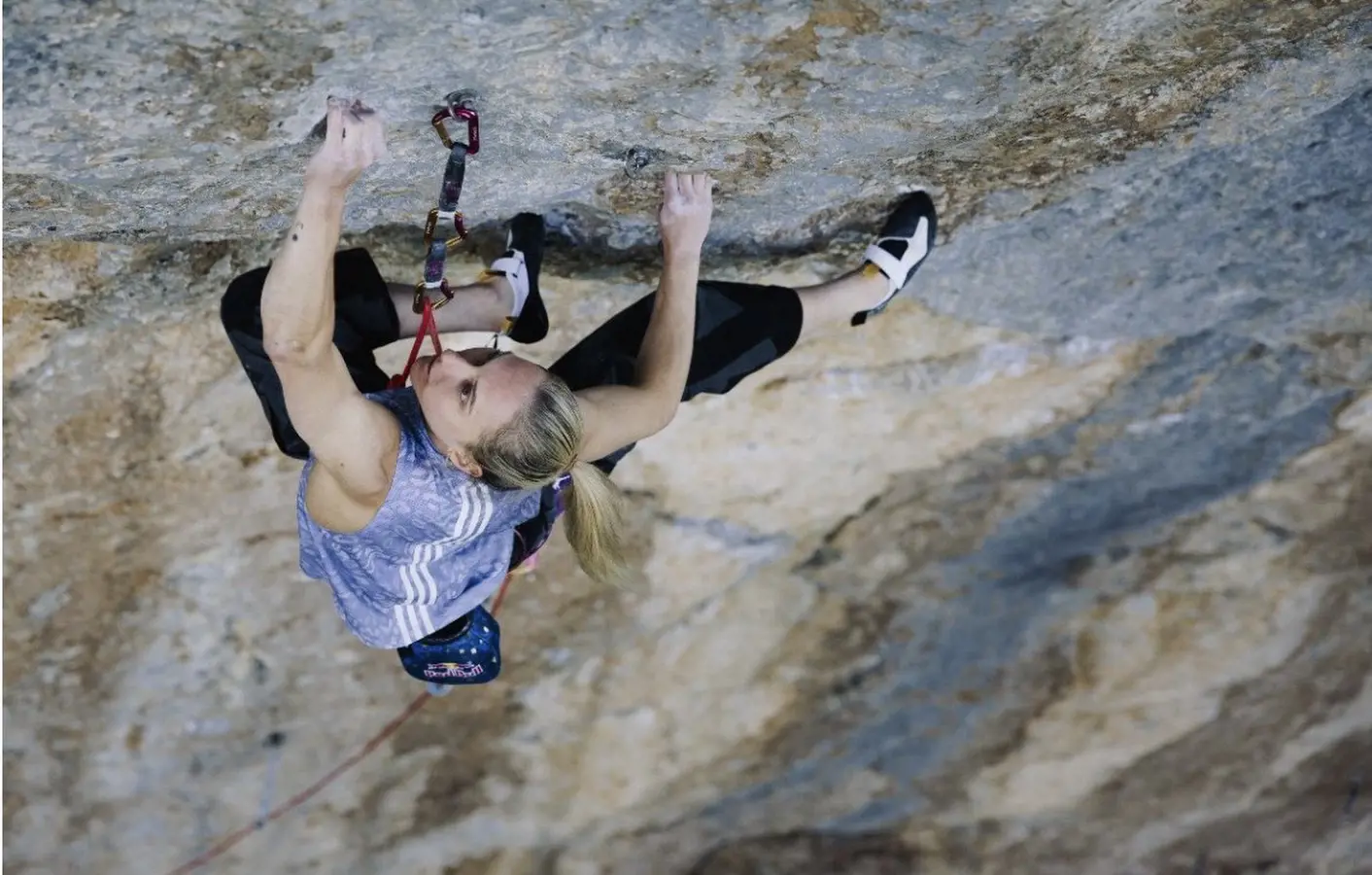
Jungfraumarathon (9a) by Solveig Korherr
Solveig Korherr, who did her first 9a in 2021, has sent Jungfraumarathon in Gimmelwald. โ€A dream route! One of the best feelings how it all came together & every day on this route over the last two and a half weeks felt better and better thanks to refining beta and perseverance. (5 days last & 9 days this year) Thanks John & Lulu for the best time up here!โ€ (c) John Thornton

Can you tell us more about the ascent?
I first tried โ€žJungfraumarathonโ€ (9a) last year for two or three weekends. I was immediately really psyched and felt quite good on it, but I stopped trying it when I injured one of my fingers.

This year, I wanted to eventually come back to it. I was quite nervous before trying it again because I didnโ€™t focus on sport climbing the last half year as I usually do. I was bouldering during the winter, did some trad climbing in between, and mainly did some shorter sport climbing routes in the Basler Jura. I wasnโ€™t sure what to expect, and I couldnโ€™t tell if I was in shape.

The first time I got on the route this trip, I was surprisingly shocked at how good all the singles moves felt. I felt much better than last year. From this point on, I was totally committed to the route. I was climbing one day on, one day off, which I have never done before. The style in Gimmelwald is very powerful and demanding. I had to rest a lot which was sometimes quite hard for me mentally. ๐Ÿ˜„

Over the last two and a half weeks, I optimized my beta, learned the moves a lot better, and gained more endurance. Every day I felt better on it, and I was falling higher and higher. On the day I sent it, everything felt perfect, and I did it on my first try. Iโ€™m really happy to see how Iโ€™ve improved on this powerful climbing style over the last few years.

What does a normal week look like when it comes to training/climbing for you?
I just worked for one year for my sponsor SCARPA Germany with marketing and planning events. I mainly trained in the gym during the week and climbed outside on the weekends. For now, Iโ€˜m taking some time off and I will spend the next few months climbing outside.

Can you tell us more about those summer plans?
Iโ€˜m planning to spend two months in France and climb in La Ramirole & probably Pic Saint-Loup as well. Iโ€˜m really staring to get into this steep & powerful climbing and Iโ€˜m psyched to check out these two places.

Francesco Berardino sent Off the Wagon Sit (8C+) last month and now the video has been released. Here is the 8a article where commented his ascent.

Quentin Guillen goes straight to 9a with Condรฉ de choc
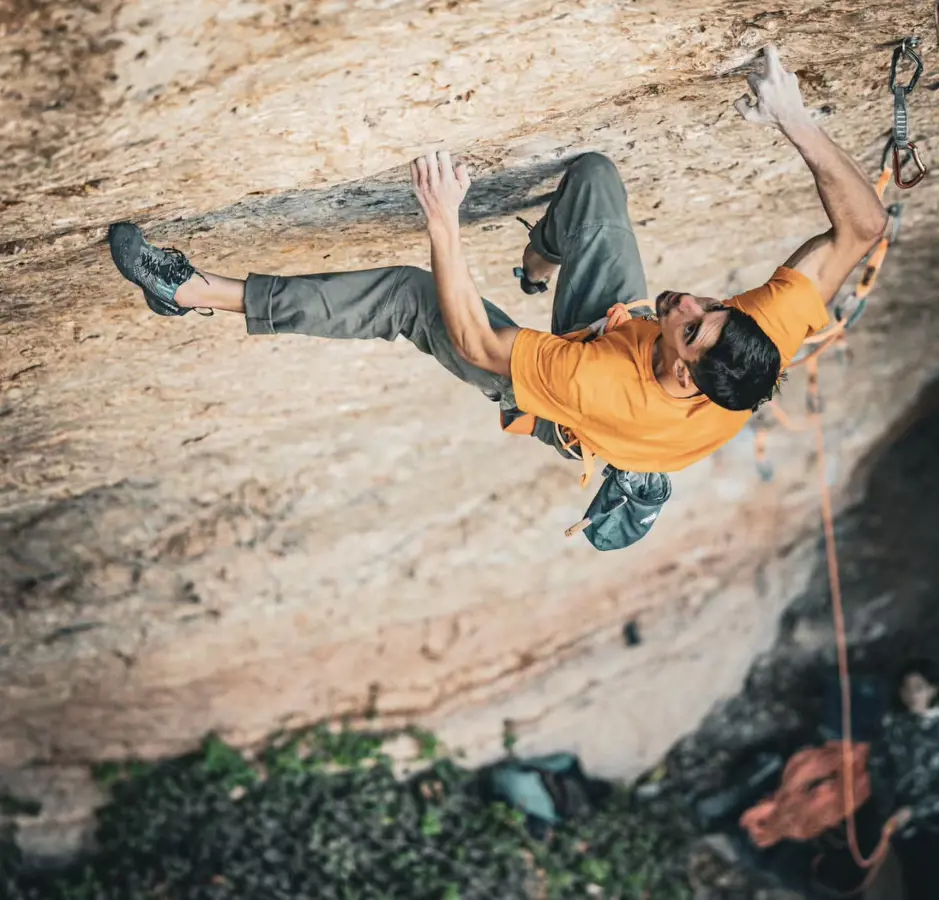
Quentin Guillen has done Condรฉ de choc (9a) in Entraygues, after trying it for three weekends.

Can you tell us more about your send and skipping 8c+?
So this year I trained with the goal to take my ticket for the lead world cup with the French team. It was a long time I didn't compete due to some injuries (2 pulley rupture the last two years). As I totally missed my selective competition, because I was too stressed, I took a 3 weeks break from climbing after this.

When I started climbing again I choose to go outdoors to try a hard route and challenge myself. First I wanted to try La moustache qui fรขche (9a+) because it is my climbing style (short endurance on crimps with a lot of overhang). But, when I came to Entraygues it was wet. My friends Justin Dechamps et Adrian Houbron had just sent Condรฉ de choc (9a). This motivated me to try this route.

The two first weekends trying Condรฉ were pretty hard because it was raining all the time so conditions were not good. On the last day of the second climbing trip I fall in last move of the first crux. I knew I should not fall in the second part of the route so it was pretty frustrating. During the third weekend the conditions were really good.

I fell 4 times at the last move of the first crux the first day, in the second day I pass the first crux at my first try of the day but my hand slipped at the end of the route. I was pretty tired and I knew I just had one last good try before coming home, I managed to climb the first crux but It was so hard I almost fall at every move of the first crux but finally I could sent it.

What is your climbing background?
I started climbing at 10-years-old in my little climbing club. I started compete pretty quickly. With some good results I could join the Pรดle Espoir Voiron at age 16. I have always been a plastic climber training every time for the competition. Sometimes i go outdoor to do some routes pretty quickly (8b/8b+) but I never try real projects.

The last 3 years were really complicated for me with the covid (no training structure ) and 2 broken pulley in 2021 ans 2022 (3 months off and 6 months of reeducation each time). But now my pulleys are feeling good and I want to try hard at the crags too! I'm so happy with the sent of "Condรฉ" but I know it was just the beginning and I'm sure I can do harder !

Elnaz Rekabi sheds some light on her return
Elnaz Rekabi has been competing actively since 2007, and in 2021 she took the bronze in the Combined World Championship. In the last two weeks, she has made her first World Cups appearances (Brixen and Innsbruck) since 2019. (c) Vladek Zumr

How was the Innsbruck Boulder World Cup?
I had 3 Tops and 2 close to the top but because the holds are new for me and I wasnโ€™t sure if that hold was good or not so I just had a little doubt which got me out of semi-final. I became #23. The facilities for training are very important for competitors, the Olympics have made this sport more professional and results are very sensitive and dependent on many different variables that affect our performance.

I felt stronger than before on the wall but I need more competition to find my best mindset and shape again for getting better results. It's too bad that it was the last bouldering World Cup of the season and I donโ€™t have more chances. But it's part of my lifestyle, my way and Iโ€™m hopeful for getting more valuable things along the rest of my climbing life.

What are your upcoming competition plans?
I will do the Lead World Cup in Villars and then go back home. Then there is the World Championship, but it's not clear whether I will get a visa or not, because we have a difficult process for getting a visa.

Do you get financial support for travel and stay in Europe?
No, I paid [this trip] myself. Part of that is my savings from the competitions which I won before and part of that is from my working as a coach. I train from 10am to 2pm and then the rest of the day I work as a coach until 10 pm. But, the NOC (National Olympic Committee in Iran) promised to support me after coming back to Iran. All I want is to train and keep my Olympic dream alive.

Drew Ruana can't stop sending!
Drew Ruana reports on Insta that he has had his most productive week ever sending three 8C's, out of which two are FA's, plus two 8B+. In 2019, he was #8 in the World Championships. Since missing the cut to make it to the Olympics, the 23-year-old chemical engineering student has evolved into one of the best boulderers in the world. In total, he has over the last three years done more than 100 boulders 8B+ and harder including nine graded 8C+. Here is an 8a interview - Progress take patience

Can you take us through this record week you had?
Friday - Railway 8C
Saturday - Hummingbird 8C FA
Tuesday - Let the right one in 8B+ (pictured)
Thursday - Aggressive Behavior sit 8B+ Friday - Church channel sit 8C FA
Iโ€™ve tried them all a lot and they just clicked, Iโ€™ve been feeling really strong lately.

What are your summer plans?
More cleaning up and hard boulders, close to doing all the hard ones, 14 or harder, in Co. even the obscure ones.

Chocolate Jesus (8B) by Katie Lamb
Katie Lamb has done Chocolate Jesus (8B) in Wild Basin. Overall, the 25-year-old has done 20 boulders 8B and harder and for almost three years she has been #1 in the 8a ranking game. (c) Keenan Takahashi

Can you tell us more about the ascent and the number of sessions needed?
Itโ€™s one of the best Iโ€™ve done in Colorado and climbs really well! The line is really good and itโ€™s a cool setting. I hiked up to it maybe 4 times but it was too wet to try the end for the first two days.

Isabelle Faus made a spring-time, low-profile ascent of, Spidey (8B+) in Clear Creek Canyon. The 30-year-old, who did her first 8B+ in 2015, has now done seven, and says on Youtube that she thinks this one is the hardest boulder she has ever done. "Spidey gets harder with every move, the first half is v9, then a few moves of v11 climbing, and ending with a hard v13. It looks long but def more of a power boulder than an endurance climb." The roof boulder which Griffin Whiteside put up finishes with a very dynamic 360 rotation.

Cintia Percivati, 40, does her first 8c+
Cintia Percivati has sent Cosi Fan Tutte (8c+) in Rodellar after only projecting if for three days plus a few attempts in 2019. (c) Esteba Degregori @verticalexplora

Congrats on your first 8c+! When and where did you start climbing?
I entered the world of mountaineering and traditional climbing at the age of 18. Later I learnt about sport climbing and I felt that both styles completed me. For 10 years I dedicated the summer seasons to climbing in the mountains of Chalten, Patagonia, where I made important ascents, the first Argentinian female team to Fitz Roy (2012) among others. The rest of the year I traveled in search of sport climbing. Many trips were through Spain, in which I always grew in grade, but I also always had to return to my country.

In 2019 I visited Mallorca, Oliana, Basque Country, where I did my first 8c (White Zombie), and then Rodellar. We climbed the last 5 days of my trip in Cosi fan Tutte, before going to the Barcelona airport. An experience that left me surprised and excited since on the 4th and 5th day I fell very high, in the last crux of the 2nd pitch. That same year my club (CABA) supported me with another ticket to Spain. I went to Villa Nueva de Rosario, to try โ€œla Rubiaโ€ a route with the same qualities as Cosi.


But I had similar luck... I was able to try it for about 4 or 5 days, managing to get quite high before falling. And then the rain came and I could no longer try it, I had to go to another place. That year I had reached my best performance in sports, and the following year the pandemic, work at home, injuries and the guide course Trekking took me away from my best performance. Last year I decided to dedicate myself firmly to trying to reach my limit in sports. With 40 looming over me and a different body but with the conviction that I could achieve it, I reached 8c again with a route in Bariloche (Alita de Mosca).

This year, I finally got Spanish citizenship, I achieved some economic stability that allows me to live in Spain and bet on my project, one more degree. I started the trip in Rodellar, a place where I have always been very well received. Thatโ€™s when I got in tune, several 8b came out on the day, and another 8c.

And when I was about to leave, Sergio Casteran told me to go to Cosi fa Tutte. The project that I was thinking of trying later, but luckily it flowed, since in two days I was remembering it and on the 3rd day it came out.

Now Iโ€™m here to try the next project, but only to see what itโ€™s all about, since itโ€™s too hot to climb in this area. We will go with my friends to climb in Asturias and in the spring hopefully I can try the next step :).

Alex Megos' talks kneebars, onsighting and comps
Alex Megos, runner-up in the Innsbruck Lead World Cup, (c) Jan Virt, has been one of the best climbers in the world for almost 15 years, both outdoors and on the competition scene. In 2009 and 2010, he won ten out of eleven Euro Youth Cups. In 2013, he became the first person to onsight a 9a with, Estato Critico. In 2012, he returned to the competition scene after five years and won the silver in the Euro Bouldering Championship and then, participating in his first Lead WC, he won. In the Tokyo Olympics, he was #9 and his last podium was in Briancon last year. When it comes to 9a routes and harder, he has done around 100 including two 9b+ FAs.

What is your take on knee pads and grading?
I have four different kneepads and I try to adapt to the progression of the sport although I am still not the biggest fan. I think it is important to respect the FA and I try to repeat routes in the same style. If it gets easier with a knee pad you have to be honest and possibly give it a new grade. Two grades are of course an option but it is difficult to draw the line. On a route like First Round First Minute (9b), you can use so many knee bars, if you are skilled, so there are not so many moves remaining to the original [ascent]. Margalef is a specific case with all the pockets, and different body types and sizes of fingers can create also new knee bar options and moves, that others can not do even with knee pads.

Can it be that all the knee baring creates new strength and skills that even if you just use say jeans, you can repeat an old route in easier fashion also without knee pads?
Yes of course! Domen [Skofic] repeated a 9b in the Ali Baba cave not using the knee pads but he probably took advantage of some new knee bars anyway. It is a tricky question and I try to adapt.

Why do you think there is little progress with onsighting for the new young generation?
Possibly due to all videos. It is easy to start scrolling and then you lose the onsight possibility. I also think that the media and the sponsors do not focus on onsight meaning that many just start projecting a 9a instead of playing the onsight game. Furthermore, if you are not tall enough it is almost impossible to onsight hard. This might create frustration for the kids.

What about your Olympic preparation and training?
I have not focused as much as I should on my training. During this summer I will only be focusing on indoor training but last winter and this spring I was more into the outdoors. I will see what happens with the 2024 selection. I am in the Olympic program and get financial support every month. I am not so psyched travelling around with only this objective. I like training and doing competition-style boulders and simulations but it is hard during the summer. I sweat a lot during the summer and looking at a competition like this, [Brixen] my fingertips are all wet.

Francis Sanzaro: "Confidence is overrated"
Francis Sanzaro is a lifelong climber and former editor-in-chief of Rock and Ice magazine. Check out his The Zen of Climbing to read more of his thoughts. His The Boulder: A Philosophy for Bouldering is on its second edition. (c) Jess Rueppel

Confidence is overrated in all sports, especially in climbing, and Iโ€™m going to tell you why. Not only that, when you start to climb with less confidence, you will climb harder, get frustrated less, and start to focus on the things that actually help you climb. Who doesnโ€™t want that?

The reason we think we need to be confident is because we are not really confident, and so we genereate self-talk, such as โ€œyou can do this,โ€ โ€œyou got this,โ€ and so on. With self talk, we mask weakness. We compensate. We fill ourselves up with positivity, but we are doing so out of a deep sense of โ€œI canโ€™t,โ€ fear, nerves or anxiety. Or a mix of all of them. Filling yourself with positive thoughts has the same effect as filling yourself up with negative thoughts. And thoughts donโ€™t help climbers.

Doing moves efficiently, without higher-order cognitive functions creating blockages in our minds, helps climbers. Blockages are what prevent intuitive reactions and execution. One paper, published in Scientific Reports, found that when athletes try to think and exercise at the same time, the ability to do both is compromisedโ€”we lose cognitive capacity and muscular performance. The loss, however, is uneven: muscles suffer the most. Muscular ability decreases 13 percent, compared to very small losses in mental function. A loss of 13 percent means you are falling on your project.

As it turns out, you donโ€™t need positivity or negativity to climb hardโ€”you donโ€™t need the โ€œI canโ€™tโ€ and you donโ€™t need the โ€œI can.โ€ You donโ€™t need the โ€œIโ€ at all. What you need to do is let your body do the work and allow your mind to work as freely as possible, across all of your limbs (without blockages). Self talk, like that of confidence, gets in the way of execution and blocks your mind from going where it needs to be.

As the sports psychologist theorist Ken Ravizza has noted, โ€œconfidence is overrated.โ€ On the day he became the first person to flash a 5.15a/9a+, Adam Ondra later said in an interview that: โ€œI lacked the confidence Iโ€™d hope Iโ€™d have.โ€ Ondra said this about the hardest flash in history, a type of climbing most people think requires the highest level of confidence.

Time and time you hear top climbers saying that on the day the sent, they felt bad. Shawn Raboutou on Megatron (V17): โ€œIt didnโ€™t feel like a good day. Like I didnโ€™t think I was going to do it.โ€ Or Stefano Ghisolfi on the second ascent of Change (9b+), โ€œYou know when there is the feeling that everything is perfect. The day is perfect. The weather is perfect. Well, it was not that day ... I really didnโ€™t know what to expect from this attempt, so I just kept climbing and kept going.โ€

Ondra, Ghisolfi, Raboutou, and so many others sent because they had a value-neutral mindset. They had little confidence in the day, or themselves on that attempt. They expected little, so they just climbed. Itโ€™s good beta, and Iโ€™ve found it to be true in my own climbing (hence, The Zen of Climbing). However, for the record, there are studies that show confidence can be beneficial in athletes, but when you really get down to it, the practices and methods for cultivating various confidences feels like constant patchworkโ€”since confidence is a fickle thing, we need to manage it all the time. And thatโ€™s exhausting.

But thereโ€™s another approach with a very long and successful historyโ€”that of avoiding positivity and negativity. Zen, samurai warriors, and many other classes of philosophy and sports psychology testify to just this. When you have confidence, you set up a duality, and with every ying, thereโ€™s a yang. An athlete only needs to add confidence when they are, unconsciously or not, judging themselves, as it is in this act of self-judgement that the need for positivity originates. In one of the foundational books on sports psychology, Timothy Gallwey writes about tennis: โ€œClearly, positive and negative evaluations are relative to each other. It is impossible to judge one event as positive without seeing other events as not positive or as negative. There is no way to stop just the negative side of the judgemental process. To see your strokes as they are, there is no need to attribute goodness or badness to themโ€ฆEnding judgement means you neither add nor subtract from the facts before your eyes. Things appear as they areโ€”undistorted. In this way, the mind becomes calmer.โ€

A calm mind doesnโ€™t judge oneself. A calm mind climbs harder.

Movement is neither good nor bad. You donโ€™t need confidence to climb hard routesโ€”you need to train, execute and keep a clear head without distraction. These three things alone are all you need. If it is in your bodyโ€™s ability to do a route, pumping yourself full of positive talk isnโ€™t going to make a difference. On the other hand, you can convince yourself all day that you canโ€™t ride a bike, but when it comes times to ride a bike, you are going to if you know how. You donโ€™t need confidence or overconfidence. Overconfidence creates gaps in attention, making you drop your guard and botch the sequence. When you are overconfident, you donโ€™t try hard enough. Maybe your mind is at the chains while your body is at the crux. Researchers on sport psychology, Sian L. Beilock and Thomas H. Carr, note the negative effects of confidence-distraction: โ€œThis shift of focus changes what was single-task performance into a dual-task situation in which controlling execution of the task at hand and worrying about the situation compete for attention.โ€

You never want a situation when your attention is split. A climber needs to execute. When complexity is introduced, thought is introduced, and when this happens, your ability to execute is diminished. For any athlete, body is first material. This doesnโ€™t mean you donโ€™t use your mind. Rather, you just have to learn to use mind differently.