
NEWS

3 March 2016
PUC micro periodization training with Adam Ondra
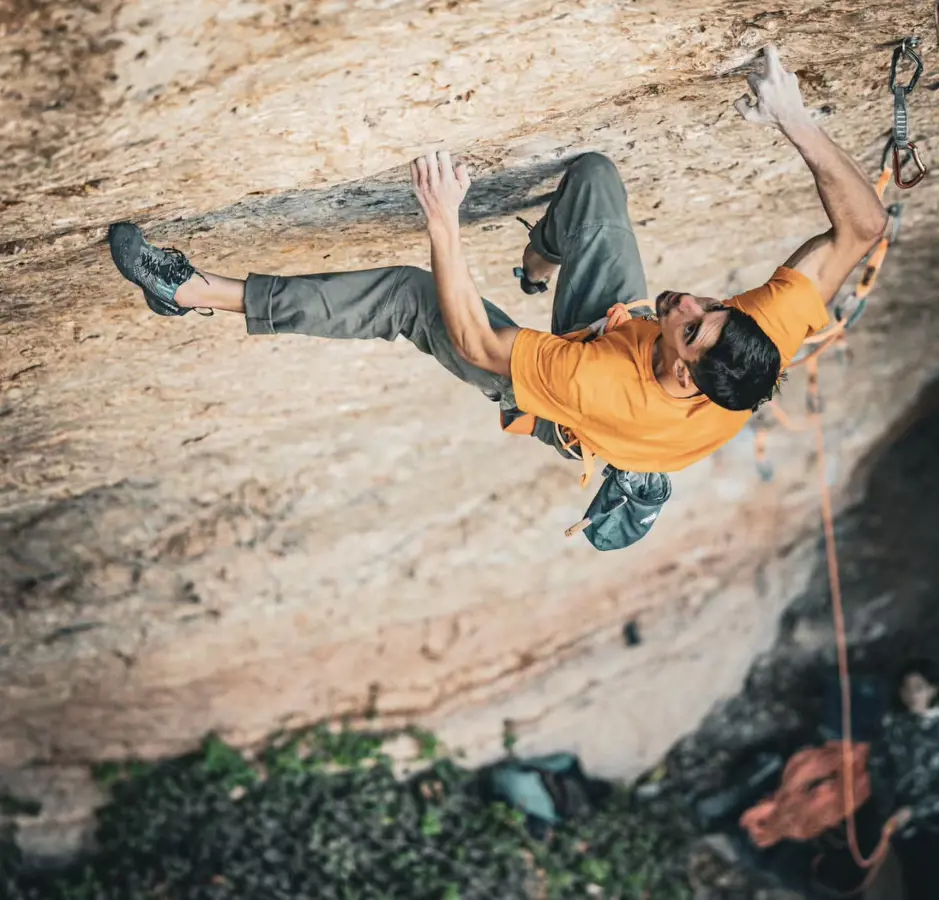
Adam Ondra started to experiment with structured and peak optimization training in 2011. During the last three years he has been working together with Patxi Usobiaga and his PUC training concept. Interestingly, this training concept includes no real periodization but instead it is ongoing mix of power and endurance in combination with micro-preparations before realizing his goals. The reasons for this are that it is more fun and less hard for the head. (c) Javi Pec
Please explain your focus in 2016 and the PUC training concept?
I definitely do not want to to make the whole World cup circuit. I want to feel more like a rock climber. At the same, I want to test how PUC training works for climbing outdoors. If I will pick a few WC stages, time will tell.
PUC training is quite simple. Training hard and smart at the same time, towards my goal. Periods of hard training and switching to the periods of realizing my goals. Periodization might be annoying sometimes, but for getting the shape to realize my dreams it is worth it! I love the feeling when I feel strong, weightless and smooth.
How much training and which type are we talking about?
Well, I usually train something like six days a week, doing campus board and bouldering every day (doing power-based campus board every even day, power endurance campus every odd day), and adding some specific training on rings and TRX every second day and endurance based climbing every second day.
Just before realizing my goals, I train two days in a row and one day rest, sometimes only one climbing day. In these days, I usually do very short campus session in the morning and some super hard routes/circuits, with long rests in between and in between 2 and 4 hard routes, excluding the warm ups.
Training might not be as hard it was in the last two years when I worked hard for the competitions. We keep experimenting and always trying to find the new and unconventional ways of training. But it is possibly smarter than in the last two years and more specific towards my outdoor goals which are mostly in Flatanger this summer.
Is not periodization more like doing four-six weeks blocks?
The length of the training period vary, and it is definitely not for the 18 weeks straight. That might be the efficient in theory, but very hard for the head. It is more fun to make the training periods a bit shorter. I do endurance period only at the very beginning of the season, or for no more than one week during the season, in case I happen to have longer period of training. But even in the endurance period, I boulder a little bit, to keep it more fun and not to go too low with the power.
The power period is something most of the time when I train and it is what I explained. But it is not power only. I add power endurance (or endurance, the border is sometimes unclear). From my experience, if I do not get pumped for a long time, my ability to climb power endurance or endurance route deteriorates a lot. And then power endurance period (just before realization of my goals) is about doing hard routes, but I still put a little bit of campus to increase my power at the same time.
Read more
0
1More than 7 000 climbers from 60 climbing gyms in six countries have participated in the HardMoves qualifications. The final will take place on Saturday in Wuppertal, where 26 gyms and their teams of ten will be trying to qualify to the super final for six teams and six climbers.
The super final will be streamed live and is going to take place over a swimming pool in front of 1 600 spectators. The line-up is very impressive indeed and Adam Ondra is participating for Klättercentret in Stockholm. Jan Hojer and Jule Wurm are participating for Chimpanzodrome/Boulderplanet.
Read more
0
82 March 2016
Gu opens up a new bouldering gym in Vorarlberg
Guntram Jörg, an active FA boulderer who has done ten 8B+'s and harder, is opening up a gym, Steinblock in Vorarlberg in the western part of Austria this Saturday. 571 m2 of climbing walls, including children and training areas.
"I try to involve young people in this project which are climbers. They should have a place to work and a spot to meet. Steinblock is not created by a marketing agency it´s a boulderers brand. People should feel the power of bouldering in our Steinblock bouldering gym. Kids should start bouldering and get the chance to start climbing at a really young age. It´s really easy to start climbing in a gym when you are young but climbing outside is more difficult. You need a car, you need to travel, you need a lot of time. This is not possible for everybody and that is the reason why we need a bouldering gym like this. Video from Gargellen located in the Vorarlberg."
Read more
0
0David Fitzgerald started climbing in 2012. 2.5 years later he did his first 8A and now he has done his first 8B+, Soul Revolution SS in Glenmalure, Ireland. "All of the good aspects of bouldering rolled into one - the full package. I will never get tired of that spot high up in the hills, far away from everything. A dream come true."The picture is from Wonderland 8B in Glendalough, which he did on the same day.
"I’ve spent the last four years exploring the bouldering in Ireland, and although the quantity of established areas and lines aren’t large, they make up for it in quality. There is so much untapped potential here on this small island that I feel we’ll never discover all of it. I'm always in search of that next great boulder and I'm aware that Ireland’s Chironico could be no more than an hour's drive away...
In the Wicklow area, Michael Duffy has dedicated himself to establishing some of the best lines that I’ve ever laid eyes upon, including Wonderland (8B) in Glendalough and Soul Revolution (8B+) in Glenmalure. The lines that he has established have led to some of my most cherished memories and I still have a mountain of them to climb."
Read more
0
0Alex Puccio, the best female boulderer on rock and in comps, who frequently uses personal grades, comes clean writing an official letter to the media saying she is in it for the inspiring challenges - Not for grades others have given.
"Dear publicity and Media, something that really bothers me. I'm pretty frustrated with what it takes to be at the top level of your sport. I feel like I'm a pretty honest climber and person and I will never be ok with taking a higher grade for a climb just to get more recognition and publicity just to be more "famous" in our sport.
People will always have their opinions and the sad thing is that when climbers take the inflated grade just to "look cooler" they might get crap from other professional climbers or climbers that are immersed in the sport, but to the majority that doesn't know any better they look "bad a**"!
Sure I could have said I've done another V14 or more V13's and even flashed a V12, but that's not me and I wouldn't have been honest to myself and to the media. I will never be one of those climbers to do that just to get ahead!
And actually some of the climbs that have been the toughest for me have not been V14 or even V13. There are quiet a few V12's that I have done that were physically and mentally the hardest for me because of the massive moves and sloppy holds. I like to seek out the "non girly" or "non shortie" climbs because I like a challenge! I don't want to be defined by my gender and height and no one will tell me what I can and can't do! And I won't just go seek out a climb with a big number attached to it just because it's my style and it would be easier for me.
A climb has to inspire me for me to want to try my hardest on it and have fun working it, otherwise it's meaningless. I will always keep pushing myself, but honestly!!! I also want to add that I'm very thankful for my sponsors that have supported what I value as an athlete, person and climber!
Read more
0
112 March 2016
Misti 8Cc (A) by Markus Jung
It looks as if running his own bouldering gym, Schlüsselstelle, together with his brother Daniel
doesn´t keep Markus Jung from climbing hard. He spent last weekend in Fontainebleau, where he did his first 8C which took him just a day, and commented, "8C? My personal grade is around 8A."
The reasons for the big grade discrepancy is that Misti was originally given a traverse grade, even if it is goes diagonal, which normally is one or two grades softer compared to boulder grades. The big dilemma is that there is no clear definition when traverse grading is in use and for 15 years 8a has been saying that traverse grades should be removed or reported like 8Cc.
Just two months ago, UKC made headlines of Kevin Lapota doing it but in reality the 8C grade should be translated to an 8B boulder at the most or, as Markus suggests, 8A.
Read more
0
222 March 2016
Hojer and Webb flash 8A+ (B) in Font
Jan hojer and James Webb have done a double flash ascent of Quoi de neuf acte 2 in Fontainbleau giving it a personal grade of 8A+. The boulder was set up by Jacky Godoffe as an 8B but later suggestions of upgrading to 8B/+ have been put forward.
James (184 cm) is by far the best flash boulderer in the world with 39 flashes 8A+ and harder, frequent using personal grades. Jan (187 cm) is the best flash boulderer in world-class competitions. Last year he won the European Championship and was #2 in the World Cup.
Read more
0
22 March 2016
8b+ by Angie Scarth-Johnson (11)
Angie Scarth-Johnson has traveled from Australia to Spain again to find some of the best limestone climbs in the world. Last year she did an 8c in Rodellar, being just 10 years old, and today she did Speed baby 8b+ in Margalef.
"The start was wet, short powerful climbing, I really enjoyed it after the first Boulder problem. I had to use one finger for intermediate."
Read more
0
0The Olympics 2020 have been a hot topic recently, and that is mainly due to the format which has been suggested. There have been several articles on 8a discussing it but not all has been said yet. Further disadvantages of the suggested Combined Olympics format are:
1. The guys qualifying for the Olympic will most probably not make it to the Speed quarter final during World Cups and the World Championships. Sean McColl is the only athlete that has been training and competing in Speed lately and he is almost 50% slower compared to those who do only speed. This means that the guys competing in the Olympics will have little or no experience to compete in the knock out rounds.
2. During the Olympics, the most important round in Speed will be the Top-16 first knock out. The Top-2 final will have almost no importance for the Combined final ranking, creating no excitement for the speed final, especially if one speed pro qualifies for the Olympic.
3. It will be hard to find organisations for running World Cups based on the Olympic format. During the Olympics, only 30 + 30 competitors will participate but in a World Cup, at least three times as many will take part.
4. IFSC has divided the competition season so it starts with Bouldering and finishes with Lead. Now this will be changed into a mix of everything for the whole 2019 season. This means that the athletes will have to train Lead, Speed and Boulder, which in many ways are their opposites. This will have a negative impact on their maximum performances outdoors and also on each individual discipline, creating a space for the non Olympic guys to win.
5. The Olympic format will not be so endurance based if there will just be one qualification and then one final round. The World Championship will be much more endurance based as the top athletes will participate in two semifinals as well, spending many more hours in isolation.
6. Some might argue that during the World Cups it will be impossible to run the Olympic format and instead it will just be a combination of Lead/Boulder and Speed, as it already is today. However, this format will not measure who is the best for the Olympic format where you have to train and prepare for all three disciplines simultaneously.
Read more
0
0Chris Sharma has previously said that the suggested combined Olympic format is "a big shame!" Adam Ondra, the best competition climber in the last two years, is even more critical, which goes hand in hand with what 8a has stated. As for his plans for 2016, Adam will once again focus on rock but possibly do some World Cups as well.
"Combined format is the great tragedy for our sport. I think that Olympics is amazing thing for climbing, but honestly, no other choice could have been worse than combined format. It is just sad to see lead climber on the speed route and speed climber on lead route. It is embarrassing for the climbers because they are on a completely different level.
Athletes are going to be forced to train what they do not specialize in. The audience is interested in seeing top performance, right? But it will only see more average performance due to the format. Additionally, it shares no spirit. Competition climbing is originated in rock climbing, where the speed is not taken into consideration (well, there are few exceptions like The Nose). What you climb and in which style is what matters. Lead and boulder fit into this philosophy. Speed does not. And it does not reflect the current situation either. Nobody is interested in doing all three disciplines except Sean. Why should something, that one person in the world is interested in doing, become Olympic?
I did not participate in World Championship 2014 in Gijon in speed. And because of that, I was not Combined World Champion. I did it deliberately, with full awareness, just because I did not agree with the rules. IFSC chose the combined format in order not to disappoint anyone, but at least I feel disappointed. In my opinion, going for speed only, lead only, boulder only or lead and boulder combined is much better than all three combined."
It should be mentioned that the latest IFSC Plenary Assembly, was opened by Marco Scolaris, who said, "We cannot say anything about the format at this point as the decision has not been taken yet.", although the application is based on 30 + 30 athletes competing in Lead, Boulder and Speed for one set of medals.
Read more
0
13 Favorites
Jorge Diaz-Rullo reports on Instagram that he has made the first ascent of Cafe Colombia in Margalef. At 27, he’s already stacked four 9b+ sends and now he’s ad…
285
81
”I stopped focusing on competition bouldering after last year’s World Cup in Prague, partly because I can already feel it on my body, especially in my shoulders. The modern competition style, with a lot of jumping from one hold to another, is very demanding for the shoulders.
Outdoor bouldering is…
189
13Sean Bailey reports on Instagram that he has done the first ascent of Duality of Man (9c) in Dry Canyon. ” After four total years and three seasons of climbing,…
163
69 Most commented
Jorge Diaz-Rullo reports on Instagram that he has made the first ascent of Cafe Colombia in Margalef. At 27, he’s already stacked four 9b+ sends and now he’s ad…
285
81
Sean Bailey reports on Instagram that he has done the first ascent of Duality of Man (9c) in Dry Canyon. ” After four total years and three seasons of climbing,…
163
69Jorge Diaz-Rullo elaborates on the reasons for him to suggest 9c for Café Colombia on Instagram, which he took down last week after projecting it for 240 sessio…
119
63