NEWS

8A+ for Becky Wilby after just 3 years of hard training
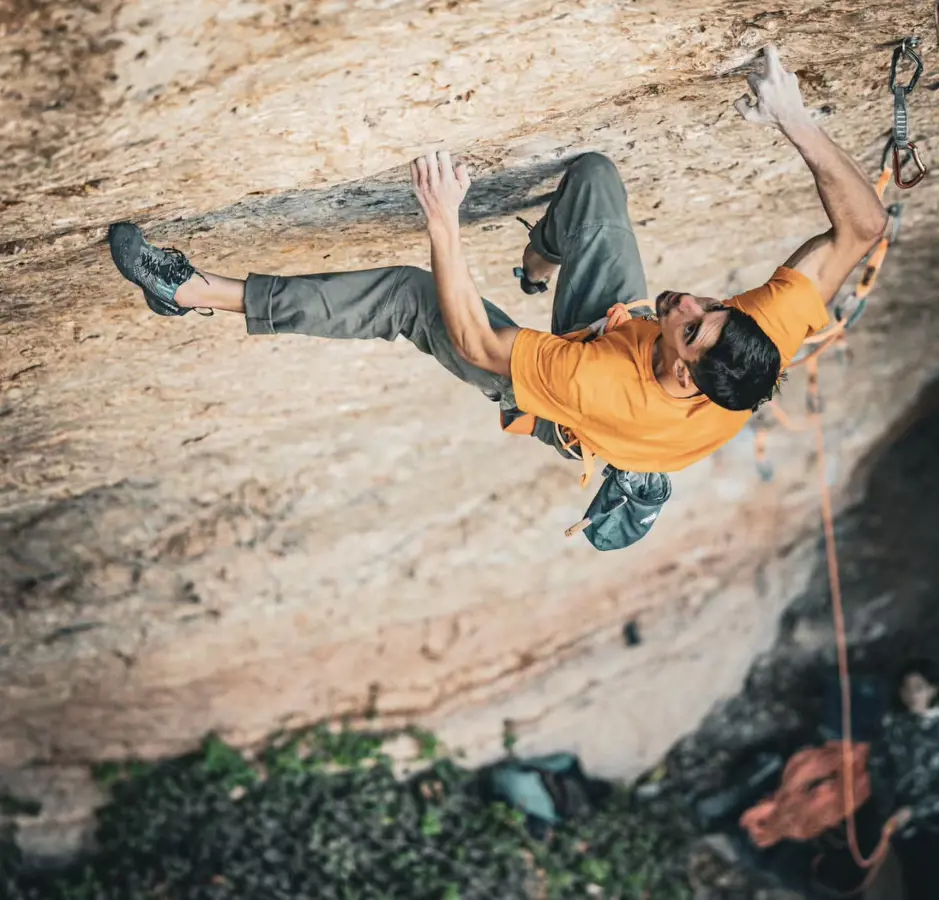
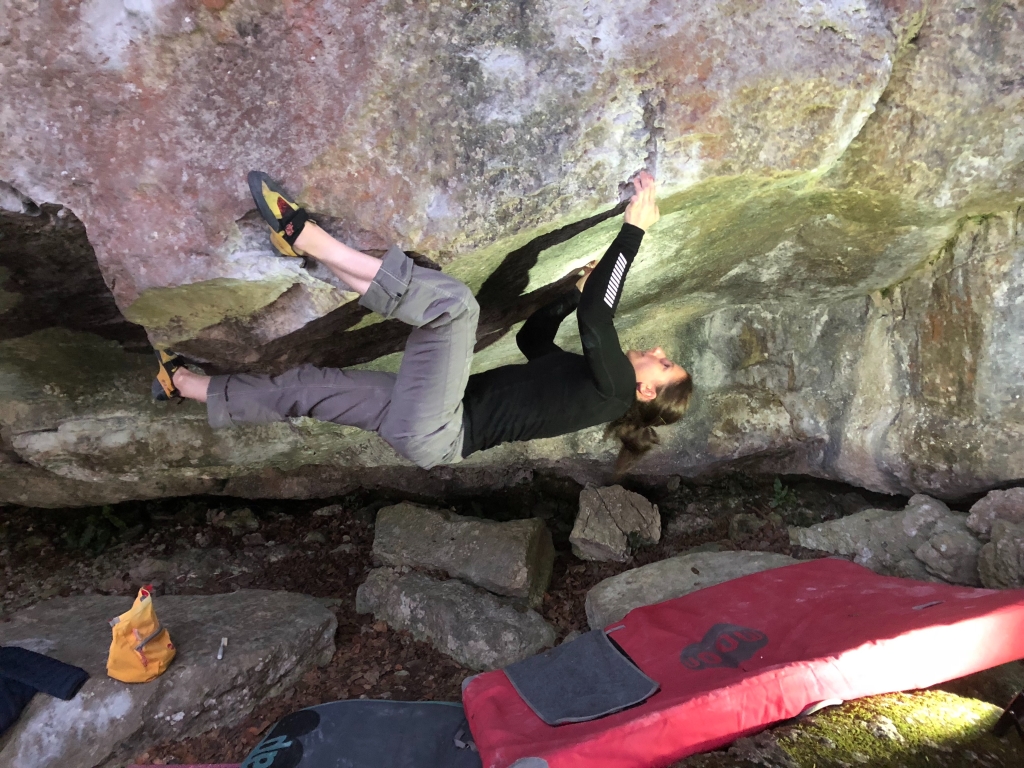
Becky Wilby has just signed up having done Armed Response 8A+ in Rocklands and five 8A's this summer. The amazing thing is that she started climbing just five years ago but it was nut until three years ago she started going outdoors and training hard. "I have trained 6 days a week, twice a day for the past 3 years, only really taking breaks for holidays, injuries or rest weeks. Generally doing an hour of strength training in the morning before work, and then mixing up the evening sessions with technique, mileage and board sessions, depending on how I felt. Weekends have looked similar. I have climbed outside as much as possible, I am fortunate to have some good local crags that I have used as training venues. My focus has always been on total body strength, and learning to use my whole body, and apparently I have naturally strong fingers!! To be honest I have never struggled with getting strong. I am very fortunate that I have had a home board and fingerboard set up, along with space to use TRX, rings, weights etc. I basically created my own gym in my parents garden Shed. Mainly because I didnโ€™t want to train at the wall, as silly as it seems, I actually train a lot better and push myself a lot harder in the comfort of my own space."

The female boulder qualifications started at 10 when it was around 18 degrees and quite sticky conditions. It was finished at 15.47 when it was like 27 degrees in the shade. The problem was that part of the walls had been in the sun for several hours. Add to that 61 sweaty fingers had put chalk on the holds several hundred times on the first holds and it easy to understand that almost no athletes did more than one or two moves on the boulders during the last hour. As it just took one top to get into the semifinal, it just might be that with a reversed starting order among the non-ranked, we would have seen a different result list. In practice, this means that actually your luck in the tombola most probably would have an impact on your Combined result. Tomorrow, they have decided to start one hour earlier meaning in practice the unfairness will be increased. The weather forecast predicts 18 degrees at 9.00 meanwhile it will rise to 28 degrees at 13.00. If they instead would have delayed the start to 13.00, the unfairness would have been less. As it stands, Adam Ondra with start number 56 in his group will start around 13.45 meaning it will be harder for him making it into the semi. The starting list is for the 23 first in each group based on the world ranking and the last 53 goes by random. Ondra comments on his Insta, " It will not be easy to make semis, especially as I have high starting number and the conditions will be hot and holds dirty, but I will do my best to fly."

Janja superior on too hard boulders
The female boulder qualification got a good start with Janja Garnbret topping out all five boulders in good style. As the competition progressed with less experienced climbers it was only the last boulder that was doable and the #4 ranked did only manage one top in group A. In the end, with the sun hitting the walls, we saw only zones on two boulders out of one placed sticking the first move. In the second group it was a bit better with Akiyo Noguchi on top with four boulders. However, also here it was good enough to make it to the semi by just doing one boulder. Austria did get four girls trough to the semi and had seven Top-23. Overall, only 37 % out of all the girls did get at least three zones. Alejandra Contreras was #41, out of 112, by doing two zones in four tries. A total of 15 girls did not get one zone. Complete results (c) Udo Nemann

More zones are needed in bouldering
The female boulder qualification in Innsbruck was yet another example showing that one more zone is needed in bouldering. In Group A's fourth Boulder you just needed to do one move to get the zone, which 38 out of 56 did. Some progressed in the next hard moves but as they could not top it their score was the same. On Group B's fourth boulder, just Janja Garnbret got the zone as it was placed higher up and then she topped out. Similar situations also on other boulders with either a very simple zone or a zone that more or less automatically meant a top. If there would have been two zones on each boulder it would have been more fair and also both the climbers as well as the spectators would have enjoyed the qualification more.

First 8C by Moritz Perwitzschky (19)
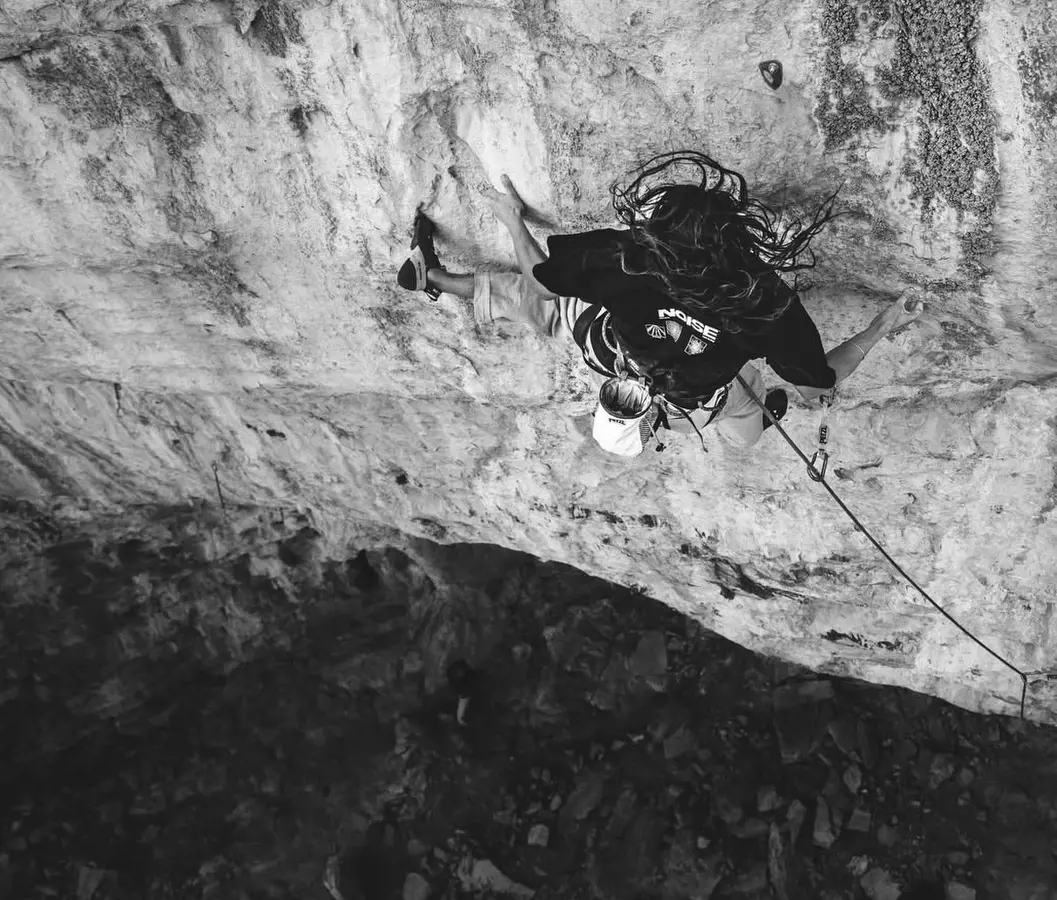
Moritz Perwitzschky has had an extremely productive trip to Rocklands doing 40 boulders 8A and harder including his first 8C, Noise vs Beauty. During the last 12 months he has done 125 boulders 8A and harder as well as 50 routes 8a+ and harder. In the Combined ranking game, the 19 year old German is #5. (c) Basti

8c+ (9a) by Fabrizio Peri (47)
Fabrizio Peri, who did Grandi Gesti 9a, when he was 42 years old has done Sitting Bull 8c+ (9a) in Collepardo. He has been working on the route during weekends for two months. The Italian started climbing in 1979 and amazingly, he did his first 8c when he was 40 years old. The reason was that he lost 7 kilos when he finished his body building training with weights. Fabrizio is a military climbing instructor meaning he trains more or less every day. Next he wants to finish a four year project as well doing possibly do Era Vella in Spain. The key is passion, strict training, nutrition and "a good dose of masochism."

Great Gallery by Vladek Zumr
Here is the link for 54 great pictures from the female and male semis and finals by Vladek Zumr. Highlighted is the sensational #4 Meichii Narasaki from Japan.

The remarkable stats for Jakob Schubert
2003 Started climbing 12 years old 2005 #2 in the Youth Worlds which he later won 3 times 2011 Winning 7 straight World Cups 2012 World Champion 2013 #2 in both Lead and Boulder WC 2014 #1 in Lead WC 2016 #2 World Champion 2017 Three Lead WC entries 3 - 1 - 1 2018 World Champion (c) Vladek Zumr

Hidden and blocked holds in Innsbruck
The route setting in the World Championship has been based on the modern style with volumes and big holds sometimes with no friction. The new thing in Innsbruck is that sometimes hidden micros have been added creating both better holds but sometimes also blocking holds. The problem for the climbers is they are often impossible to check from below doing observation but also while climbing. As the climbers are not used to this, they do not expect such things in the route reading. The picture from (c) VladekZumr.com shows the frustration from Adam Ondra just after he did fall probably due to hitting such an almost invisible blocking micro.

During the World Championship in Innsbruck we have seen a record number of ties. As climbing progress it is just natural that the best climbers even out, increasing the route setters delicate job. Ondra and Schubert did get the same score and there is no way to separate them but to go for count back or time. Pilz did finish the female route 10 seconds faster than Garnbret. The problem was that during Janja's climbing there were no official split times making it very hard to build up the excitement understanding who is in the lead, i.e. who is climbing faster. Luckily they both topped making it easier to get the winner. Let us say they both finished with a score of 42, then the judges might have had to watch the videos and see that Pilz got it 2.42 seconds meanwhile Garnbret was 0.5 seconds slower. Such an analyses would probably have taken several minutes to do. One solution for this could be to use split times for every ten moves which can be used to separate identical scoring until they reach the next split time. This would guarantee that for example during the Olympics we do not need to wait five minutes before the winner in Lead can be announced.