
NEWS
3 February 2016
Mowgli repeats his 8B+ (C) twice after just a short warm up
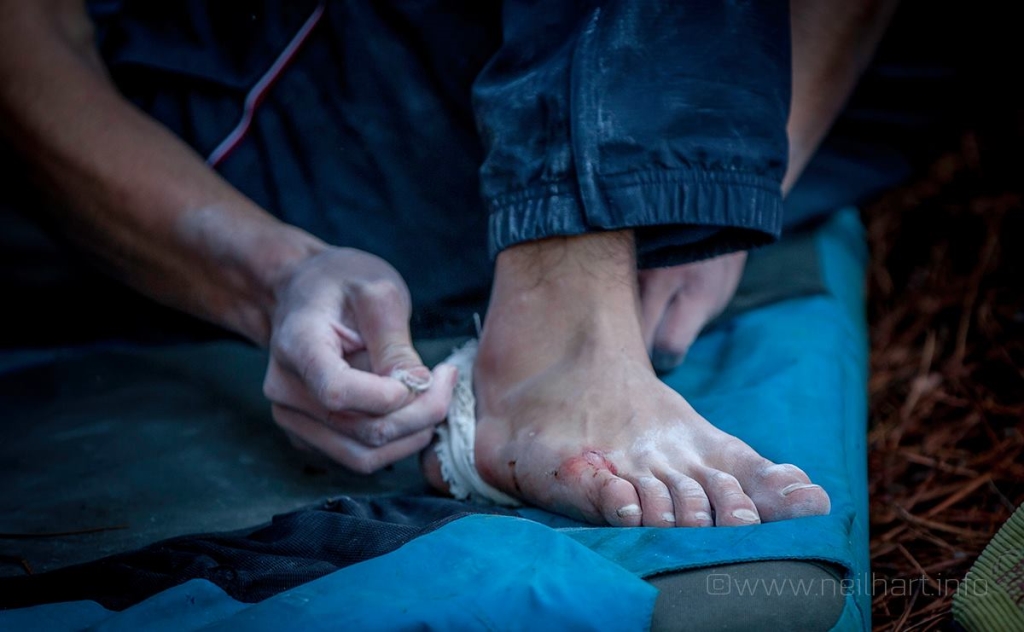
Charles Albert, who did the FA of the L'Alchimiste left exit last week, considered to be harder than the 8C right exit, did it today twice. (c) Neil Hart did get it on video both times.
"He is so strong he made it look like a 6A. I picked him up at one o'clock and we did a very quick 7B that took two tries and we drove to the L'alchimiste. He just pulled on and fell three times on the crux then sent it, then climbed it again so we could get another angle.
It is easier for him bare foot because he can hook his toes into the side pulls better. Definitely a new level!"
Read more
0
6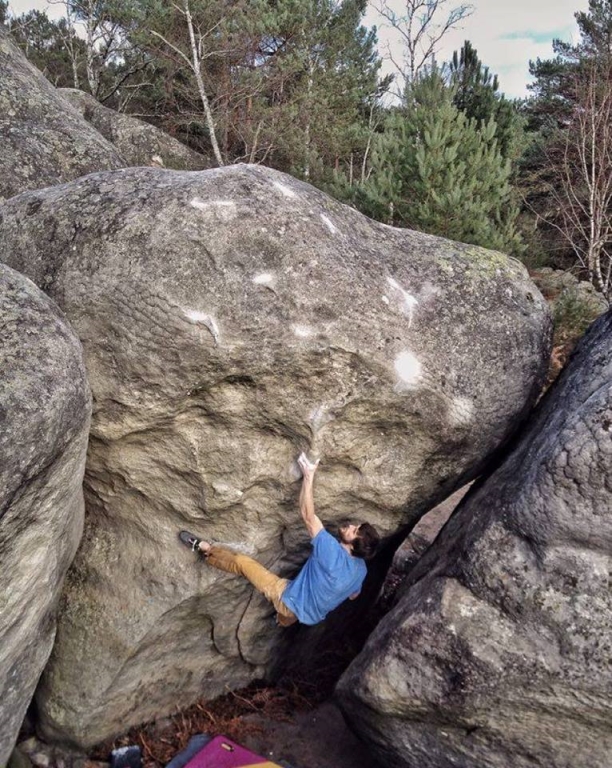
3 February 2016
L'Alchimiste 8B (C) by James Webb
James Webb, #2 in US Bouldering Nationals last weekend, arrived to Fontainebleau, when it was snowing. It cleared up and one hour later he did the fourth repeat of L'Alchimiste. Gradewise, it has been given 8C and 8B+ and on Bleauinfo there was 8C/+ mentioned as well. James did it in just three tries and gave it a personal 8B grade in his scorecard. (C) David Mason
"3 tries total. Im a bit confused by this right & left exit stuff. Its just one wall.. with just one line.. and two different options for beta. Thats it. Pick the beta that suits your style and go for it. Nonetheless, a quality problem! Very psyched to be here.
It is a nice line for sure. Great rock and interesting features.
Today was the first day. Traveled here over the night and landed this morning. Took the train to Font and my bud Dave Mason picked me up and we went climbing...
No world cups for me. Would rather spend my time here on the rock. Probably gonna be here till mid march. Hopefully the weather holds up for us!"
Read more
0
242 February 2016
These Bleauseards deserve much more credit
Bouldering was more or less invented in Fontainebleau and it is still the most often visited and biggest arena in the world. The first topo was produced in 1945 but already in the 19th century, the Bleauserads were challenged by the blocs. The Bouldering difficulty gradings can also be said to have been invented in the Forest and in fact, the american V scale is above 7A a copy when in comes to grade steps.
Grades in Font have been said to be sandbagged but in reality this is just another way of saying that another grade scale has been invented outside Bleau. The best way to describe this is to compare the maximum grades. In 2005, the highest grade in Font was 8B, which can be compared to the fact that in 1996 and 2000, the world's first 8B+ and 8C had been established and since then repeated many times.
Meanwhile, some 100 guys had done an 8B+ outside Font until 2005 and gained fame in magazines and on websites as well as sponsor contracts, but nobody claimed to have done 8B+ in the Forest. In reality, there is probably at least a handful Bleauseards that have done 8A to 8B Boulders in Font, equally difficult as some 8B+ to 8C+ that were reported at the time around the globe in areas like Ticino, Rocklands, Hueco Tanks, etc.
Here are some Bleauseards who probably climbed 8A - 8B's in Font prior to 2005 - these problems would have been reported as 8B+ outside Font - Julien Nadiras, Antoine Vandeputte, Olivier Lebreton, Sebastien Frigault, Christophe Laumone, Jacky Godoffe, Manu Marquès and Christian Roumegoux.
The bleau.info scorecards of Marques Vimeo and especially Roumegoux (52), in the picture by Pierre Delas, are very impressive and yet they are unknown outside Font. Some 15 years ago Christian did an 8c+ and onsighted two 8b's on rock and did several 8B's in Font. If Font used the same grades as Ticino etc, he could be a world famous boulderer having done probably some 8B+'s.
Read more
0
612 February 2016
The Torre traverse in 20 hours instead of four days
Climbing reports that Colin Haley and Alex Honnold have done the second ascent of the Torre Traverse in Patagonia in 20 hours 40 minutes. Haley did the FA together with Rolando Garibotti in four days in 2008.
"Last season, Haley and Honnold attempted and nearly completed the one-day Torre Traverse, climbing all the way to a stance two pitches below the top of Cerro Torre in just 22 hours. Here, a terrible storm forced them to a halt and eventually into a painful retreat down the west face of Cerro Torre and across the ice cap. By the time they made it back to town they had been going 53 hours straight with no stove or bivy gear."
The picture was taken Alex Honnold, who reports on Facebook, "Sunrise on the South East Ridge of Cerro Torre as @colinhaley1 leads our rappels down after a long day of traversing the range. 32 hours camp to camp to climb all 4 Torres. Thanks for an amazing day out, Colin!"
Read more
0
0Rock & Ice reports that Marianne van der Steen has set a new standard for dry-tooling by making the first ever male or female flash of a D13+, Kamasutra at Bus del Quai in Italy. It was opened last year by the three times Ice World Champion, Angelika Rainer and here is FA video.
"Van der Steen told Rock and Ice that shes a slow climber and thinks that might be a reason why she never [does] too well in World Cups where time is an important factor."
The most amazing thing with Marianne's world record was that, "When she got to the ground, she wasnt pumped at all, she says, therefore it didn't feel like I'd done something super difficult. It was only later that evening when I realized and heard probably no one had ever done a D13+ flash.
Picture by Marco Servalli.
Read more
0
41 February 2016
The Boreal sticky rubber story
Until 1995, all sport climbing grade breakthroughs from 8a+ to 9a were done with Boreal shoes, including Ben Moon's Hubble and Wolfgang Gullich's Action Directe. Furthermore, Lynn Hill's FA of The Nose 8b+ in Yosemite was also made in Boreal shoes.
Read the amazing story of the innovation of the sticky rubber in 1979 on the new Boreal website. In 1983, John Bachard imported 263 pairs and they completely sold out in two hours in the Yosemite Mountain shop. In the last 8a poll, 'Best Climbing shoes', Boreal did get 10%, which is more than a double up compared to five years ago.
Read more
0
01 February 2016
Women are catching up in the Santa Linya caves
Some ten years ago, several men - notably Dani Andrada, Patxi Usobiaga and Chris Sharma - broke through to the next grading level establishing several 9a's and 9a+'s in Santa Linya. As of 2016, however, it seems that progress has become stagnant with Chris Sharma's two 9b FAs representing the highest attainable level.
Women, in the mean time, have caught up, in 2010 Angela Eiter did the first female 8c in Santa Linya. Quickly thereafter other women have followed suit with ten other females having completed climbs ranging from 8c to 9a(+) over the last two years. Complete stats. In this great picture captured by Luka Fonda, Janja Garnbret (16) flashes La Fabelita 8c.
If the trend continues, it is only a matter of time before women are on par with men in Santa Linya. While impossible to know for certain, one of the reasons behind such phenomenal progress for women may lie in the nature of the climbing in the cave where technical skill and endurance are of vital importance. That, and the fact that these ten women - and the many who will follow - are testaments of climbing strength and power.
Read more
0
41 February 2016
Daniel Woods suggests new scoring in bouldering comps
Daniel Woods, who has won one World Cup and nine US Bouldering Nationals, has written down some interesting thoughts regarding competition climbing. His thoughts go along with the opinions and suggestions from 8a. The scoring could be based on several bonus holds, i.e. in the middle of the two extreames, scoring all holds like in the US and just one bonus like in IFSC. (c) Greg Mionske for USA Climbing
"Over the last decade, I have competed at ABS nationals, WC events, international invitational events and the key thing that has always changed is the format/scoring. This might be the most important aspect of a competition especially for the audience. Our main goal as competitors is to go out and see if we can overcome the test in which the route setters present to us (simple to understand for us). The goal of the audience is to be involved and understand what each of us are doing so their attention span is being maintained. If the audience is confused, they become bored and disconnected (also simple to understand).
There is no such thing as a perfect way to score a comp. There is such a thing as scoring a comp that is simple and easy for the audience to understand. If the competitors are left confused back in ISO and have no idea what the standings are, then how is the audience supposed to be able to follow as well? With past experience from other events and scoring systems (IFSC and the top then point per hold format) it is at least easier for us to get a sense of how we stand in the event. This allows us to develop a strategy for each boulder. The audience can even tally up what is going on.
The new way of scoring things in which the US has developed confuses me to say the least. It puts more pressure on just a single boulder rather than an average of all 4. You do not know your overall placement until the comp is over which in my opinion the audience should know the winner and podium as soon as the final climber finishes. Were not here to do math problems and make things complicated... were here to climb and inspire people to watch us climb and go back having the feeling that they also want to climb or compete one day. The only credit that I give to the new scoring system is how precise it can be... a flaw to this though is that it "determines" the hardest boulder based off of percentages which in the end outweighs overall mean.
I want to see competition climbing become successful and for people to feel like they had a good show. The percentage of people that asked me what the podium was, or how we are scored, or just plain out what the fuck is going on left me thinking that the comp had already failed. If we have to watch a 12 min video to understand the scoring then what happens when a non climber asks us what is going on and we as professionals reply back with a shrug and a face of confusion... not really going to sell competition climbing to that person haha.
I recently did a comp in January called Di'namik and they used a two zone scoring format which I really liked. 1st zone was 5 points, 2nd 10, top 25. By doing this you can set a hard section down low and up high. The audience can tally up who is doing what but to be honest every finals comp should have a running scoreboard. Make it even more basic so the drunken audience does not have to even question what is going on haha. Even to step things up, place the point value next to the zone so the audience looks at that random piece of tape and immediately knows what it means. Point is simple is better than complex...
The only thing that should be complex is what the route setters want to throw out at us. I thought the problems at ABS finals were on point and awesome testing power, balance, and coordination... big up to the route setters and to Nathaniel and Megan for being on point.
In order for competition climbing to become popular to the masses we need 2 key components: Simplicity and Consistency
DW
Read more
0
171 February 2016
Mammut gets gold award for the #360 Project at ISPO
Mammut won a gold award for their #360 Project: "Interactive climbs are now possible for the first time in the history of alpinism. Experience the most famous routes of the world in a 360° view." It works best with a smartphone or a tablet.
Jury: "Value, usefulness and fascination - Mammut bring the mountains to the computer screen. An ideal platform for planning actual tours with Tips from professionals, or to dream of unreachable peaks. An ideal example for the future of marketing communication...
Read more
0
031 January 2016
Coleman & Mascarenas win US Bouldering Champs
Last year, Nathaniel Coleman and Megan Mascarenas did make the biggest breakthrough at the Bouldering competition scene and they started 2016 up in the best way by winning the US Nationals. Among the male, five guys topped out three out of four boulders and they were separated depending on how they were ranked on each boulder. This means that US Nationals' scoring is not the same as at the IFSC comps. Among the female, Megan and Alex Puccio were kind of superior and in the final, Alex had better a ranking score but Megan topped one more boulder. Video replay
1. Nathaniel Coleman - Megan Mascarenas
2. Jimmy Webb - Alex Puccio
3. Carlo Traversi - Claire Blurfeind
Complete results Alex and Daniel Woods, who was #4, had previously won nine Nationals straight. The Bouldering WC starts in Switzerland on the 15th of April.
Read more
0
12Favorites
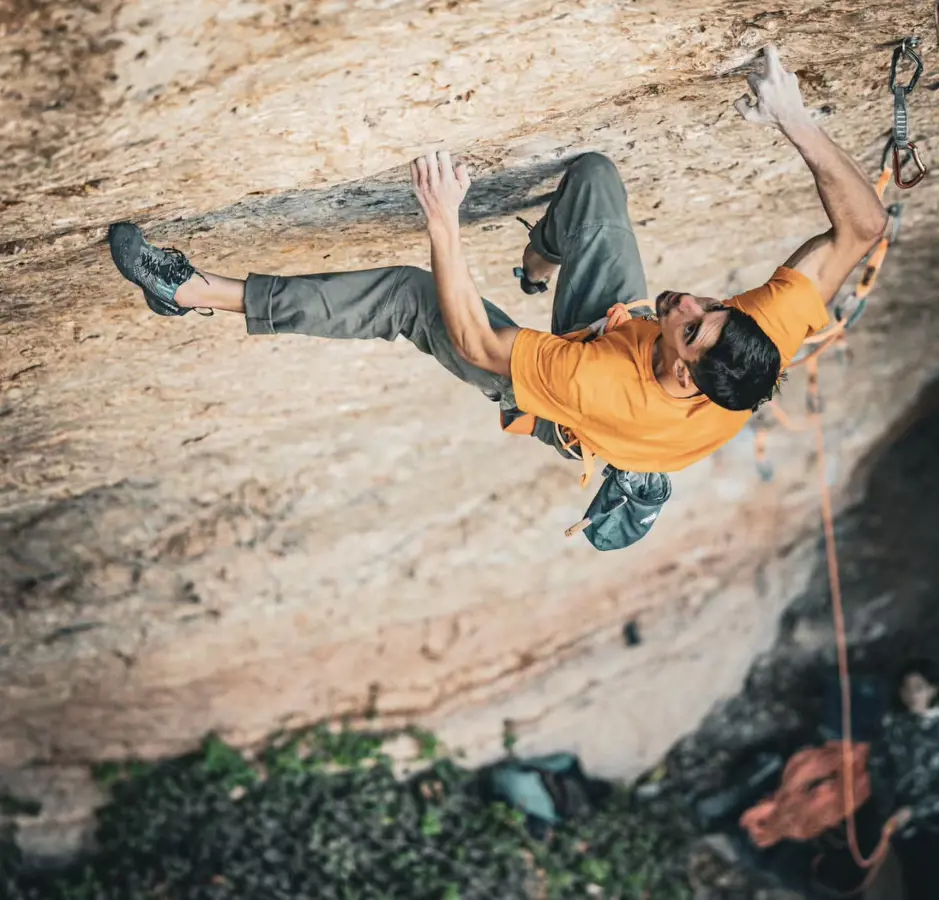
Jorge Diaz-Rullo reports on Instagram that he has made the first ascent of Cafe Colombia in Margalef. At 27, he’s already stacked four 9b+ sends and now he’s ad…
285
81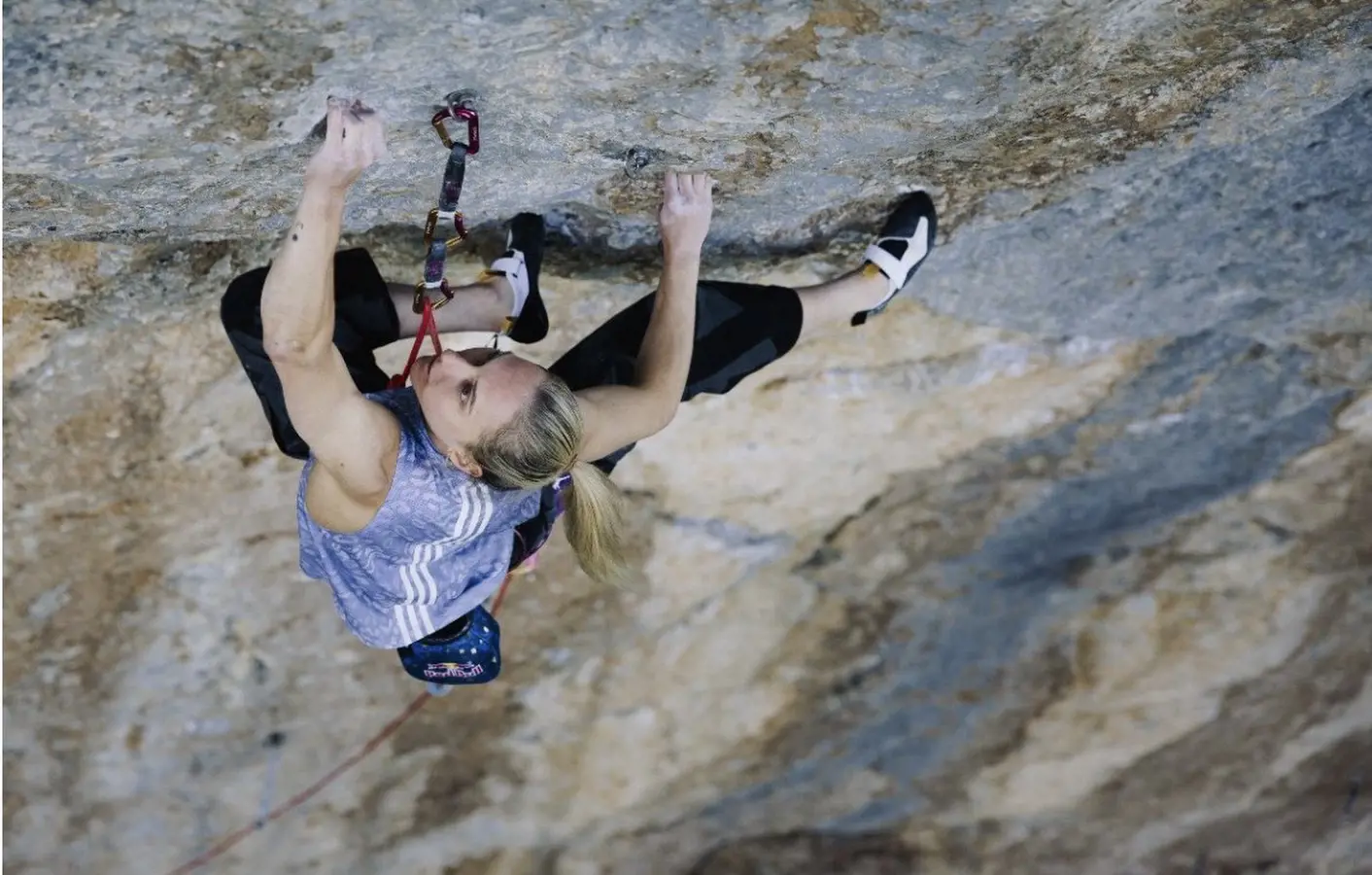
Janja Garnbret has added another milestone to her remarkable climbing career by becoming the first woman to climb Bibliographie (9b+) in Céüse, one of the harde…
220
22
”I stopped focusing on competition bouldering after last year’s World Cup in Prague, partly because I can already feel it on my body, especially in my shoulders. The modern competition style, with a lot of jumping from one hold to another, is very demanding for the shoulders.
Outdoor bouldering is…
189
13Most commented
Jorge Diaz-Rullo reports on Instagram that he has made the first ascent of Cafe Colombia in Margalef. At 27, he’s already stacked four 9b+ sends and now he’s ad…
285
81
Sean Bailey reports on Instagram that he has done the first ascent of Duality of Man (9c) in Dry Canyon. ” After four total years and three seasons of climbing,…
163
69Jorge Diaz-Rullo elaborates on the reasons for him to suggest 9c for Café Colombia on Instagram, which he took down last week after projecting it for 240 sessio…
119
63