Michael Piccolruaz Olympic preperation interview
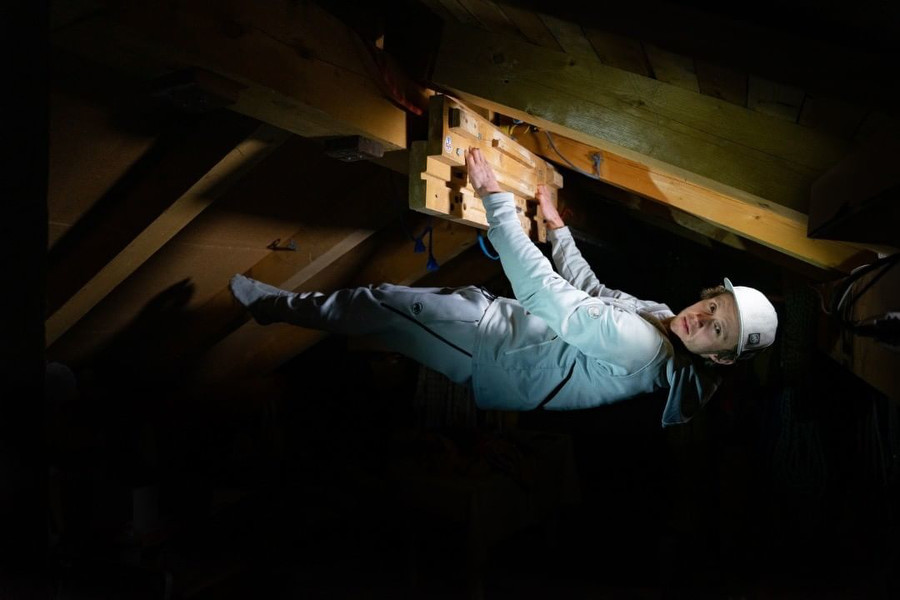
Michael Piccolruaz qualified to the Olympics by finishing #14 in the World Championship in August 2019. During the last five years he has been studying and training in Innsbruck where he, for the last 3.5 years, has shared apartment with Jakob Schubert. Now he is just one exam away from his Bachelor degree in Geology. Since Covid-19 emerged, he has mainly been studying and training at home in Val Gardena in the Dolomites.

How do you plan your last six months of Olympic preparation?
Well as for now the preparations are focused on getting fit for the bouldering season. It will be important to do a few comps again before the Olympics, especially after not doing any for so long. I'm not entirely sure which Boulder world cups I will do but for sure those in Europe. Hand in hand with the boulder preparation goes Speed training. Most definitely I will also start all the Speed World Cups which are taking place together with the bouldering world cups. They are the best training we can have. Before the season starts it would be cool to go to Japan for a training camp for about 10 days but unfortunately with the current situation that might be difficult.

Unfortunately, the gym in Innsbruck is closed for everybody but the Austrian national team, so I haven't climbed with Jakob (Schubert) since November, which is very unfortunate. So now I'm training back home in South Tyrol, but I hope the gym in Innsbruck will open as soon as possible again. New boulder problems are something I am definitely missing most from my training in Innsbruck. We train in small gyms now and we do not have the chance to regularly climb on new comp style boulders, however, as the gyms are closed right now and only we athletes can go in I sometimes bring along my makita (drill) and set a few specific moves (slabs, jumps...) for myself. That is really helpful. Hopefully, we will also have some national training camps in the future

Right now I normally train 5 days a week with mostly double sessions. Twice I train Speed, the rest is Bouldering training. I now sometimes train with Filip Schenk as he lives in the same small village as I do. It's good to have somebody to train with and share motivation. Alone it would definitely be harder. I do have a trainer who writes me my training plans and regularly checks in on how I am doing. With the season going on we will then start to insert some lead training, however, it is not gonna be too much since I always feel that a lot of Lead training is not good for my bouldering and speed performance.

Do you do any specific speed training? What is your PB?I don't do specific leg training for speed. But when I am in the gym I always do one or two exercises for my legs in general. Good leg muscles are also good for preventing injuries. My personal best in speed is 6:65. My goal would be reaching a time under 6:30.

What about getting stronger legs from ski-touring?
It is Amazing right now. I go once or twice a week, on the rest days basically. It's between 1000 and 1800 meters of altitude up to 7.5 hours of walking.

What is your goal for the Olympics? Any specific plans due to the Combined multiplication format?
My goal for the Olympics will be making finals. From there on everything is possible and it will really depend on the shape on the competition day, and mostly also the setting style. I will leave lead a bit behind and focus to have the best bouldering and speed shape.

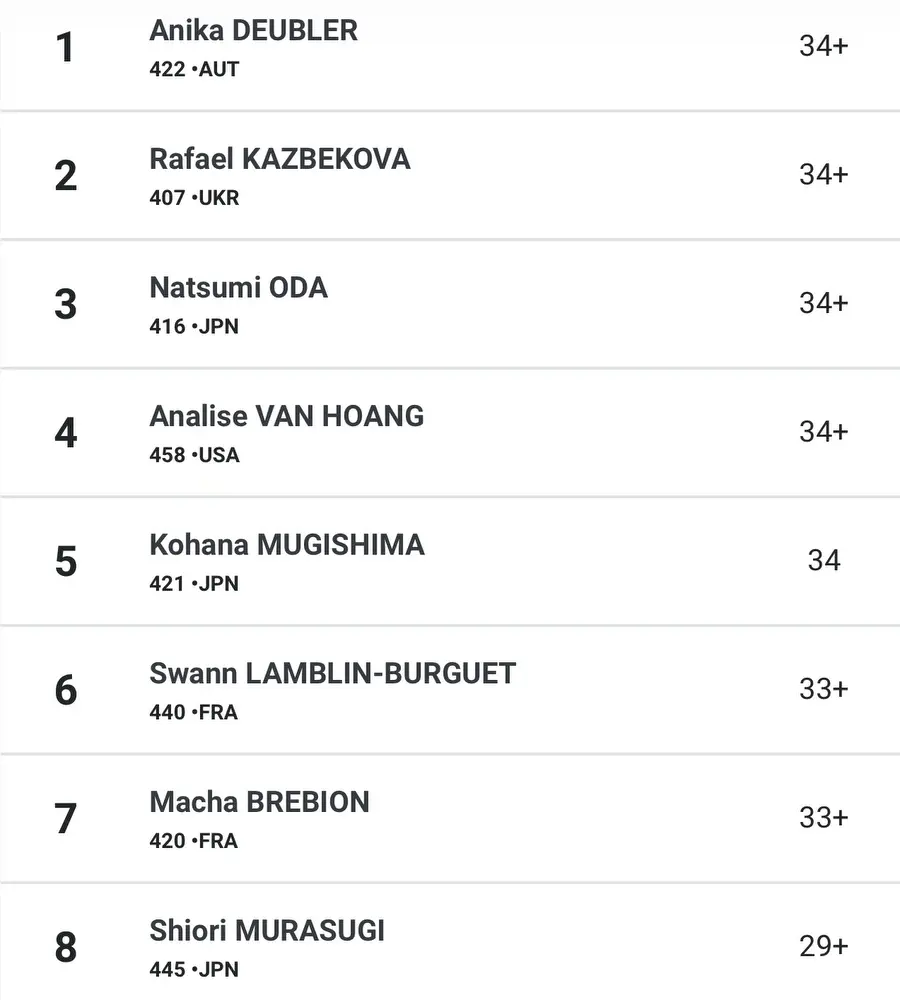
Semis Decide Girlsโ€™ U-19 Results
The U-19 girls' final at the Youth World Championship in Arco produced an exceptionally close contest, with four athletes scoring 34+. Anika Deubler claimed theโ€ฆ
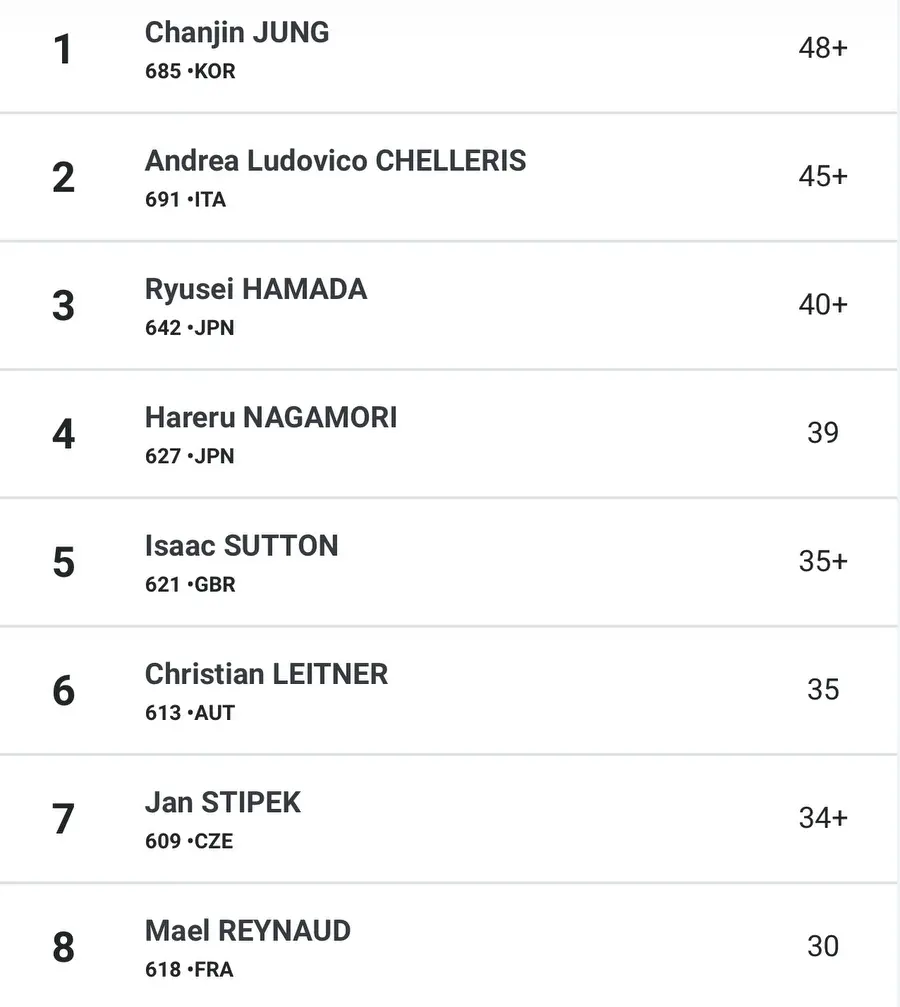
Chanjin Jung defends his YWC title
Chanjin Jung, who also won the youth world championship in 2025, was the only climber to top the semifinal route, then went on to finish three holds ahead of thโ€ฆ
Janja Garnbret and Domen ล kofic are challenged by the tallest artificial multi-pitch route in the world in a chimney at Slovenia's Trbovlje Power Station. The 13 pitches route, graded between 7b and 8b+, was designed by IFSC route setters Katja Vidmar and Simon Margon but it has now been removed. Janja and Domen managed to both do all pitches on their second attempt that lasted 7.5 hours.

โ€œI was a bit scared before the start,โ€ Janja said, โ€œI was afraid of falling, which can get really nasty in case of a vertical wall compared to an overhanging wall where you hang in the air. Here you can quickly hit a wall or a hold before the rope stops you. Thus, I needed to fall a few times until I finally relaxed and banished the fear.โ€ ล koficโ€™s experience of such climbs was hardly much greater having done just one multi-pitch previously. โ€œThe chimney is completely different from anything I've climbed so far. It is a giant, artificial object, which I found rather mystical. I felt discomfort, strong fear of the unknown but I quickly made friends with the chimney, as the route was really beautiful and challenging. Once I started focusing on climbing, all other thoughts were gone, and I was just enjoying itโ€, he said.

Le sens de la fรชte 8B+ FA by Nico Januel (37)
Nico Januel has done the FA of Le sens de la fรชte 8B+ in Dame Jouanne after some ten sessions. Video on his Insta. "I split one of my middle fingers first thing during the warm-up. Proper bleeding, total bummer. So despite feeling in great shape, I knew I only had one shot. And boom, I sent it! Itโ€™s a great feeling, after falling 10-12 times at the dyno!"

The 37-year-old, who is working for the French federation with route setting, coaching and training, has previously done a couple of 8C's. More info at Fanatic Climbing.

Pierre Le Cerf, who did his first 9a+ last autumn, has done his fifth 9a, WRC in Castillon. "Demands a lot of endurance. It starts with an 8c+ (Alien Carnage) and finishes in a small 8a+ with twelve moves to get 9a."

In his latest Insta post, the 20-year-old does a 28 second front lever in 28 mm pinkies!

Eddie Fowke stops as IFSC photographer
So how did you become the IFSC Photographer?
As many reading this will know, I began The Circuit Climbing in 2013. Its goal was to document the competitive side of climbing and introduce the climbers and their exploits to a broader community as I felt it was extremely underrepresented in the media of the time. Seeing what I was doing, the IFSC approached me in 2014 with the offer of being the official photographer for the IFSC. By bringing me in, someone was already attending the events and had no national bias (few Kiwiโ€™s attend World Cups) it gave them an asset who was impartial and of course, I was already promoting their product through my own platform.

How much work and travel did you put in?
It was an incredible amount of work. Being present at every round from approximately an hour before it began until its conclusion led to extremely long days. Not to mention at the end of the shooting, the sorting, editing and distribution of images began. At a normal World Cup, my workday would be 12 to 16 hours.

In my time as Official photographer, I spent as much time as possible optimizing travel, taking trains or other public transport where possible, and only flying when it was needed. Even so between 2015 and 2020, I spent more than 800 hours in the air, covering in excess of 600,000 kms. Jetlag became a part of life!

What are your best memories?
There are so many amazing memories, that itโ€™s almost impossible to answer that. Any time a climber wins their first World Cup it gives you a huge emotional rush as you know just how much that means to them. More than a couple of times Iโ€™ve had to blink tears from my eyes to keep shooting! I also have great memories of all the people who have come up to thank me over the years, telling me stories of how my images and visual storytelling inspired them. My role has never to be โ€œa nameโ€, that is for the stars of climbing. But to have my work recognised and appreciated is extremely fulfilling.

Two memories that stick out are the first victories of Jernej Kruder in Meiringen and Gabri Moroni in Hachioji. To have seen the effort they both put in over the years finally rewarded was incredible. In competition there are some amazing climbers who never quite achieve what they show the promise to, some because they are in the shadow of one of the greats, others simply because of luck and timing. So seeing those to veterans of the sport finally achieve the top step of the podium after so many years of trying was something that will stick with me forever!

Who are the athletes you think will improve the most in 2021?
After a season away from the sport due to Covid-19, itโ€™s almost impossible to say. Being that the vast majority of what we are seeing is peopleโ€™s personal social media feeds, our perception is coloured by who promotes themselves better on social media which can give a false perspective. I donโ€™t think we will get an honest gauge on the climbers' levels until 2022 at the earliest. There are several incredible young athletes like Colin Duffy from the US and Oriane Bertone from France stepping into the elite competition, and there are many for whom this is the end of their competition journey. And with the likelihood of 2021 being a disrupted season, I think we just need to wait and see!

How could the IFSC comps be improved?
I believe there are many development areas for an organisation like the IFSC. I wonโ€™t go into them here though, as they employ staff to manage the progression of the sport and how it is presented. It is on them to implement the changes required to evolve the sport. And if they donโ€™t? Well, I think that if the IFSC doesnโ€™t progress the sport, the sport will have enough inertia to develop itself. If we had a time machine and could travel to 2030 we would see a very different sport. Just as we are a very different sport today from where we were in 2010.

What will you work with in 2021?
The first objective of 2021 is to complete The Circuit Climbing coffee table book. A book made up of photos and essays covering competition climbing in all its guises from 2015 until the present. This has been the major project of mine (as The Circuit Climbing) during the break from competitions and is one I hope will be a document of historical relevance in the sport for years to come. Secondly, I will be photographing for several major publications within the industry as I document the competitions that happen around the world (if and when they start), as well as maintaining my relationships with the brands who rely on The Circuit Climbing to provide them with the high quality of imagery they require to promote their sponsored athletes.

Max Bertone has, in just one hour, done Atomic Playboy in Fontainebleau. It was put up by Greg Sobczak in 1993 as an 8B traverse. Later it has been called 8A+ traverse or 8A boulder.

The 154 cm tall 13-year-old has also done two other 8A's: Les Beaux Quartiers video and Big Golden assis video. He did the first in just two sessions and the latter in less than ten tries. His father Stefano actually says "This is clearly better than Oriane at the same age." Oriane is Max's 15-year-old sister that has done 15 boulders 8B and harder, currently #4 in the 8a ranking game.

Hungry Hungry Hippos 8A+ by Katie Lamb
Katie Lamb, who did six 8B's in 2020, has done her 13th 8A+, Hungry Hungry Hippos in Red Rocks. In the 8a ranking game, she is #4.

"I was inspired by the recent K2 winter summit by a Nepali team and found many lessons to learn from them in seeking my own desert summit. To name a couple โ€” push through the finger frostbite pain barrier and find power in the sun, and pray to the mountain for safe passage. Even though it was warmer than negative 76 Fahrenheit, I had trouble getting my skin warm enough to grab sandstone grips. My friend Shuggie Bain gave me some inner warmth and then summit was trivial! First session I did the stand, next session I did the full sit."