NEWS

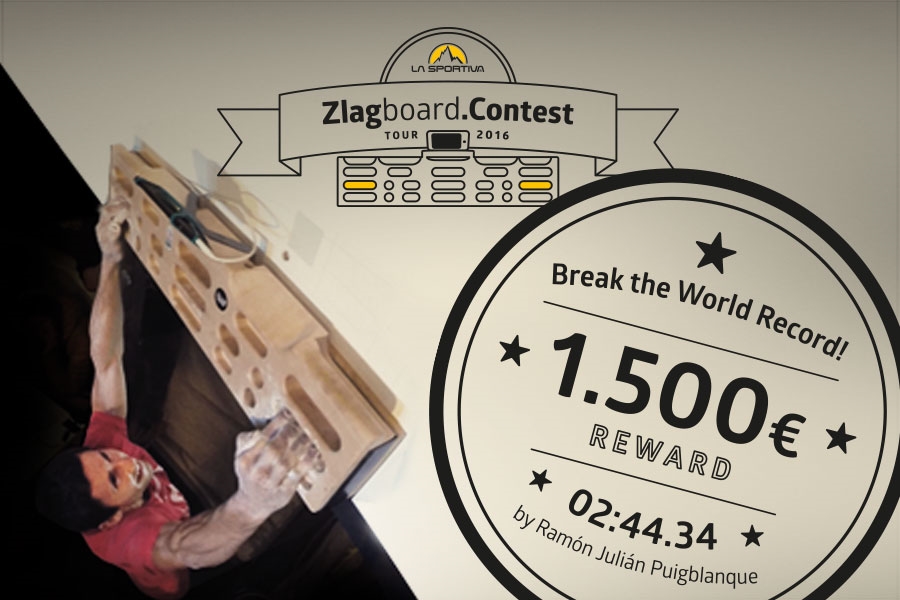
1 500 Euro for a new Zlagboard World Record
The makers of Zlagboard are giving 1,500โ‚ฌ to the one who breaks the standing hangtime world-record. Those who think that this is an easy catch should warm up their body, especially fingers and hang on, literally! Even the record holder Ramon himself was not able to repeat his own record on a second attempt, tough. 2:44.34 - not more, nor less! What is this โ€žhangingโ€œ all about? The makers of Zlagboard have started with the hangtime contests in 2014 and it turned out to be pretty successful. All the competitors hold on the same 2 cm grips with just the tips of their fingers. In front of their tense facies the world-ranking appears and their own hangtime hops higher and higher while they are gripping. This is possible thanks to the smartphone-based application which is connected to the board. The next Zlagboard contests where you can win Euro 1 500 are; Dolorock Climbing Festival in Landro Valley, the Austrian Climbing Festival in Zillertal or the Gramitico in Val Daone.

During the Bouldering World Championship in 2007, Daniel Dulac won the semifinal by flashing all four problems but in the final he did not do a single Boulder even if each of the other five finalists did three problems on average. Daniel said that it was extremely frustrating to hear the spectators praise his opponents for topping 13 out of the first 15 Boulders and then try to equal their performance after his bad start on problem 1. The comparison of average semi ranking with final results from the last 142 Boulder World Cups and World Championships, suggests that there is no correlation for the Top-4. (Separate average results for World Championships in brackets). 1=3.1 (4.0): The 10 World Champs have on average qualified as #4 from semi 2=3.2 (3.9) 3=3.3 (2.5) 4=3.3 (3.2) 5=3.9 (3.6) 6=4.2 (3.8) It is somehow strange that the Top-4 in the final had more or less the same average results in the semifinal. This might be best explained that starting last is a disadvantage in the form of pressure. The more experienced the climber is, the higher probability of winning they have, which confirms the statement above. The first time you start last, you almost never win but if you go on competing, the probability will increase. However, many have won for the first time having started at the beginning. Furthermore, in the world championshps, the correlation between semi and final results is negative, which means that the #1 & #2 in the final usually have the worst result in the semifinal. Other possible explanation of the phenomenon could be the friction, which gets worse after five climbers have tried it for some 20 minutes. Moreover, as spectators normally scream more the first time somebody makes it to the bonus or gets close to the top, the last person out will probably get less cheering when achieving the same as their predecessors. Finally, the last person out will not probably have as efficient resting time as the early starters. (This is kind of hard to explain but if all first 6 competitors struggle with a 4+ minutes problem followed by a problem that goes quicker, the resting is shorter for the last one out. On the other hand, a less time-consuming problem followed by a 4+ problem will mean longer rest for the last one out but a long rest is less important if you do the last problem rather quickly).

Interview with Angie Scarth-Johnson (11)
Our Spanish editor, Ignacio Sandoval Buron, has made an INTERVIEW with Angie Scarth-Johnson, who did her first 8c this spring, being eleven years old. She has now been in Spain for three months, which is possible because she is home schooled by her non-climbing parents. Interestingly, the 11-year-old is her own trainer. Picยฉ The North Face Australia.

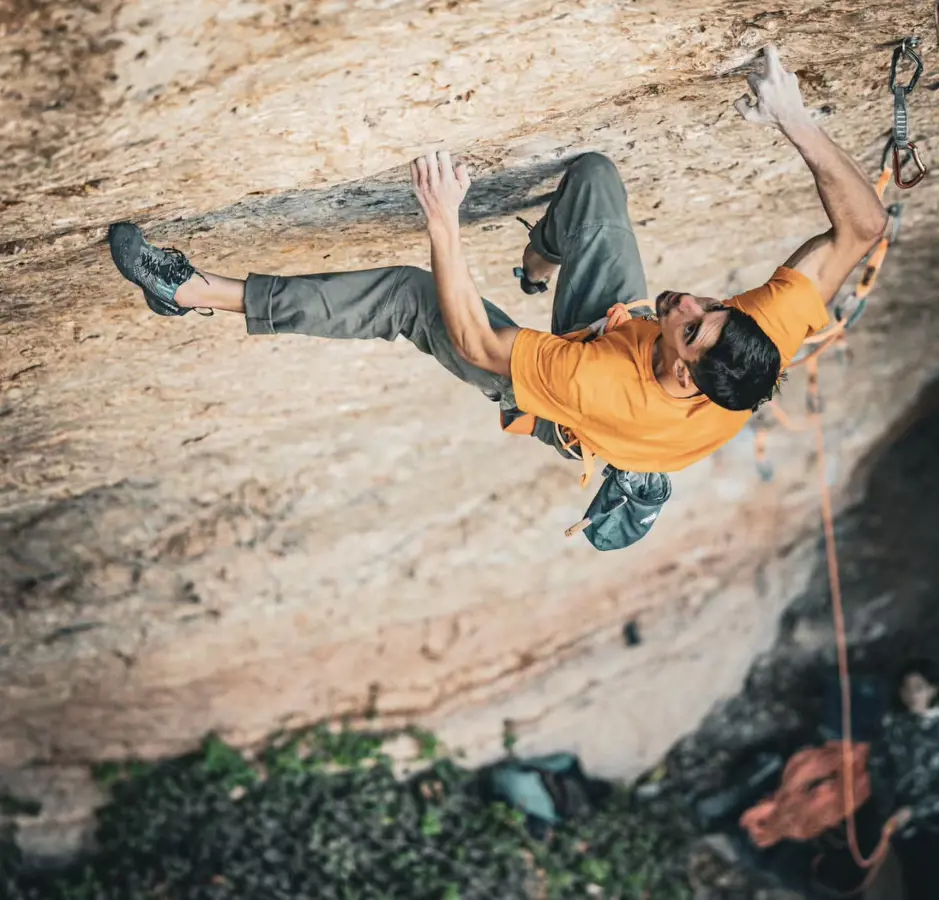
Adam Ondra has done Under vibes in Arco. During the same weekend, the 23-year-old onsighted also five 8a+ to 8b+ routes. In total, he has done 120 routes 9a and harder and onsighted 333 routes 8a+ and harder. The runner-up in these statistics, Ramon Julian Puigblanque has done 49 routes 9a and harder and onsighted 159 routes 8a+ and harder.

8B FA by Isabelle Faus
Isabelle Faus has done Carefully by Hand 8A+ and the FA of The Dark Daughter 8B in RMNP, which might be the hardest female FA in the world! - Trav into child of God, started matched sitting down right in the lowest part of the seam,, first stand up move is hard.. I'm sure tall people will blow off the first move but I couldn't reach the crimp while sitting.. It's much harder than carefully by hand in my opinion,, fun trav.

Goldrake 9a+ by Reffo Silvio
Silvio Reffo has done his second 9a+, Goldrake in Cornalba, after eight days of projecting. (c) Enrico Veronese - I started to try the route togheter with Stefano Ghisolfi, since the first attempts I had a good feeling. The route begins immediately with very intense climbing, after a partial rest there's a very hard and technical boulder where I fell many times. Finally yesterday I managed to climb the route and solve this jewel of Cornalba's crag.

Barbara Zangerl does first ever repeat of an E9 from 2001
Barbara Zangerl, one of the leading multi-discipline climbers, has made the first ever repeat of Dave MacLeod's Achemine E9, a testpiece from 2001. (c) Riky Felderer - I tried first in toprope and it took me some time to get a good solution for the crux. The day after I gave one first lead try and fall. And the third day on....I fell once on the really last hard move. On the second try I was lucky enough! The protection is really good! There is a runout about 13m from the last camelot to the top. So you really can't fall on the last meters. But the hard part is done before. If you take a fall there, you take a biiiiiiiiig whipper. E-grades is used in UK and is a combination of how difficult and dangerous the route would be to onsight! In practice this works very well on easier routes indicating which route to onisght. For the harder routes that are always redpointed it is very hard to estimate the onsight grade. Based on the converter scales available, a safe E9 should be around 8b+.

In the male qualification, all Top-20 did all five boulders, which can be compared with the 12th semifinalist who did not do any boulder at all. More than 50% of the Top-13 were from Japan and there were just three Europeans, out of which two Russians. Among the female, all Top-3 were from Asia and the big sensation was that Shauna Coxsey did not make it to the final, although she won last four events. Interesting is also that half of the girls did not do a single boulder. Finals start at 15.00 Euro Time. Semi results.

Japan dominates in India
The first Boulder Would Cup in Mumbai, India, was a great show with extremely good results for Japan. Beside gaining two golds and getting another two medals, they had another three male in the Top-9. Semi results in brackets once again indicate upside-down result in the final in comparison with the semifinal. (c) Shinji Mizumura 1. Fuji Kokoro (5) JPN - Miho Nonaka (3) JPN 2. Tomoa Narasak (3) JPN - Monika Retschy (5) GER 3. Alexey Rubtsov (6) RUS - Akiyo Noguchi (2) JPN Complete results Interesting is also that runner-up Monika Retschy was second last in both the semifinal and the final as well before the last boulder which she onsighted. The two winners of the semifinal, Jongwon Chon and Sol Sa, were #4 and #5 in the final. This confirms that it seems more difficult to start last in the final.