NEWS

Patrick Matros - Lifestyle climbing trainer
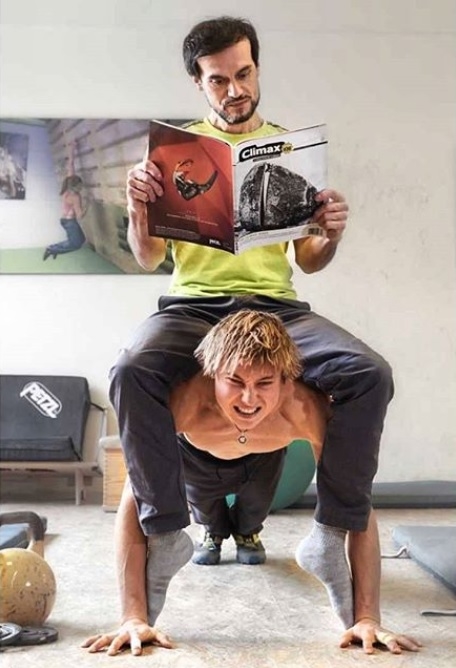
Patrick Matros, a professor for sport and educational science and one of of Alex Megos mentors, shares his view on training, in regards Olympics and that the youngsters are at risk. The 44 year old has learnt the hard way and has now a more holistic playful climbing lifestyle approach. Read more and follow him and his counterpart Dicki Korb through, Gimmekraft, Instagram and Facebook. "I started climbing 25 years ago and we all had this strange training approach, copied from other sport disciplines: In winter season we did a lot of pull-ups, front-lever and campus-boarding first phase was more for hypertrophy and after that we went for maximum power. It was normal, that it took minimum one month to get used to rockclimbing again when outdoor season started. Nowadays I am happy to finish this stage injury free and improved with my knowledge of training in climbing. One risk with the Olympics is that we will see climbers training much more intense and structured at early age and this will have a huge impact on kids and youngsters approach to sportclimbing and bouldering. In the last years I recognize more and more that kids are playing less, as the coaches and parents put more pressure on them in early years. Instead they focus way too much on short term and performance oriented goals like gaining strength with intensive bouldering on tiny holds or making too much strength exercises. Often it is all about climb harder and harder as fast as possible. I have a 6 year old daughter and it breaks my heart when I see coaches and parents pushing young kids too much and I am sure we will see more injuries e.g. an increase in epiphyseal (growth plate) injuries. Our approach is different: We have actually had the opposite focus with a more holistic, long time and task oriented approach when it comes to training Alex Megos. The fun to make climbing moves and do the sport is the core! This means that only the intrinsic part of motivation with a playful approach is able to give you the energy for a long (life) time motivation. And which sport fits better to this idea than climbing? You have so much variations and disciplines, you can climb outdoor and indoor and you can travel around the world to fantastic places! Should you sacrifice a lot of that just for saying that your son or daughter or athlete was able to get some good comp results and then got injured or dropped out because of monotonously training regimes? I think competition can be nice and it can enrich a climbing career, but especially with kids and young adults it is not all around focusing just on the next comp result and it should never be! Of course, some kids and youngsters like to compete and have fun doing it and it is okay for them to have performance oriented goals beside the task oriented ones. But as parents or a trainer you should never forget, that climbing is more than that: it is a lifestyle and a great way to learn about life and have adventures in beautiful areas of the planet. So donโ€™t put too much extrinsic pressure on them. And be careful, as this often happens in a very subtle way!"

Celebration puts pressure on the opponets
Niklas Held, working as a route setter, has published a video analyses from the WC in Meiringen. Interesting is his comments in regards that Jernej Kruder, with his big celebration of boulder #1, heated up the spectators and sending the message, including putting more pressure, to his opponents. (c) Eddie Fowke It should be mentioned that Jernej is known for his big celebration and happy face and it comes just natural for him. However, for others who just quietly walks off the stage after sending, such celebration could be a clever move as Niklas points out. You could imagine that sitting in the isolation listening to the crowd go wild will create some extra pressure. Possibly this could beside the friction also partly explain why the #6 ranked in the semifinal, so often get much better results in the final.

In October 2017, Brad Gobright and Jim Reynolds set a new speed record on the 900 meters the Nose at 2.19.44, on their eleventh attempt . Looking at the great video you can see that they almost simu climbed everything and that they in reality did climb probably more like 1 100 meters due to all traverses etc. The FA in 1958 took 45 days and nowadays, normally 3-4 days is used to reach the summit.

Two Nineteen Forty Four from Tristan Greszko on Vimeo.

Jan De Smit has done his first 8B+ Mรฉcanique รฉlรฉmentaire in Fontainebleau. It should be noted that last year was his best, being 42 years old, doing two 8B's. "Even after thirty years of climbing I am still learning. Climbing hard over forty is difficult but not impossible, if you are mindful in your training/climbing then age does not have to be a limiting factor. After a complete biceps rupture last year I thought I might have to lower my expectations but with good surgery and smart training I can now do everything like before. Feeling proud to have done one of the best lines in Font."

121 male and 104 female are registered to compete in the Boulder World Cup in Moscow this weekend, which can be compared with 60 respectively 37 participated in their last WC in 2010. The increased number of competitors is great for our sport at the same time in creates problems like very long isolation and also difficulties to separate the athletes in the qualifications. In Meiringen, with superb semis and finales, several athletes had to wait 7+ hours in the Iso in the qualification. Further more, 32 male out of 54 in Group 1 did score 2 boulders and in the other group, 17 did top all five boulders. One solution could be to reduce the number of athletes for each country at the same time to increase the number of extra athletes per country based on World Cup points etc. Another solution is to add one zone which would reduce ties and which would make it possible to make the boulders slightly harder if needed.

Olympics qualifications etc
Jorg Verhoeven has published the Olympic format and the qualification procedure which already has been discussed on 8a. It has been confirmed with IFSC that Japan can only participate with max two athletes even if they have a host selection. Here are two issues that should be mentioned. As max one Japanese will be able to qualify from the Combined WCH 2019, possibly it will be good enough to be Top-10 to get the Olympic ticket for the non-Japaneses. During the special qualifying event, it might be that among the male, it is likely that due to the country quota and the strong Japanese team, 15 - 20 (all) will make it through to Tokyo. In theory you could end up in a case where even the #21 in the Combined WC 2019 gets an automatic ticket to the Olympics, i.e: 7 from WCH + 8 quota limitations. This means only five from the special event can be selected even if there are six available spots. Further more, it just might be that it is good enough to be Top-10 in both Europe and Asia Champ to get the Olympic ticket. It should be noted that the 15 minutes break in between each discipline reported is not correct. In the finals it is a minimum of 15 minutes and in the qually it is a minimum of 30 min before the Bouldering and 120 min before the Lead.

Injury prevention - by Schรถffl
Isabelle and Volker Schรถffl, have written an article about injury prevention. They are both active climbers and medical doctors. Both have done first ascents up to french 8b, many of them in Laos and Thailand.They are team physicians to the German Climbing team and Volker is a member of the MedCom IFSC and author of โ€žOne move too manyโ€œ. They have done 100+ scientific papers on climbing medicine and are teaching world wide on this topic. They are right now working for an aid organization as doctors in Laos where they also were among the pioneers for Thakhek. Further information: sportmedicine.rocks Specifically they have mentioned some risks for kids and young teenagers - Neglect campus board - No additional weight - Reduce finger intensive bouldering - Avoidance of constant crimping Full article about injury prevention.