NEWS

Slovenia and Japan shared the podiums
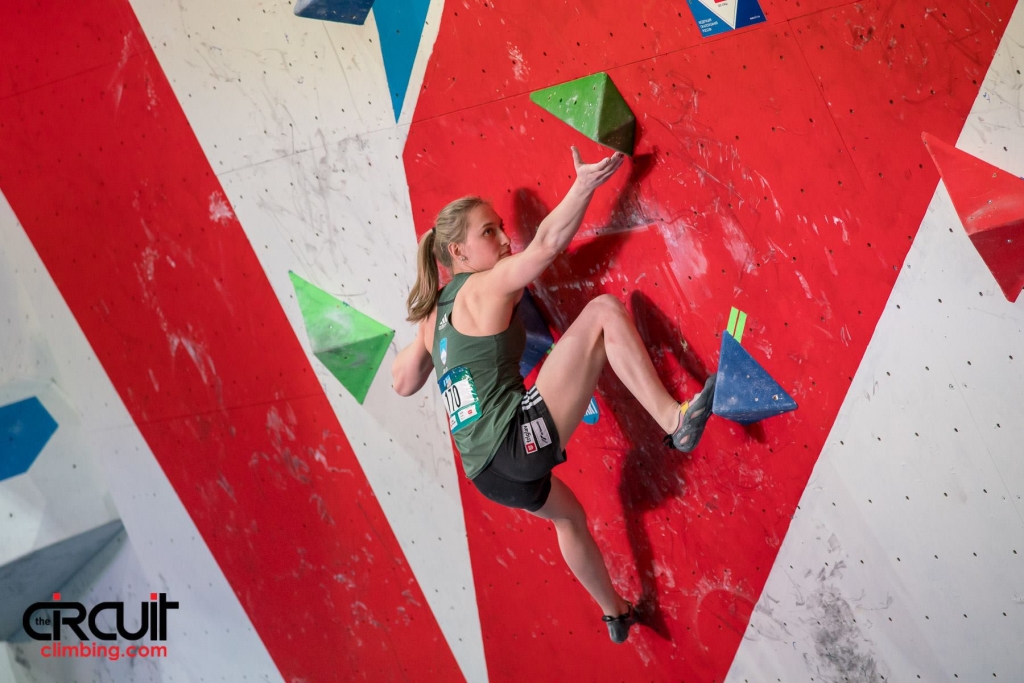
Excellent route setting also in the final in Moscow where it was thrilling to the very last try. Janja Garbret had to flash and so she did, winning on count back over Miho Nonaka. Also last starter in the final, Jongwon Chon had the chance to secure the victory but could not reach the top, and ended #4. As you can see below, Slovenia and Japan shared the podiums equally. 1. Janja Garnbret SLO 44:7/5 - Tomoa Narasaki JPN 44 2. Miho Nonaka JPN 44:7/5 - Jernej Kruder SLO 34:5 3. Akiyo Noguchi JPN 34 Gregor Vezonik SLO 34:6 Complete results Noteworthy is also that Vezonik was #51 in Meiringen last week. Eddie Fowke from The Circuit Climbing and the IFSC official photographer, who has captured almost all World Cups the last five years, was very impressed of the whole competition and the final show. "Very good comp. Too many dyno's in finals though. Super well run, the Russian's put on a great show and put a huge effort into everything going right." In Speed, Yoshiyuki Ogata was best of the top ranked boulderers being #43 with 7.90. Among the female, Miho Nonaka was #44 with 10.51.

The Bouldering World Cup is booming and there are 118 male in the starting list for the qualification starting 07.30, Euro time, Saturday morning. The female begin 15.00 with 100 female participating. On Sunday there will be live-streaming from the semi starting 08.00. The finals start 17.00 with the female and around 18.30 with the male. Live results

Great qualification round where all the ten boulders were topped in Moscow. Japan continue their strong domination in the Bouldering World Cup with eight guys qualifying to the Top-20 semifinal. Winners of the two groups were Gabri Moroni and Jongwon Chon. Jakob Schubert and Jan Hojer were the big surprises not making the semi final. Other sensational results were Gabri Moroni moving from #27 in Meiringen to #1 in Moscow, Alex Khazanov from #57 to #3 and Martin Stranik from #73 to 9. Complete results

There were no big sensations in the female qualification in Moscow and the Top-4 ranked were finalists in Meiringen. In general, very good route setting and although five girls topped all five problems, three boulders were good enough to make it to the semi tomorrow. Complete results

Alexey Rubtsov speaks out
Innsbruck 2018 has published a very interesting interview with Alexey Rubtsov who won the World Champion in 2009 after just having trained bouldering for three years. His big focus is the Olympics and last year he tried Lead and was #17 without any training. Here are some of the lonely wolf's straight forward messages. "The brain is the most important part in climbing. Maybe not in speed (laughs), but in bouldering for sure. In Europe, every coach thinks that he's the smartest one and his system is the best. They are authoritarian. But they should understand that they know nothing and start their education from zero. I can't tell you what I do, because that is my secret. Laughs. You need to widen your repertoire to improve, not focusing on small things, but on the big picture... It is better for me to be alone. You could maybe remove the bonus, even. You can do the boulder, or you can't. Bouldering is good. One bonus, two bonuses, ten bonuses, ... what is that? It's not Bouldering."

8c by Matilda Sรถderlund
Matilda Sรถderlund, one of the leading female climbers in 2012, before she begun her University studies, is back in the game with the FFA of Golden for a moment 8c in Welcome Springs. With her MBA degree her plan is actually to work with climbing in the future. (c) Sophie Odelberg "Golden was my big goal for the spring. This was actually my first experience of projecting a route and the first trip I have done with the aim and focus of just climbing one specific route. Definitely an awesome and developing experience - and an emotional rollercoaster. Sent the route on the very last day of my trip, epic! So happy! One of the best routes I have ever done." Instagram

Era Vella should officially be called 8c+
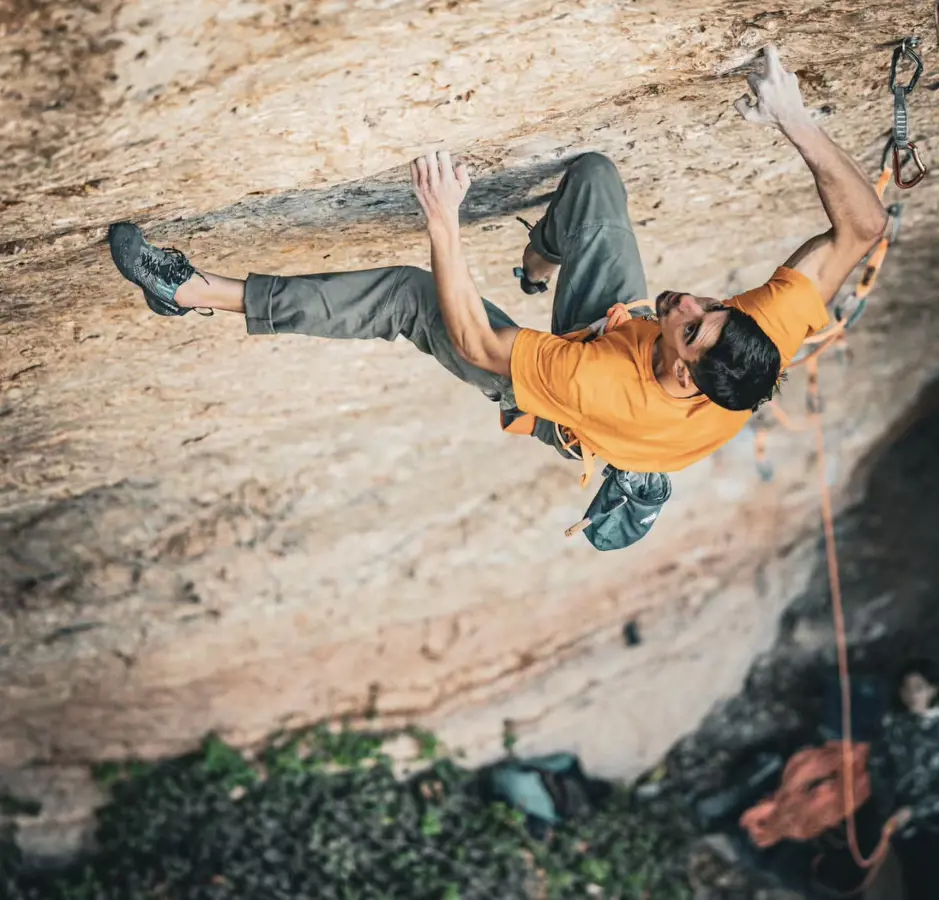
Era Vella is a stunning 45 m line in Margalef that was put up by Chris Sharma in 2010. He called it a soft 9a and the FA was actually done during a warming-up try. Quickly it become the most repeated 9a in the world and based on several comments and personal best, 8a started saying it might be 8c+. In 2015, Jonathan Siegrist did it and said was like an 8c and 8a started to report it as 9a (8c+). Later also Magnus Midtbรถ and Seb Bouin reported it as 8c+. Interesting is that since Midtbรถ's ascent in 2015 (c) Joรฃo Giacchin , only four more guys have done it included Alex Megos last week. Previously, it had been done five times every year. In the big databases it is in fact not considered 9a any longer and that goes also for the Vertical-Life app based and published in cooperation on Dani Andrada guidebook. During the last few years, we have seen some popular hard core routes in the Lleida area beeing down graded in order to fit with the international level. Probably, we will see more down gradings in the area, as a chain reaction, as others that are already contenders of being down graded, now need to be compared with Era Vella being 8c+, although hard for it's grade. Grades are the number one criteria for the media selecting and reporting ascents. Since 2002, 8a has in order to present the most accurate, sometimes commented the grade. In practice, it is not average consensus that change gradings. Instead, it is more like in the Emperor's clothing, somebody speaks out and then later repeaters follow. It should me mentioned that 8a thinks it is just natural that most climbers do not bother giving personal grades and instead focus on just the beauty of the route. On the other hand, the climbing community should be thankful towards the guys sharing their personal view as otherwise we would all climb 9a and we would not understand how hard and give appropriate credit for the first guys doing 9a's more than 25 years ago.

IFSC has published some 2018 rule changes with the most important is how to start in Bouldering. "The competitor must pass through a stable position before moving. In practice this means you can not just tap your foot against a starting hold before moving. Instead you need to place the foot there and remain in a "stable position" which might be 0.5 seconds or so. If you just tap the hold, the referee should stop the climber.