NEWS

USA Climbing explains that the reason for no USA climbers are competing in the Youth Olympic Games in Buenos Aires is that they had failed to, in time, be a recognized member of their USOC. In the Combined Youth World Championship 2017, the qualifying event, Ashima Shiraishi and Brooke Raboutou were #2 and #3. From Italy, Giorgia Tesia qualified by winning the Combined European Championship (CEC) and Pietro Biagini qualified twice including being #2 in the CEC. Bagni might not be so famous yet but with a personal Speed record of 7.36 and #45 in the Lead WCH in Innsbruck, he would have had chances to actually make podium and this also goes for Georgia. From the Youth World Championship, were the Top-15 qualified, the lowest ranked male who made it to Buenos Aires was #24 and the lowest ranked female was #64.

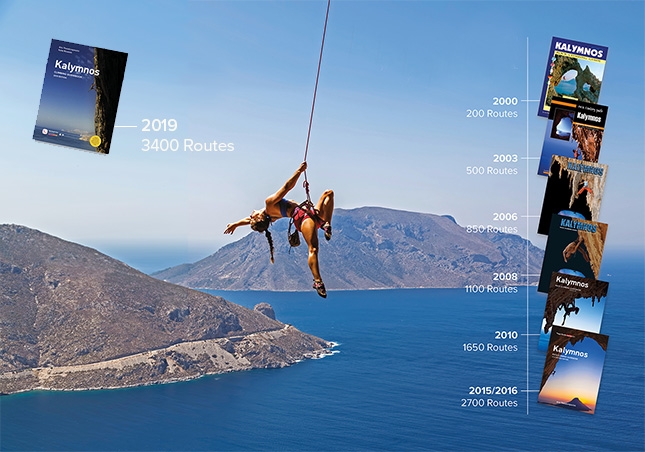
7th Kalymnos topo with 3 400 routes
Climb Kalymnos has presented a great retrospective of the seven guidebooks that has been published since the first in 2000 with just 200 routes. The 7th edition includes 3 400 routes which is 700 more than the in the 6th edition. Buy it for Euro 45 including a free digital code. "A big part of the proceeds goes back into maintenance and new routing. Since 2015, the topo is also available through the Vertical-Life App. "If you donโ€™t want the print version of the guidebook, the app is also available as a separate purchase. If you are a first-time app buyer it costs โ‚ฌ18; if you have already bought the 2015/16 print edition and downloaded that app version, you can download just the updates for โ‚ฌ9." โ€œItโ€™s funny to say, but it [the Kalymnos guidebook] may seriously be the best guidebook in the world. Thank you for all the hard work in new routing and maintenance!โ€ โ€“ Alex Honnold

Great start in Buenos Aires
Almost perfect route setting in the female qualification and no false starts created a great first day in Buenos Aires. Surprisingly, favorite Laura Rogora who was #10 in Lead in the WCH in Innsbruck and who won the Boulder Youth WCH is out. Complete results (c) Eddie Fowke - Vita Lukan from Slovenia was runner up behind Sandra Lettner from Austria.

Slovenia should be in the sports book of record
Slovenia has for many years been one of the leading competition climbing nations in the world. This is nothing but remarkable as they only have 2 million inhabitants and also that they have few big climbing gyms. At the same time as the indoor scene is booming, Slovenia has not been so much part of it and instead their success comes based on many small rather old-school gyms. Martina Cufar won the Lead World Championship in 2001 and since, their Lead female team has been more or less #1 in the world for 17 years straight. During the latest years also, especially their male Boulderers, have showed amazing progress. In the National Team ranking 2018, Slovenia was #2 in Boulder and they are also currently #2 in Lead. Is there anybody who could come up with an explanation who a relatively, to western Europe, poor country with 2 million inhabitants with few no big modern indoor climbing facilities could be so successful? Is old-school gyms peppered with holds better in comparison to less (colorful) holds in the modern gyms? We know that some train extremely structured mainly doing endurance circles on super small walls. At the same time, they have Jernej Kruder, who won the Boulder WC 2018 but mainly climbs long routes outdoors. Instead, the most striking thing talking to several athletes and coaches during the last 15 years, is how young they start and the number of climbing hours they put in. Most schools actually have a small wall and most of the best did actually start before they were eight years old. Already being 13 years old, it is quite normal for the best to do several competitions and climb 15-20 hours a week out of which a big portion outdoors. Slovenia is also known for having a great team spirit. Finally, climbing has a very high sport status in Slovenia. (c) Luka Fonda

Es Pontas 9b? by Jan Hojer
Jan hojer has done the third ascent of Chris Sharma's Es Pontas on Mallorca from 2006. Chris did not grade it but after some years he said 9b was possible when this grade was put forward. Jernej Kruder did the first repeat and he calls it 9b. "The grade is symbolic!" Hojer took the bronze in the Combined WCH in Innsbruck last month. In 2016, he worked Es Pontas together with Jernej for a month. Hojer Insta: "Thanks @chris_sharma ! You sure know how I feel right now ! Thanks so much for putting up this route! Your vision is the only reason I got to experience all of this!"

The Essential 9a by Moritz Welt (17)
Moritz Welt has done his second 9a the last month, The Essential in Frankenjura. "A couple of sessions about two years ago, three more tries this autumn! Just perfect!" (c) Manuel Welt At least equally impressive is his 46 boulders 8A to 8B+ and 71 routes 8a+ to 9a, during the last hear. In the Combined Ranking game, the 17 year old German is #3 after Adam Ondra and Daniel Woods.

In 2004, Chris Sharma put up Practice of the wild in Magic Wood and even if he did not grade it, 8C has become the official grade. It took four years until the stunning supersteep and long line got repeated and another three for the third ascent. Then it quickly became one of the most repeated 8C's in the world and in 2016, Gabri Moroni was the first, as he has been for more routes and boulder, to give it a personal downgrade. Including three more such personal suggestions and most others say it is "soft" as well as most do very quickly, 8B+ seems to be more correct based as of the 2018 standards and training possibilities. In 2004, supersteep and very long boulders were rare both indoors and outdoors. When the boulderers, with poor such training facilities, tried it I bet it felt like a hard 8C. Even in the 8a yearbook of 2008, Bjรถrn Pohl picked it out as one of the Top-10 hardest boulders on the planet. As of today, with much more focus and possibilities to work on such supersteep and long boulders, the community seems to think it is easier in comparison to more vertical 8C'. In other words, Sharma was right in 2004 but new and improved training facilities have probably grade wise made him wrong as of 2018. 8a Grade Article from 2008 explaining it in theory. "Many years ago, climbing activities took place on vertical trad routes giving climbers certain abilities to succeed and grade these routes. Today, on the opposite, most training occurs in steep indoor gyms giving other prevailing skills for climbers. This has changed the community's time/success ratio on different type of route/boulders, and grades have to be changed. In practice this mean that some steep old routes should be in the risk-zone of being downgraded." The good part of such grade changes, due to training or population changes etc, is that grades loose their correctness and thus importance. It just might be that with more smaller and taller climbers getting into the community, confirmed benchmark 9a's or 7A might just need to change to correspond better to the up-to-date community perception.

Loic Zehani has done his tenth 9a with the FA of Les mollahs du mur in Orgon which was bolted by Olivier Bert. "This winter I would love to try "Le Bombรฉ Bleu" at Buoux (maybe 9b) and mythical project for sure. Last year I did almost all the moves (just the first one where I could not do the land a two finger pocket properly after a mega jump. It's a fantastic line in a fantastic place bu it's very dangerous for the fingers." LBB was bolted by Marc Menestrel in 1991. Many of the top climbers like Ben Moon, Stefan Glowacz, Chris Sharma, Fred Rouhling and Iker Pou have tried it saying it is indeed super beautiful. Noteworthy is that in 1993, a french magazine reported it to have been done and graded 9a but today nobody believes this to be true.

James Webb made the FA of La Rustica in 2013 calling it a hard 8B+. Nalle Hukkataival thinks that it merits 8C and have also, instead of the original crouched start, made a full SDS to the extraordinary line. "Well safe to say itโ€™s 8C as shit and also likely the hardest boulder problem in Switzerland. And exceptionally rad."

Janja Garnbret World Games September Athlete
The World Games Association has awarded Janja Garnbret as their athlete of September. World Games presentation video. (c) Eddie Fowke The 19 year old Slovenian has won three out of five Lead World Cup events in 2018 and in Bouldering she has won two out of three. In the remaining three events she did not win this year, she was #2. During the last 20 WCs or WCHs, since she was 17 years old, she has not missed the podium once. Interestingly is that during the years since she made her debut on the World Cup scene in 2015 being 16 years old, taking the two silvers in Chamonix and Imst, she has skipped many WCs. Also this year, she did only take part in three out of seven Boulder WC's andit is the same story every year more or less. Long term progress instead of winning more overall titles.