NEWS

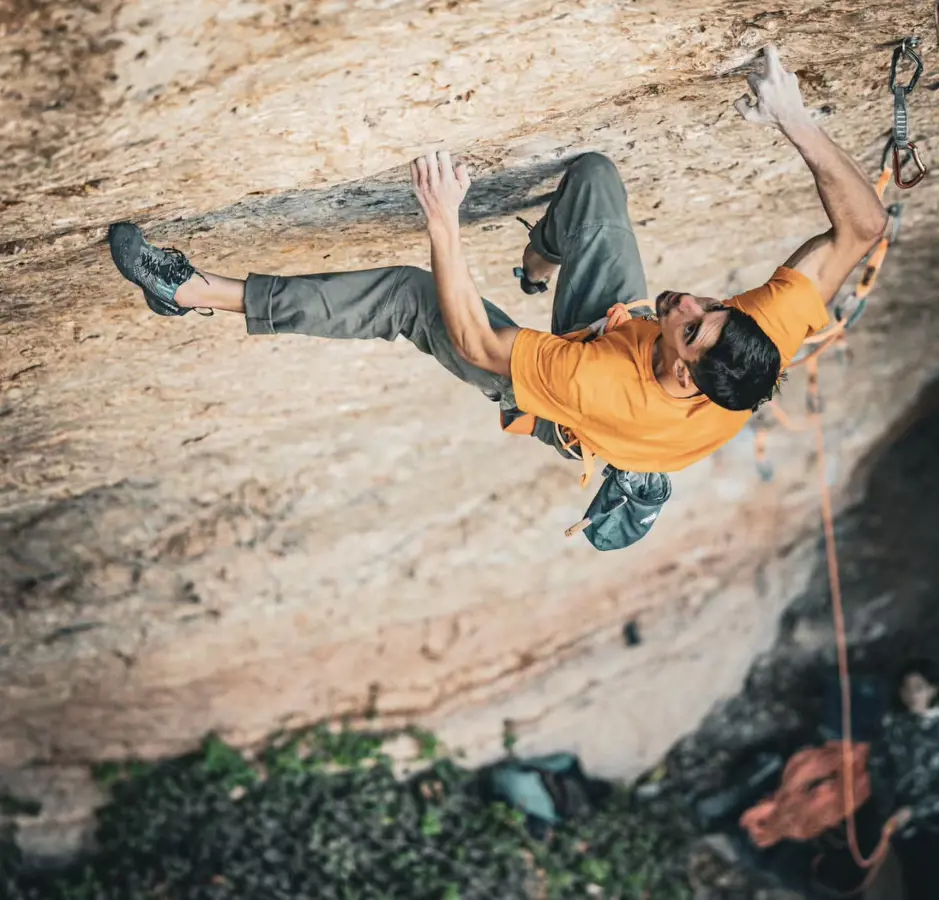
Le Cadafist 9a/+ by Cedric Lachat
Fanatic Climbing reports that Cedric Lachat has done Le Cadafist in Saint-Lรฉger. It was FAed by Gรฉrome Pouvreau in 2017 as a 9a but later a tufa broke. (c) Julia Cassou
- JuliaCassou.com

Noteworthy is that Cedric was one of the best lead competition climbers in the world in between 2001 to 2013. He has won one European Championship as well as two World Cups. The best result in a World Championship is #3. In other words, the 36-year-old should be considered as one of the best climbers in the world during the last 20 years, as he also has done 40+ routes 9a and harder.

Super Samson 8c by Thรฉo Blass (11)
Thรฉo Blass, who last year became the youngest ever to send an 8c at age 10, has done his third, Super Samson in Claret after some eight sessions. His father Vladimir Arnaoudov, also an 8c climber, gives us the story.

"Theo decided to try the route after sending his second 8c in January - Guere d'usure at the same crag (Claret). Super Samson is quite different from the two previous 8c routes he did: it has a short and very bouldery crux (about 5 moves V10 boulder about 20 meters from the ground). As there were no intermediate holds Theo had to use largely the same holds as grown-ups and had to do some big moves but his relatively small fingers and height were an advantage for some of the moves.

Theo could do the bouldery crux after 2-3 sessions and after checking out all the sections and trying all the falls (which he generally does on hard routes to avoid bad or uncontrolled falls) he got very close to sending the route, however, the send turned out to be a bit more elusive due to bad conditions. The route became a bit of a mental challenge and Theo had to take a couple of weeks break before returning to the route and sending it quite easily.

This route demonstrates one more time that grades are relative, especially for kids. Adults can come up with some sort of consensus most of the time, but the further you get from the average adult climber's morphology, the more relative grades become. Guere d'usure, which is supposed to be an easier 8c took Theo much longer to send (the crux of Guere d'usure largely consists of compression moves on good sloppy holds with bad feet).

We regularly try to tell our kids that grades are not that important and that it is all just a game, and what really matters is to try hard, enjoy climbing, and be the best of oneself, but the message is somehow inconsistent and I don't think they always believe us because most adults that kids look up to seem to take grades very seriously. Never mind, we will keep trying:)"


Article after sending Guere d'usure, where Vladimir explains the background starting climbing regularly at age 8 and 18 months later doing his first 8b. Here he explains how he belays him after he did his first 8b+ at age 9.

Baumwesen 9a by Roland Wagner (41)
Roland Wagner has done Baumwesen 9a in Salzburger Land. "Brilliant route. Took a bit longer than anticipated. 12 days this year plus 14 days in 2018/19. Using the momentum of โ€œSehnsuchtโ€, I felt it could go down rather quickly. Baumwesen (โ€œthe tree beingโ€) is a bit of a peculiar route since itโ€™s right behind a massive tree. Itโ€™s nonetheless awesome and for sure one of my harder ones.

The route was FAโ€™ed by Jakob Kronberger in 2017 and hasnโ€™t seen an ascent since. I feel very privileged that with climbing we get to choose our "battles". Lifeโ€™s been really good up there with no end in sight! Onward!โ€
(c) Chris Krah

Interestingly, the 41-year-old had only done one 9a prior to 2021, and in January he did his Sehnsucht 9a/+. Then he also provided five reasons why he thinks he could send his hardest route by the age of 40+:

1. Motivation/Obsession 2. Hard structured multi-task training 3. Injury-free 4. Lucky with conditions 5. Inspiration.

Return to climbing carefully!
As we found that a lot of climbers have not been climbing during lock down we asked physiotherapist, researcher and 8a member, Gudmund Grรธnhaug, Insta if there are anything to consider when returning to climbing after a break. Currently he is doing a research including a questionnaire on training and injuries during the quarantine and/or corona restrictions.

"First of all it is important to remember that all structures in the body, muscles and ligaments are weaker after a break. Most people know and understand that they will have weaker muscles, but also tendons and ligaments will be weaker after a long break. When returning to climbing the muscles will gain strength faster than the tendons and ligaments. In practical terms, this means that those who quickly return to climb on their previous level are taking a huge risk of getting injured!"

How to avoid injuries when returning to climbing?
Spend a bit more time to train smart, do not rush it and focus more on footwork and technique, regaining the psyche and climb more on easier routes than you would do in a normal year.

Climbing easy routes will not return the strength?
Thatโ€™s true. To make a successful comeback it is important to train strength by bouldering or working some cruxes on the routes you want to do. But trying to send hard should not be the focus of the first two months of climbing. It is a long time to wait if you feel strong, but going out hard and getting injured will influence the rest of the season! Training wisely and returning to the previous level slowly will make you stronger and better prepared for the rest of this season, and the next. Going too fast at the start will end the season before it even began!

Sounds difficult to climb with the breaks on if you are feeling strong?
Yes! Try to think of this as returning from an injury! Not being able to climb is pretty much the same as having an injury. It takes time to recover and get back into shape again. Two months of careful climbing may sound a lot, but that is what it takes to get back to previous strength for the tendons and ligaments. The muscles will be stronger after 2-4 weeks. The hard part of this return phase is to feel strong but not try your hardest on the projects. Which means that week 2-8 after returning to climbing is where a lot of climbers will injure themselves if they are not taking care!

Hugh 9a by Noรฉ Moutault (18)
Noรฉ Moutault, who has won one Euro Youth Championship in Lead and gotten the bronze in Boulder, jumps three grades and does Hugh 9a in Eaux claires."This route was totally my style, holes and dynamic pockets ;). I made it in my third session." Video on his Insta

How have you been training the last year?
My dad manages a climbing gym so it's like my second home. I trained six days a week and I was with a friend who had nothing for training at his home. I did two sessions per day, one of climbing and the second of the hang board.

Nihilist low 8B by Karoline Sinnhuber
Karoline Sinnhuber has done her sixth 8B, Nihilist low in . "Somehow I got fit over winter without being able to visit any gyms... weird things happening atm :D super psyched anyway! Let's go for the sit!"

Why are you using different shoes?
I used two different shoes because you have to make a foot swap on the big and slippery hold in my hands. Somehow the Drago sticks a bit better for the swap than the Instinct ๐Ÿ˜….

How many sessions did it take and what about the sit start?
I did the โ€šnormalโ€˜ Nihilist 8A a few years ago. Came back for the low start in autumn and had 2 sessions before it became too cold. This spring I spent another 3 or 4 sessions on it for the send. The Sit 8B+ adds another 2 moves, which are suuuuper hard.

One of the official goals for IFSC is to promote climbing "as a healthy and educational activity for youth." Occasionally, the organization measures the BMI of athletes and notifies the Federations if a male is below 18.5 or a female is below 17.5. Possibly, the IFSC could go even further by prohibiting athletes under a certain BMI from competing? This BMI should be low enough to put climbers' health at risk. Examples of extremely low BMIs: a 160 cm tall female weighing 43 kg = 16.8 BMI, and a 170 cm male weighing 51 kg = 17.6 BMI.

Some countries already have BMI regulations for being allowed in the national team. Reino Horak from the Norweigian Federation explains that they use different BMI levels based on age groups. They have cooperated with the Austrian Federation and their research for getting the right levels for the different age groups. All athletes also have to sign a contract including a medical examination.

"The Norway Federation continuously try to monitor our athletes and also give education and information from Sunn Idrett about this matter. They also have to make an educational web-based Antidoping test each year. These topics are related and federations should give education and implement healthy living for athletes as they develop and grow older. Doing this in combination with some IFSC regulations will prevent a lot of the problems at adult age."

It should be noted that IFSC already has a system for determining which athletes are disallowed to compete for medical injury reasons. As an example, if a climber gets a sprained ankle, a doctor can state that the athlete must be able to jump on the injured foot before continuing to compete. Furthermore, for getting a competition license, the Federations must agree that the athletes are fit to compete.

9a+ and 8c+ FAs by Seb Bouin
Sebastien Bouin reports on Insta that he has done the FAs of Oppression 8c+ and Les gardes fous 9a+, both in St Guilhem. The latter took some ten days and 25 tries. "I am preparing myself for a project in Spain, and I have the opportunity to mix outdoor and indoor climbing at home. So these routes were perfect. Waiting for good conditions in Catalunya, it was a good excuse to jump on these projects."

He is talking about Stoking the fire 9b in Santa Linya. "I would like to try the direct which could be a 9c project. But the first step is the 9b ๐Ÿ˜."

The 27-year-old did his first 9a in 2011 and now he has done 65 of them, meaning that he is #5 on that list. His hardest are three 9B/+ out of which two FAs and Adam Ondra's Move. (c) Sam Biรฉ

Underweight is really common among climbers
Based on 700 unique votes - How common is underweight in Climbing? we can see that only 10 % have said they have never seen it. Actually, 8 % of the voters say that have suffered.

Third 8c+ by Mattรฉo Soulรฉ (14)
Mattรฉo Soulรฉ has done his third 8c+, Le blond, la brute et le manouche in Joncasses, after six sessions. "Awesome. Thirty movements without ever being able to put on chalk. The perfect route of resistence. Really fingery."

Already in 2017, he did his first 8b and later he has also flashed ten 8a+ and onsighted one. Last June, he did his first 8c+, Dieu merci and that one is still unrepeated.