
11 July 2026
James Pearson highballs Legacy (9a) and The Finnish Line (8C)
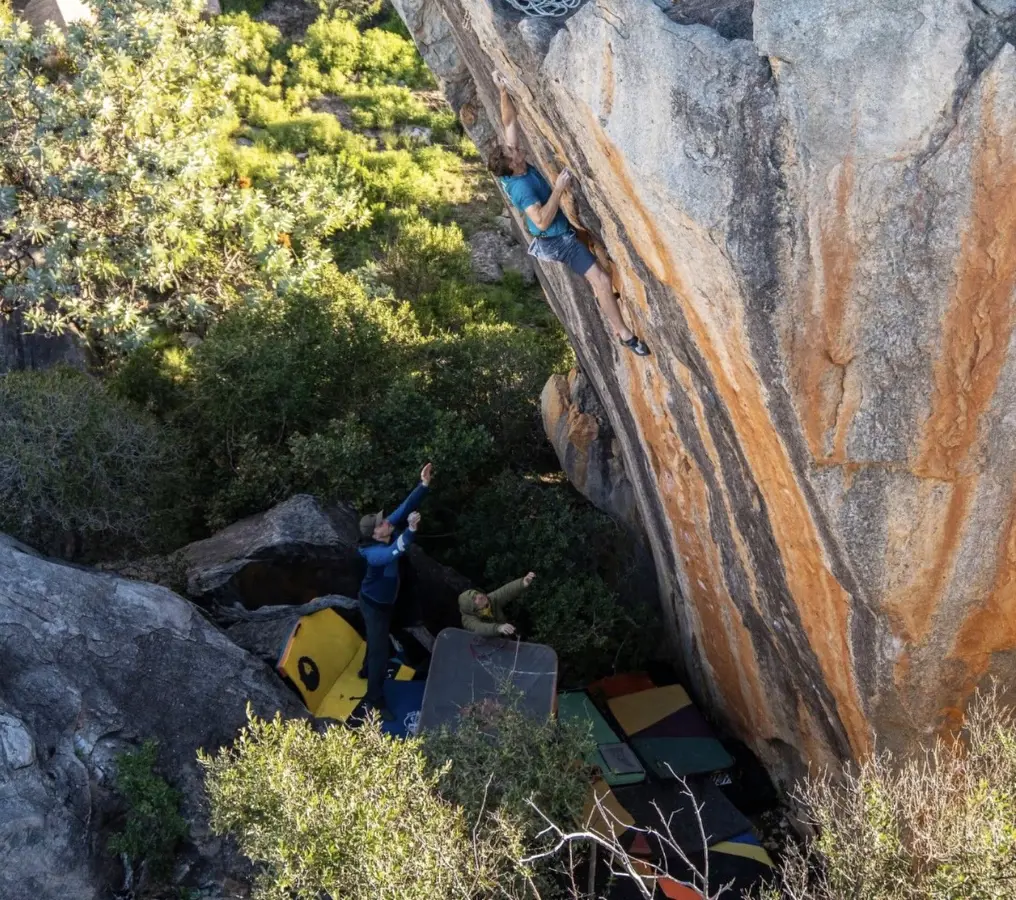
James Pearson seems to be reaching a new peak at age 40, sending The Finnish Line (8C) and Legacy (9a) in Rocklands. Interestingly, the 40-year-old, who has one of the most impressive trad tick lists in the world, says he has almost stopped training and climbs outdoors just when he feels like it. Here is his story about sending the 9a route as a highball boulder.
”First, a bit of history. Dave Graham originally spotted this line — a ten-metre wall of immaculate streaked black and gold Rocklands sandstone — pretty early in the area's development. His instinct was to climb it as a highball: no rope, just pads and friends. For one reason or another he never got around to it, and some years later the line was bolted by ZA local Sean Maasch and offered to Fred Nicole, who began projecting it every season. After five years or so Fred was getting very close — he'd even fallen once after the crux — but had been hindered by injury. At the time the route was considered a “closed project", a practice fairly normal in certain circles back in the day, though much less common today. Then in 2019, Giuliano Cameroni asked Fred's permission to try it, and made the first ascent (with a rope) after three days of work. Fred followed just a few days later, and Giuliano insisted they share the credit, naming the route Legacy — Africa's first 9a. Since then Paul Robinson and Paige Claassen have also repeated it, also on a rope, but interestingly both noting that the line felt more like a boulder problem than a route. Paige's 2023 write-up ended with something like: "I can only imagine someone will boulder this someday."
I came to Rocklands this trip with a head full of highball ideas, and after sending The Finnish Line (8C) early on, started wondering what might be next. I spoke to Keenan Takahashi, who was working some other highball projects nearby, and after hearing what he had to say about Legacy I went to take a look for myself. Standing below the wall for the first time, my first thought was: it's big, but it totally goes.
Before I go further, I want to be clear: the way Fred, Giuliano, Paul and Paige climbed this isn't just "valid" — it's clearly the more sensible approach, given the height, the landing, and the fragile nature of the holds up high. Doing it without a rope meant a serious logistical mission: hiking in a mountain of pads, rounding up friends willing to stand beneath a fairly consequential fall, and committing to all of that in a place where getting injured would be a very bad idea. But Dave's original vision for the line felt like unfinished business, and it matched something in how I like to climb. Climbing doesn't have one correct format — it's always a mix of local ethics and personal preference.
The opening four moves are definitely the crux: small, slick holds with intense, snatchy moves right off the deck. I worked those out on the first day, then checked the upper wall on a static line. The moves above are more straightforward in comparison, but surprisingly sustained on sharp, fragile crimps — with the hardest coming right at the top. I had to find a compromise between efficiency and minimising any outward force on the holds to avoid snapping anything. The last move is the trickiest in this regard. The easiest way is a big drop-knee off the right-hand side-pull, allowing a static move to the final jug — very controlled, but if the hold went you'd fly sideways off the wall, well clear of the pads. I chose to climb it front-on instead, feet low, going for the top jug with the other hand. Slightly harder, but a fall from there would at least be predictable — hopefully feet first into the upper nest of pads.
On day two I went back up on my own and tried the upper wall above some pads, just to get a feel for being up there. I started climbing and jumping off, taking progressively bigger falls, letting the exposure become normal. By the end of the session I felt comfortable enough to know that if I could get through the start, there was a real chance I'd go to the top. A few days later — a little warm, but with a good wind — a group of friends hiked in every pad they could find and arranged themselves below. There was a lot of laughing and messing around while we got everything sorted, which was exactly what I needed to keep the tension low. I talked them through the sketchiest parts, told them there was a real chance the bottom boulder might take me all day — or might not go at all. Then I put my shoes on, pulled on, and climbed to the top. The feelings on the upper wall were exactly what I'd hoped for — calm, focused, and completely present. The noise from below only reached me on the top-out. It felt like finishing a sentence that someone else had started. Thanks to everyone that made it possible: Keenan Takahashi, Martin Käble, Ethan Pringle.”
Can you tell us more how you prepared for this trip getting this boulder peak?
Strangely, it seems like the less I train, the better I get! For example I didn’t climb or train at all this winter, I just skied, and when I came back to my projects in the spring, I sent a lot of them!!!
Honestly, I don’t really know what is happening. I was training semi regularly up until I climbed Echo wall a couple of years ago. After that I felt like I wanted a bit of a break so I took the summer off and in the autumn surprised myself by sending some long-term projects. I decided to continue the rhythm of just climbing outside whenever I felt like it, and doing other stuff when I didn’t, and it still seems to be working 🤣
I spoke to my Trainer Ollie about it and he doesn’t really understand the ear, but told me if the machine isn’t broken, then don’t try to fix it!
”First, a bit of history. Dave Graham originally spotted this line — a ten-metre wall of immaculate streaked black and gold Rocklands sandstone — pretty early in the area's development. His instinct was to climb it as a highball: no rope, just pads and friends. For one reason or another he never got around to it, and some years later the line was bolted by ZA local Sean Maasch and offered to Fred Nicole, who began projecting it every season. After five years or so Fred was getting very close — he'd even fallen once after the crux — but had been hindered by injury. At the time the route was considered a “closed project", a practice fairly normal in certain circles back in the day, though much less common today. Then in 2019, Giuliano Cameroni asked Fred's permission to try it, and made the first ascent (with a rope) after three days of work. Fred followed just a few days later, and Giuliano insisted they share the credit, naming the route Legacy — Africa's first 9a. Since then Paul Robinson and Paige Claassen have also repeated it, also on a rope, but interestingly both noting that the line felt more like a boulder problem than a route. Paige's 2023 write-up ended with something like: "I can only imagine someone will boulder this someday."
I came to Rocklands this trip with a head full of highball ideas, and after sending The Finnish Line (8C) early on, started wondering what might be next. I spoke to Keenan Takahashi, who was working some other highball projects nearby, and after hearing what he had to say about Legacy I went to take a look for myself. Standing below the wall for the first time, my first thought was: it's big, but it totally goes.
Before I go further, I want to be clear: the way Fred, Giuliano, Paul and Paige climbed this isn't just "valid" — it's clearly the more sensible approach, given the height, the landing, and the fragile nature of the holds up high. Doing it without a rope meant a serious logistical mission: hiking in a mountain of pads, rounding up friends willing to stand beneath a fairly consequential fall, and committing to all of that in a place where getting injured would be a very bad idea. But Dave's original vision for the line felt like unfinished business, and it matched something in how I like to climb. Climbing doesn't have one correct format — it's always a mix of local ethics and personal preference.
The opening four moves are definitely the crux: small, slick holds with intense, snatchy moves right off the deck. I worked those out on the first day, then checked the upper wall on a static line. The moves above are more straightforward in comparison, but surprisingly sustained on sharp, fragile crimps — with the hardest coming right at the top. I had to find a compromise between efficiency and minimising any outward force on the holds to avoid snapping anything. The last move is the trickiest in this regard. The easiest way is a big drop-knee off the right-hand side-pull, allowing a static move to the final jug — very controlled, but if the hold went you'd fly sideways off the wall, well clear of the pads. I chose to climb it front-on instead, feet low, going for the top jug with the other hand. Slightly harder, but a fall from there would at least be predictable — hopefully feet first into the upper nest of pads.
On day two I went back up on my own and tried the upper wall above some pads, just to get a feel for being up there. I started climbing and jumping off, taking progressively bigger falls, letting the exposure become normal. By the end of the session I felt comfortable enough to know that if I could get through the start, there was a real chance I'd go to the top. A few days later — a little warm, but with a good wind — a group of friends hiked in every pad they could find and arranged themselves below. There was a lot of laughing and messing around while we got everything sorted, which was exactly what I needed to keep the tension low. I talked them through the sketchiest parts, told them there was a real chance the bottom boulder might take me all day — or might not go at all. Then I put my shoes on, pulled on, and climbed to the top. The feelings on the upper wall were exactly what I'd hoped for — calm, focused, and completely present. The noise from below only reached me on the top-out. It felt like finishing a sentence that someone else had started. Thanks to everyone that made it possible: Keenan Takahashi, Martin Käble, Ethan Pringle.”
Can you tell us more how you prepared for this trip getting this boulder peak?
Strangely, it seems like the less I train, the better I get! For example I didn’t climb or train at all this winter, I just skied, and when I came back to my projects in the spring, I sent a lot of them!!!
Honestly, I don’t really know what is happening. I was training semi regularly up until I climbed Echo wall a couple of years ago. After that I felt like I wanted a bit of a break so I took the summer off and in the autumn surprised myself by sending some long-term projects. I decided to continue the rhythm of just climbing outside whenever I felt like it, and doing other stuff when I didn’t, and it still seems to be working 🤣
I spoke to my Trainer Ollie about it and he doesn’t really understand the ear, but told me if the machine isn’t broken, then don’t try to fix it!
0 comments
Most commented
Jorge Diaz-Rullo reports on Instagram that he has made the first ascent of Cafe Colombia in Margalef. At 27, he’s already stacked four 9b+ sends and now he’s ad…
26 January 2026
Sean Bailey FA’s Duality of Man (9c)
Sean Bailey reports on Instagram that he has done the first ascent of Duality of Man (9c) in Dry Canyon. ” After four total years and three seasons of climbing,…
23 March 2026
Jorge Diaz-Rullo proposes 9c for Café Colombia
Jorge Diaz-Rullo elaborates on the reasons for him to suggest 9c for Café Colombia on Instagram, which he took down last week after projecting it for 240 sessio…
Related
16 July 2024
Naoki Shimatani does G-Master (8C)
Naoki Shimatani reports with an Instagram video that he has sent G-master (8C) in Rocklands. His big project is The Finnish Line (8C) where he has already spent…

Sung Su Lee has been on a four weeks trip to Rocklands where he managed to send The Finnish Line (8C),
Spray of Light (8C), The smile (8C) and
Monkey Wedding …
29 June 2022
Legacy 9a by Paul Robinson
Paul Robinson has done the third ascent of Legacy (9a) in Rocklands. It was found and tried by Dave Graham as a scary highball. Later Fred Nicole bolted it and …
Related news
16 July 2024
Naoki Shimatani does G-Master (8C)
Naoki Shimatani reports with an Instagram video that he has sent G-master (8C) in Rocklands. His big project is The Finnish Line (8C) where he has already spent…
Sung Su Lee has been on a four weeks trip to Rocklands where he managed to send The Finnish Line (8C),
Spray of Light (8C), The smile (8C) and
Monkey Wedding …
29 June 2022
Legacy 9a by Paul Robinson
Paul Robinson has done the third ascent of Legacy (9a) in Rocklands. It was found and tried by Dave Graham as a scary highball. Later Fred Nicole bolted it and …
Favorites
8 June 2026
Janja Garnbret does Bibliographie (9b+)
Janja Garnbret has added another milestone to her remarkable climbing career by becoming the first woman to climb Bibliographie (9b+) in Céüse, one of the harde…
Jorge Diaz-Rullo reports on Instagram that he has made the first ascent of Cafe Colombia in Margalef. At 27, he’s already stacked four 9b+ sends and now he’s ad…
16 March 2026
Ondra flashes 3*8C in two weeks
”I stopped focusing on competition bouldering after last year’s World Cup in Prague, partly because I can already feel it on my body, especially in my shoulders. The modern competition style, with a lot of jumping from one hold to another, is very demanding for the shoulders.
Outdoor bouldering is…