
6 May 2021
Haglund deformity due to tight shoes
Björn "Dr 8a" Alber talks about the problem with tight shoes and explains Haglund deformity which his son, who is a World Cup boulderer, has faced for some years.
"In the plus 30 years, I have climbed and coached climbers, climbing shoes have had a tremendous development. Common for all is that they get snugger and proportionally smaller compared to the foot's actual volume and size. The drawback is damaged feet! In the early days, it was limited to deformity of the toes eg Hallux Valgus- sharp inward angling of the big toe- sometimes leading to corrective surgery.
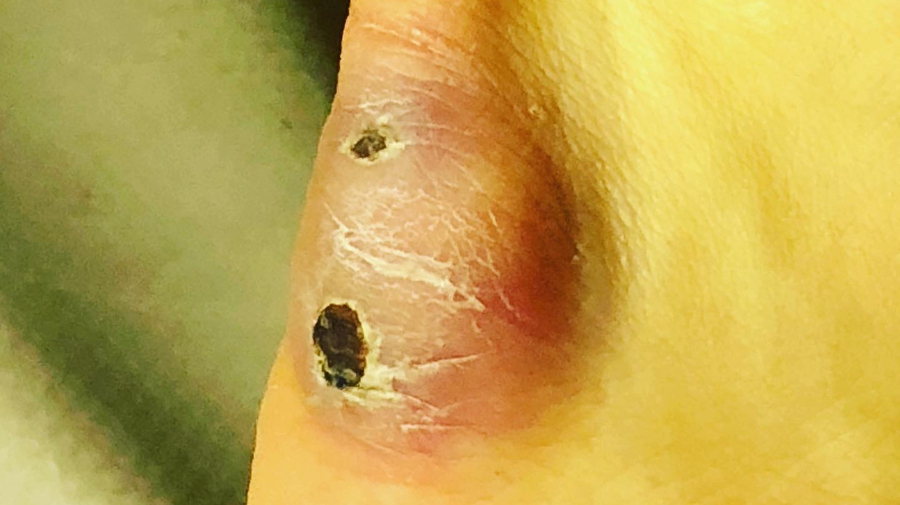
Haglund's deformity, which was first described in 1927, is a new (for climbers) and more sinister deformity. It involves the abnormal growth and following soft tissue changes around the Calcaneal insertion of the Achilles tendon (see picture) the top end of the Calcaneal bone grows a bone spur which in turn – by the pressure of the shoe- irritate the soft tissue above (the Achilles tendon thickens, an inflammatory response will develop in the tendon as well as in the ”bursa” between the tendon and the bone). The result is an extremely painful condition that will make it almost impossible for the athlete to wear his “competition” shoes, and perform heel-hooks etc.
The rigidity and size of the shoe is the main problem but some external factors will contribute:
It is more common in females than in males – softer tissue due to estrogen
High arc of the foot predisposes
Tight Achilles tendon predisposes
Protruding (extending back from the heel) Calcaneus bone- with sharp angles predisposes
While this condition was first predominantly seen in middle-aged females (high heels) it will be more troublesome when developing in young athletes because between 11-19 years of age the great growth spurt will make for a greater deformity. For the climber – especially a young one- the best plan is to limit the use of extreme, aggressive shoes! (This is just as important for Soccer and Hockey players that get to stiff shoes at an early age).
The cure of this condition is;
Stop using aggressive tight shoes- a period of no climbing might be necessary
Get help from a physiotherapist with stretching of the Achilles tendon
Use anti-inflammatory drugs, gel and/or pills
Get local steroid injection (should be done by specialists)
When starting to climb harder again use larger shoe and have an orthopaedic technician make an inlay to take the stress of these structure- see picture.
If this fails surgery should be performed!
In this picture, you see the heel of a top Swedish athlete where the above strategies have failed. The surgery (Surgical excision by lateral approach) should take away a sufficient part of the superfluous bone, which in turn will involve up to 6 months before returning to hard climbing! Since the deformity is most often bilateral a 12-month period of no climbing can be expected. Needless to say, the best strategy is to avoid getting this condition at all question the use of extreme shoes in young athletes! Be observant and take preventive measures in time!"
"In the plus 30 years, I have climbed and coached climbers, climbing shoes have had a tremendous development. Common for all is that they get snugger and proportionally smaller compared to the foot's actual volume and size. The drawback is damaged feet! In the early days, it was limited to deformity of the toes eg Hallux Valgus- sharp inward angling of the big toe- sometimes leading to corrective surgery.
Haglund's deformity, which was first described in 1927, is a new (for climbers) and more sinister deformity. It involves the abnormal growth and following soft tissue changes around the Calcaneal insertion of the Achilles tendon (see picture) the top end of the Calcaneal bone grows a bone spur which in turn – by the pressure of the shoe- irritate the soft tissue above (the Achilles tendon thickens, an inflammatory response will develop in the tendon as well as in the ”bursa” between the tendon and the bone). The result is an extremely painful condition that will make it almost impossible for the athlete to wear his “competition” shoes, and perform heel-hooks etc.
The rigidity and size of the shoe is the main problem but some external factors will contribute:
It is more common in females than in males – softer tissue due to estrogen
High arc of the foot predisposes
Tight Achilles tendon predisposes
Protruding (extending back from the heel) Calcaneus bone- with sharp angles predisposes
While this condition was first predominantly seen in middle-aged females (high heels) it will be more troublesome when developing in young athletes because between 11-19 years of age the great growth spurt will make for a greater deformity. For the climber – especially a young one- the best plan is to limit the use of extreme, aggressive shoes! (This is just as important for Soccer and Hockey players that get to stiff shoes at an early age).
The cure of this condition is;
Stop using aggressive tight shoes- a period of no climbing might be necessary
Get help from a physiotherapist with stretching of the Achilles tendon
Use anti-inflammatory drugs, gel and/or pills
Get local steroid injection (should be done by specialists)
When starting to climb harder again use larger shoe and have an orthopaedic technician make an inlay to take the stress of these structure- see picture.
If this fails surgery should be performed!
In this picture, you see the heel of a top Swedish athlete where the above strategies have failed. The surgery (Surgical excision by lateral approach) should take away a sufficient part of the superfluous bone, which in turn will involve up to 6 months before returning to hard climbing! Since the deformity is most often bilateral a 12-month period of no climbing can be expected. Needless to say, the best strategy is to avoid getting this condition at all question the use of extreme shoes in young athletes! Be observant and take preventive measures in time!"
0 comments
Most commented
Jorge Diaz-Rullo reports on Instagram that he has made the first ascent of Cafe Colombia in Margalef. At 27, he’s already stacked four 9b+ sends and now he’s ad…
26 January 2026
Sean Bailey FA’s Duality of Man (9c)
Sean Bailey reports on Instagram that he has done the first ascent of Duality of Man (9c) in Dry Canyon. ” After four total years and three seasons of climbing,…
23 March 2026
Jorge Diaz-Rullo proposes 9c for Café Colombia
Jorge Diaz-Rullo elaborates on the reasons for him to suggest 9c for Café Colombia on Instagram, which he took down last week after projecting it for 240 sessio…
Favorites
Jorge Diaz-Rullo reports on Instagram that he has made the first ascent of Cafe Colombia in Margalef. At 27, he’s already stacked four 9b+ sends and now he’s ad…
16 March 2026
Ondra flashes 3*8C in two weeks
”I stopped focusing on competition bouldering after last year’s World Cup in Prague, partly because I can already feel it on my body, especially in my shoulders. The modern competition style, with a lot of jumping from one hold to another, is very demanding for the shoulders.
Outdoor bouldering is…
26 January 2026
Sean Bailey FA’s Duality of Man (9c)
Sean Bailey reports on Instagram that he has done the first ascent of Duality of Man (9c) in Dry Canyon. ” After four total years and three seasons of climbing,…
Favorites
Jorge Diaz-Rullo reports on Instagram that he has made the first ascent of Cafe Colombia in Margalef. At 27, he’s already stacked four 9b+ sends and now he’s ad…
16 March 2026
Ondra flashes 3*8C in two weeks
”I stopped focusing on competition bouldering after last year’s World Cup in Prague, partly because I can already feel it on my body, especially in my shoulders. The modern competition style, with a lot of jumping from one hold to another, is very demanding for the shoulders.
Outdoor bouldering is…
26 January 2026
Sean Bailey FA’s Duality of Man (9c)
Sean Bailey reports on Instagram that he has done the first ascent of Duality of Man (9c) in Dry Canyon. ” After four total years and three seasons of climbing,…