
30 March 2026
Fatal accident on Kalymnos due to triple bolt failures - Updated!
Rebolt Kalymnos, founded by volunteers including expert mountain guide Aris Theodoropoulos to improve safety on the island, has released the following statement: [The Kalymnos Rescue Team report has been added in the end of the article.]
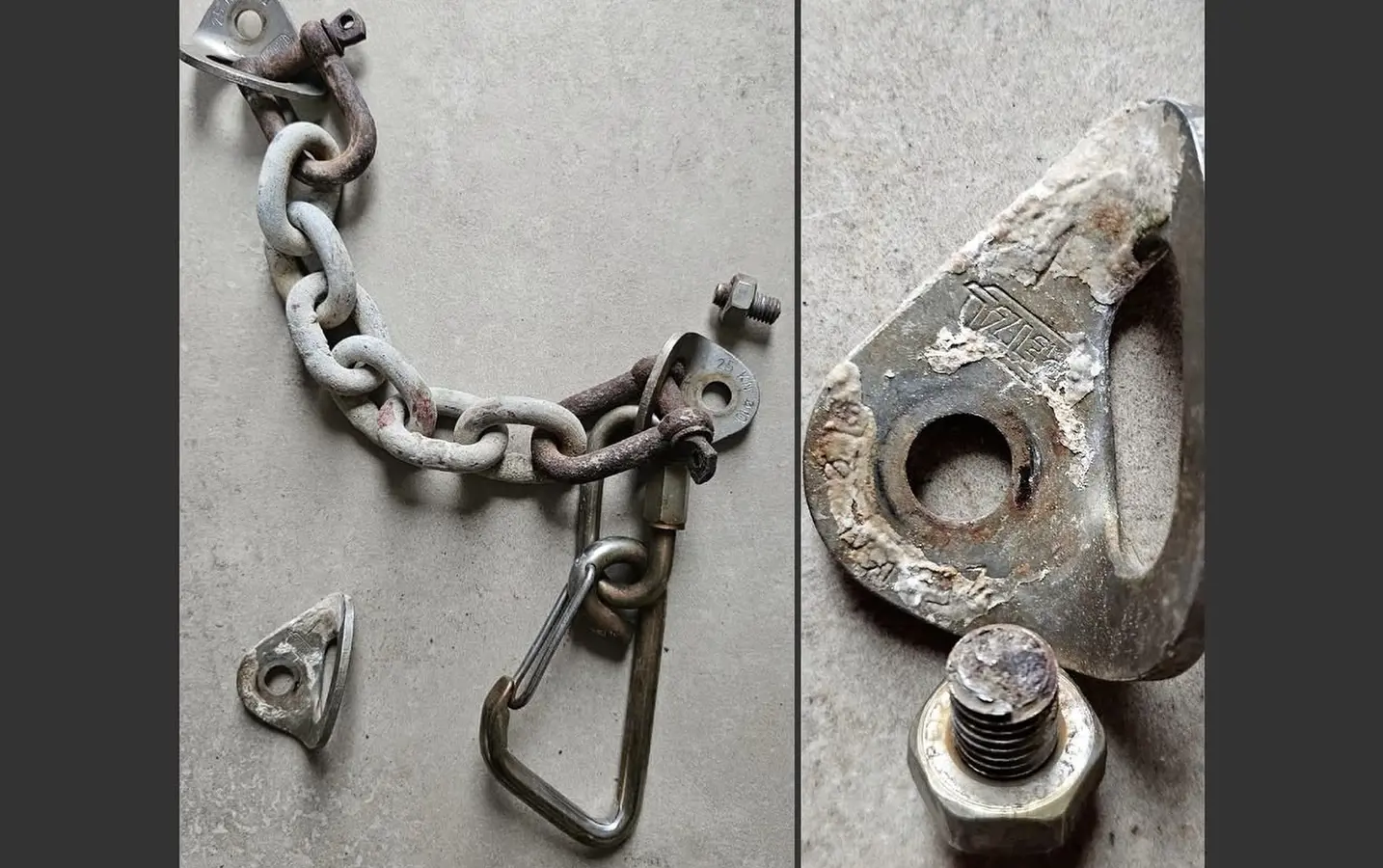
”The tragic accident that claimed the life of a 60-year-old Czech climber happened on St Savvas (7b+) a route from 2002 at sector Jurassic Park using 10 mm expansion bolts (unidentified brand) and PETZL hangers.
The climber finished leading the route, clipped the chains, then started lowering and cleaning the route. He removed the two quickdraws below the anchor. Then, the anchor failed (both bolts at the anchor broke).
Since the climber had already removed the last two draws before the anchor, the load transferred to the next bolt down (3rd bolt before the anchor). This bolt also broke.
He took a big fall onto an intermediate ledge, but was still alive and responsive after the fall. Rescue attempts by helicopter and the fire department and rescue team volunteers all failed, and the climber died from his injuries hours later.
The primary cause of the accident appears to have been a series of failures of the aging (~24 years) hardware. The climber did nothing wrong. This is exactly the kind of accident we have been working to prevent."
Rebolt Kalymnos continuous saying that this is that they plan to:
• Inspect all routes equipped before 2005 that haven't already been rebolted.
• Close suspect routes until they are rebolted.
• Send the failed anchor for forensic metallurgical analysis.
• Speed up work to create a publicly accessible list of all rebolted routes and crags on our website [where you also can donate].
In the meantime, climbers are advised to avoid routes that were equipped before 2005 and have not been rebolted (routes that have been rebolted typically use RAUMER glue-in anchors or LAPPAS expansion bolts). They are also encouraged to report any potential safety concerns to the organisation.
Kalymnos Rescue Team report:
”First of all, as a rescue team, we want to express our grief and sincere condolences to Peter's family and loved ones as well as to the climbing community that is grieving a member. It is our duty to give you the chronicle of the incident by listing the situation and the development of our own contribution. For obvious reasons, we explain the process of how 112 works in Greece and emphasize that it is a European emergency number!! 112 has the ability to find the position and immediately alerts the local police which in turn notifies the fire department which is responsible for operations outside the urban fabric, which in turn judges whether additional help is needed or not from the volunteer rescue team of Kalymnos. The chronicle of the incident begins from the moment when the relatives and witnesses of the fall, most likely due to a material failure and while they have first offered him first aid by treating external injuries from the fall, immediately call for help through 112. The fire service informs the rescue team by text message that there is a climber accident in the Jurassic Park field with a broken leg after a fall of 20 meters!
The ascent to the field begins for 6 people, of which 5 people are members of the fire brigade and one person is a member of the volunteer rescue team. The first to arrive is the member of the rescue team together with one member of the fire brigade, both without insignia, but they declare their status. Upon his arrival, the rescuer is informed by the relatives of the injured that the climber on the descent of the route seems to be in the void due to a material failure and falls about 15 meters from the belay into a loft. His friends pulled him down to the ground with a rappel from a height of about 10 meters. The rescuer assesses the seriousness of the situation, describing the climber as multi-injured and emphasizes to his relatives that the descent of the injured must begin if he is safely immobilized on a stretcher that the firefighters would bring in a few minutes. His relatives, however, inform him that a helicopter is coming. The team of 4th firefighters arrives at the field with an A-backpack and a stretcher. Firefighters confirm to the rescuer that they have made contact and the helicopter is on its way, as his relatives said. The rescuer emphasizes that in a similar case in the past, the helicopter failed to approach due to the inaccessibility of the area and weather conditions, as well as stated that the type of helicopter is not suitable for such fields!
Helicopter Chronicle:
The helicopter does 1st reconnaissance at the place where the injured person is, however, does not attempt as the spot is not accessible. In consultation with the head of the fire brigade, it is decided to move the injured person to a higher point indicated by the pilot ( Route difficult for the safety of rescuers, injured and escorts ). 2nd Attempt to approach the helicopter to no avail. The pilot informs again that the team will have to move the injured person to a more accessible place for him so that he can operate again. The transport of the injured begins, the route even more difficult and dangerous for the rescuers, the injured and his relatives. The team has arrived at the scene and at the same time the helicopter is operating to 3rd time to approach, but the weather conditions do not allow it (Heavy rain, strong winds). At the same time, the volunteer rescuer doctor arrives at the scene after managing to find a replacement on duty at the hospital, but the relatives of the multi-injured man inform him that they have spoken to a doctor on the phone and that they do not need anything more from him. The volunteer doctor assesses the situation, confirms that he is multi-injured, and that his condition will worsen. The helicopter leaves and informs the head of the fire brigade after 10 minutes that it will NOT operate again due to weather conditions (it is raining and windy) and due to the fact that within a few minutes darkness is coming. Three hours have passed from the call for help to the last attempt and finally departure of the helicopter. The rescuer of the team, after the fruitless efforts of the aerial approach of about 2.5 hours, informs his relatives that the helicopter left for good and suggests the best solution to descend. Some of the injured man's relatives suggest spending the night in the mountains. The rescuer explains the dangers due to the condition of the multi-injured person and the weather conditions. After a short meeting of his relatives, they decide and agree that the best solution is indeed to descend. It has already gotten dark, the weather has worsened, which makes the descent extremely difficult and dangerous for all participants. Given the weather conditions and the criticality of the condition of the multi-injured person and the failure of the air ambulance, additional members of the rescue team are called for help.
The descent begins:
Along the way, the condition of the multi-injured person worsens, the doctor suggests the placement of a venous catheter. Initially, his relatives refused, but seeing the deterioration of the condition of the multi-injured man, they accepted. After a while Peter stops breathing, some resuscitation attempts were made, which were terminated due to the unfavorable prognosis (distance of further specialized care more than two hours in the field.) The other members of the team who arrived begin the procedures for securing the stretcher for its descent, now giving priority to the safety of the rescuers and the others who were there, due to the danger of the terrain.
In the last part of the route, the firefighters who had been called from Kos are also assisting. Peter was handed over to the ambulance. This is a testimony we have experienced, we understand the sadness and anger for the shortcomings of air rescue in our country, for which we have been fighting for years. What really sad and depressing Kalymnos Rescue Team in the lonely struggle it is giving, without help from the state mechanism, is that we count more than 150 rescues, since 2013, without human losses with an average of two hours of approach and delivery in an ambulance, is that an article, which is not for the present to answer, uncritically flattens everything. For the last 3 years we have been supporting the state mechanism that is responsible for decision-making and we give our best to help immediately anyone who needs our help in the field, having received the appropriate training at a technical, but also pre-hospital level.”
”The tragic accident that claimed the life of a 60-year-old Czech climber happened on St Savvas (7b+) a route from 2002 at sector Jurassic Park using 10 mm expansion bolts (unidentified brand) and PETZL hangers.
The climber finished leading the route, clipped the chains, then started lowering and cleaning the route. He removed the two quickdraws below the anchor. Then, the anchor failed (both bolts at the anchor broke).
Since the climber had already removed the last two draws before the anchor, the load transferred to the next bolt down (3rd bolt before the anchor). This bolt also broke.
He took a big fall onto an intermediate ledge, but was still alive and responsive after the fall. Rescue attempts by helicopter and the fire department and rescue team volunteers all failed, and the climber died from his injuries hours later.
The primary cause of the accident appears to have been a series of failures of the aging (~24 years) hardware. The climber did nothing wrong. This is exactly the kind of accident we have been working to prevent."
Rebolt Kalymnos continuous saying that this is that they plan to:
• Inspect all routes equipped before 2005 that haven't already been rebolted.
• Close suspect routes until they are rebolted.
• Send the failed anchor for forensic metallurgical analysis.
• Speed up work to create a publicly accessible list of all rebolted routes and crags on our website [where you also can donate].
In the meantime, climbers are advised to avoid routes that were equipped before 2005 and have not been rebolted (routes that have been rebolted typically use RAUMER glue-in anchors or LAPPAS expansion bolts). They are also encouraged to report any potential safety concerns to the organisation.
Kalymnos Rescue Team report:
”First of all, as a rescue team, we want to express our grief and sincere condolences to Peter's family and loved ones as well as to the climbing community that is grieving a member. It is our duty to give you the chronicle of the incident by listing the situation and the development of our own contribution. For obvious reasons, we explain the process of how 112 works in Greece and emphasize that it is a European emergency number!! 112 has the ability to find the position and immediately alerts the local police which in turn notifies the fire department which is responsible for operations outside the urban fabric, which in turn judges whether additional help is needed or not from the volunteer rescue team of Kalymnos. The chronicle of the incident begins from the moment when the relatives and witnesses of the fall, most likely due to a material failure and while they have first offered him first aid by treating external injuries from the fall, immediately call for help through 112. The fire service informs the rescue team by text message that there is a climber accident in the Jurassic Park field with a broken leg after a fall of 20 meters!
The ascent to the field begins for 6 people, of which 5 people are members of the fire brigade and one person is a member of the volunteer rescue team. The first to arrive is the member of the rescue team together with one member of the fire brigade, both without insignia, but they declare their status. Upon his arrival, the rescuer is informed by the relatives of the injured that the climber on the descent of the route seems to be in the void due to a material failure and falls about 15 meters from the belay into a loft. His friends pulled him down to the ground with a rappel from a height of about 10 meters. The rescuer assesses the seriousness of the situation, describing the climber as multi-injured and emphasizes to his relatives that the descent of the injured must begin if he is safely immobilized on a stretcher that the firefighters would bring in a few minutes. His relatives, however, inform him that a helicopter is coming. The team of 4th firefighters arrives at the field with an A-backpack and a stretcher. Firefighters confirm to the rescuer that they have made contact and the helicopter is on its way, as his relatives said. The rescuer emphasizes that in a similar case in the past, the helicopter failed to approach due to the inaccessibility of the area and weather conditions, as well as stated that the type of helicopter is not suitable for such fields!
Helicopter Chronicle:
The helicopter does 1st reconnaissance at the place where the injured person is, however, does not attempt as the spot is not accessible. In consultation with the head of the fire brigade, it is decided to move the injured person to a higher point indicated by the pilot ( Route difficult for the safety of rescuers, injured and escorts ). 2nd Attempt to approach the helicopter to no avail. The pilot informs again that the team will have to move the injured person to a more accessible place for him so that he can operate again. The transport of the injured begins, the route even more difficult and dangerous for the rescuers, the injured and his relatives. The team has arrived at the scene and at the same time the helicopter is operating to 3rd time to approach, but the weather conditions do not allow it (Heavy rain, strong winds). At the same time, the volunteer rescuer doctor arrives at the scene after managing to find a replacement on duty at the hospital, but the relatives of the multi-injured man inform him that they have spoken to a doctor on the phone and that they do not need anything more from him. The volunteer doctor assesses the situation, confirms that he is multi-injured, and that his condition will worsen. The helicopter leaves and informs the head of the fire brigade after 10 minutes that it will NOT operate again due to weather conditions (it is raining and windy) and due to the fact that within a few minutes darkness is coming. Three hours have passed from the call for help to the last attempt and finally departure of the helicopter. The rescuer of the team, after the fruitless efforts of the aerial approach of about 2.5 hours, informs his relatives that the helicopter left for good and suggests the best solution to descend. Some of the injured man's relatives suggest spending the night in the mountains. The rescuer explains the dangers due to the condition of the multi-injured person and the weather conditions. After a short meeting of his relatives, they decide and agree that the best solution is indeed to descend. It has already gotten dark, the weather has worsened, which makes the descent extremely difficult and dangerous for all participants. Given the weather conditions and the criticality of the condition of the multi-injured person and the failure of the air ambulance, additional members of the rescue team are called for help.
The descent begins:
Along the way, the condition of the multi-injured person worsens, the doctor suggests the placement of a venous catheter. Initially, his relatives refused, but seeing the deterioration of the condition of the multi-injured man, they accepted. After a while Peter stops breathing, some resuscitation attempts were made, which were terminated due to the unfavorable prognosis (distance of further specialized care more than two hours in the field.) The other members of the team who arrived begin the procedures for securing the stretcher for its descent, now giving priority to the safety of the rescuers and the others who were there, due to the danger of the terrain.
In the last part of the route, the firefighters who had been called from Kos are also assisting. Peter was handed over to the ambulance. This is a testimony we have experienced, we understand the sadness and anger for the shortcomings of air rescue in our country, for which we have been fighting for years. What really sad and depressing Kalymnos Rescue Team in the lonely struggle it is giving, without help from the state mechanism, is that we count more than 150 rescues, since 2013, without human losses with an average of two hours of approach and delivery in an ambulance, is that an article, which is not for the present to answer, uncritically flattens everything. For the last 3 years we have been supporting the state mechanism that is responsible for decision-making and we give our best to help immediately anyone who needs our help in the field, having received the appropriate training at a technical, but also pre-hospital level.”
15 comments
Sort by:
Date
Reply
Most commented
Jorge Diaz-Rullo reports on Instagram that he has made the first ascent of Cafe Colombia in Margalef. At 27, he’s already stacked four 9b+ sends and now he’s ad…
26 January 2026
Sean Bailey FA’s Duality of Man (9c)
Sean Bailey reports on Instagram that he has done the first ascent of Duality of Man (9c) in Dry Canyon. ” After four total years and three seasons of climbing,…
23 March 2026
Jorge Diaz-Rullo proposes 9c for Café Colombia
Jorge Diaz-Rullo elaborates on the reasons for him to suggest 9c for Café Colombia on Instagram, which he took down last week after projecting it for 240 sessio…
Favorites
8 June 2026
Janja Garnbret does Bibliographie (9b+)
Janja Garnbret has added another milestone to her remarkable climbing career by becoming the first woman to climb Bibliographie (9b+) in Céüse, one of the harde…
Jorge Diaz-Rullo reports on Instagram that he has made the first ascent of Cafe Colombia in Margalef. At 27, he’s already stacked four 9b+ sends and now he’s ad…
16 March 2026
Ondra flashes 3*8C in two weeks
”I stopped focusing on competition bouldering after last year’s World Cup in Prague, partly because I can already feel it on my body, especially in my shoulders. The modern competition style, with a lot of jumping from one hold to another, is very demanding for the shoulders.
Outdoor bouldering is…
Favorites
8 June 2026
Janja Garnbret does Bibliographie (9b+)
Janja Garnbret has added another milestone to her remarkable climbing career by becoming the first woman to climb Bibliographie (9b+) in Céüse, one of the harde…
Jorge Diaz-Rullo reports on Instagram that he has made the first ascent of Cafe Colombia in Margalef. At 27, he’s already stacked four 9b+ sends and now he’s ad…
16 March 2026
Ondra flashes 3*8C in two weeks
”I stopped focusing on competition bouldering after last year’s World Cup in Prague, partly because I can already feel it on my body, especially in my shoulders. The modern competition style, with a lot of jumping from one hold to another, is very demanding for the shoulders.
Outdoor bouldering is…