
14 November 2020
David Reeve and highly corrosive crags
David Reeve has published a very long article in regards bolts and highly corrosive crags. We are very thankful for him putting together a short summary.
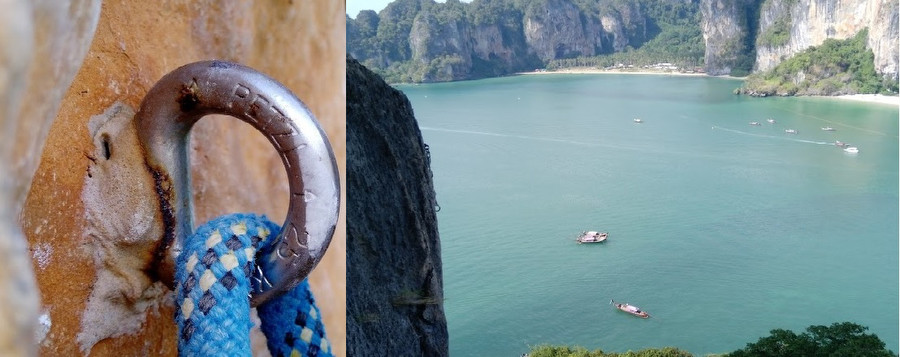
"There are a number of highly corrosive crags that are notorious for their ability to devour stainless steel – eg Railay, Tonsai, Long Dong, much of the Mediterranean coast, and the Portuguese coast to name just some of them. After several years of study, in part funded by the UIAA, and with the help of many volunteers, this is what I now know about these locations
1. All corrosive crags are sea cliffs, yet very few sea cliffs in the world are particularly corrosive, so there has to be more to the story than just the action of seawater.
2. All corrosive crags are associated with high levels of sulphate, both on the rock surface, and seeping through the groundwater. Sulphate promotes the growth of sulphate reducing bacteria (SRB) in the anoxic spaces beneath the fixed hanger at the point where the bolt enters the rock. For glue-ins, bacteria occupy the minute crack between glue and bolt.
3. All failed anchors I have studied reveal the presence of iron and nickel sulphides, a clear indicator of the agency of SRB.
4. SRB are well known to promote a destructive process called hydrogen embrittlement within susceptible stainless steels. It can take the form of stress-cracking that looks similar to chloride-induced SCC but differs in a number of ways. It is called sulphide stress cracking or SSC. More alarmingly, we sometimes see embrittlement with very little corrosion, where perfect-looking uncracked bolts can be snapped with a single hammer blow.
5. The nickel content of the stainless steel, in combination with the temperature at which the product is formed has a dramatic effect on hydrogen susceptibility. It is a threshold effect. At 8% nickel, 304 (A2) is likely to give rise to a product that will last no more than 10 years in an environment where SRB are present. At 10%, 316 (A4) is right on the threshold. It is possible that 316 will last for many decades in the same environment. Steel with a higher nickel content would be a better choice, but, without jumping to the very expensive 904, there is currently no commercial offering at say 14% to 20% nickel.
6. A susceptible stainless steel of any type will reveal this weakness by being magnetic to a reasonable degree. By reasonable degree I mean a super-strong magnet will partially lift a bolt lying on a table. If it doesn’t then it is likely the martensite level is below the critical level. Check welds, and parts of the bolt that have been deformed in manufacture. These areas are the most likely to be magnetic.
7. Sea cliffs in Sweden: I’d be very surprised if you have any problems there. Most sea cliffs are fine except for the few that show sulphate accumulation. Most sulphate cliffs in the world are located in regions of continental subduction. Volcanic activity associated with such shifting of the continental plates provides the sulphur source. The exceptions are those associated with the volcanism of mid-ocean, sea-floor expansion, such as the Canaries and Hawaii. It is only when sulphate is present does the whole thing about magnetism become relevant. 304, magnetic or not, has done great service at sea cliffs around the world. These days with 316 becoming competitive in price, I would choose 316 because it is somewhat more sea water resistant than 304. However, if the price difference is large, I’d stay with 304.
The above is purely my opinion and should not be construed as being endorsed by, or a recommendation from, the UIAA. I am always very careful to set my personal opinions apart from those of the UIAA. I am a technical advisor to UIAA Safe Com on the subject of rock anchors, but that’s all I am. I cannot speak for the organisation. However, they have funded a big part of my research over the past few years, and the reason I started my blog was to ensure that my efforts, and those of the volunteers that help me at crags around the world, are not lost. I distrust “experts” and have no wish to be one. However, I’m very happy to tell people what I have discovered, and let them process that information to make their own decisions."
"There are a number of highly corrosive crags that are notorious for their ability to devour stainless steel – eg Railay, Tonsai, Long Dong, much of the Mediterranean coast, and the Portuguese coast to name just some of them. After several years of study, in part funded by the UIAA, and with the help of many volunteers, this is what I now know about these locations
1. All corrosive crags are sea cliffs, yet very few sea cliffs in the world are particularly corrosive, so there has to be more to the story than just the action of seawater.
2. All corrosive crags are associated with high levels of sulphate, both on the rock surface, and seeping through the groundwater. Sulphate promotes the growth of sulphate reducing bacteria (SRB) in the anoxic spaces beneath the fixed hanger at the point where the bolt enters the rock. For glue-ins, bacteria occupy the minute crack between glue and bolt.
3. All failed anchors I have studied reveal the presence of iron and nickel sulphides, a clear indicator of the agency of SRB.
4. SRB are well known to promote a destructive process called hydrogen embrittlement within susceptible stainless steels. It can take the form of stress-cracking that looks similar to chloride-induced SCC but differs in a number of ways. It is called sulphide stress cracking or SSC. More alarmingly, we sometimes see embrittlement with very little corrosion, where perfect-looking uncracked bolts can be snapped with a single hammer blow.
5. The nickel content of the stainless steel, in combination with the temperature at which the product is formed has a dramatic effect on hydrogen susceptibility. It is a threshold effect. At 8% nickel, 304 (A2) is likely to give rise to a product that will last no more than 10 years in an environment where SRB are present. At 10%, 316 (A4) is right on the threshold. It is possible that 316 will last for many decades in the same environment. Steel with a higher nickel content would be a better choice, but, without jumping to the very expensive 904, there is currently no commercial offering at say 14% to 20% nickel.
6. A susceptible stainless steel of any type will reveal this weakness by being magnetic to a reasonable degree. By reasonable degree I mean a super-strong magnet will partially lift a bolt lying on a table. If it doesn’t then it is likely the martensite level is below the critical level. Check welds, and parts of the bolt that have been deformed in manufacture. These areas are the most likely to be magnetic.
7. Sea cliffs in Sweden: I’d be very surprised if you have any problems there. Most sea cliffs are fine except for the few that show sulphate accumulation. Most sulphate cliffs in the world are located in regions of continental subduction. Volcanic activity associated with such shifting of the continental plates provides the sulphur source. The exceptions are those associated with the volcanism of mid-ocean, sea-floor expansion, such as the Canaries and Hawaii. It is only when sulphate is present does the whole thing about magnetism become relevant. 304, magnetic or not, has done great service at sea cliffs around the world. These days with 316 becoming competitive in price, I would choose 316 because it is somewhat more sea water resistant than 304. However, if the price difference is large, I’d stay with 304.
The above is purely my opinion and should not be construed as being endorsed by, or a recommendation from, the UIAA. I am always very careful to set my personal opinions apart from those of the UIAA. I am a technical advisor to UIAA Safe Com on the subject of rock anchors, but that’s all I am. I cannot speak for the organisation. However, they have funded a big part of my research over the past few years, and the reason I started my blog was to ensure that my efforts, and those of the volunteers that help me at crags around the world, are not lost. I distrust “experts” and have no wish to be one. However, I’m very happy to tell people what I have discovered, and let them process that information to make their own decisions."
4 comments
Sort by:
Date
Reply
Most commented
Jorge Diaz-Rullo reports on Instagram that he has made the first ascent of Cafe Colombia in Margalef. At 27, he’s already stacked four 9b+ sends and now he’s ad…
26 January 2026
Sean Bailey FA’s Duality of Man (9c)
Sean Bailey reports on Instagram that he has done the first ascent of Duality of Man (9c) in Dry Canyon. ” After four total years and three seasons of climbing,…
23 March 2026
Jorge Diaz-Rullo proposes 9c for Café Colombia
Jorge Diaz-Rullo elaborates on the reasons for him to suggest 9c for Café Colombia on Instagram, which he took down last week after projecting it for 240 sessio…
Favorites
Jorge Diaz-Rullo reports on Instagram that he has made the first ascent of Cafe Colombia in Margalef. At 27, he’s already stacked four 9b+ sends and now he’s ad…
16 March 2026
Ondra flashes 3*8C in two weeks
”I stopped focusing on competition bouldering after last year’s World Cup in Prague, partly because I can already feel it on my body, especially in my shoulders. The modern competition style, with a lot of jumping from one hold to another, is very demanding for the shoulders.
Outdoor bouldering is…
26 January 2026
Sean Bailey FA’s Duality of Man (9c)
Sean Bailey reports on Instagram that he has done the first ascent of Duality of Man (9c) in Dry Canyon. ” After four total years and three seasons of climbing,…
Favorites
Jorge Diaz-Rullo reports on Instagram that he has made the first ascent of Cafe Colombia in Margalef. At 27, he’s already stacked four 9b+ sends and now he’s ad…
16 March 2026
Ondra flashes 3*8C in two weeks
”I stopped focusing on competition bouldering after last year’s World Cup in Prague, partly because I can already feel it on my body, especially in my shoulders. The modern competition style, with a lot of jumping from one hold to another, is very demanding for the shoulders.
Outdoor bouldering is…
26 January 2026
Sean Bailey FA’s Duality of Man (9c)
Sean Bailey reports on Instagram that he has done the first ascent of Duality of Man (9c) in Dry Canyon. ” After four total years and three seasons of climbing,…