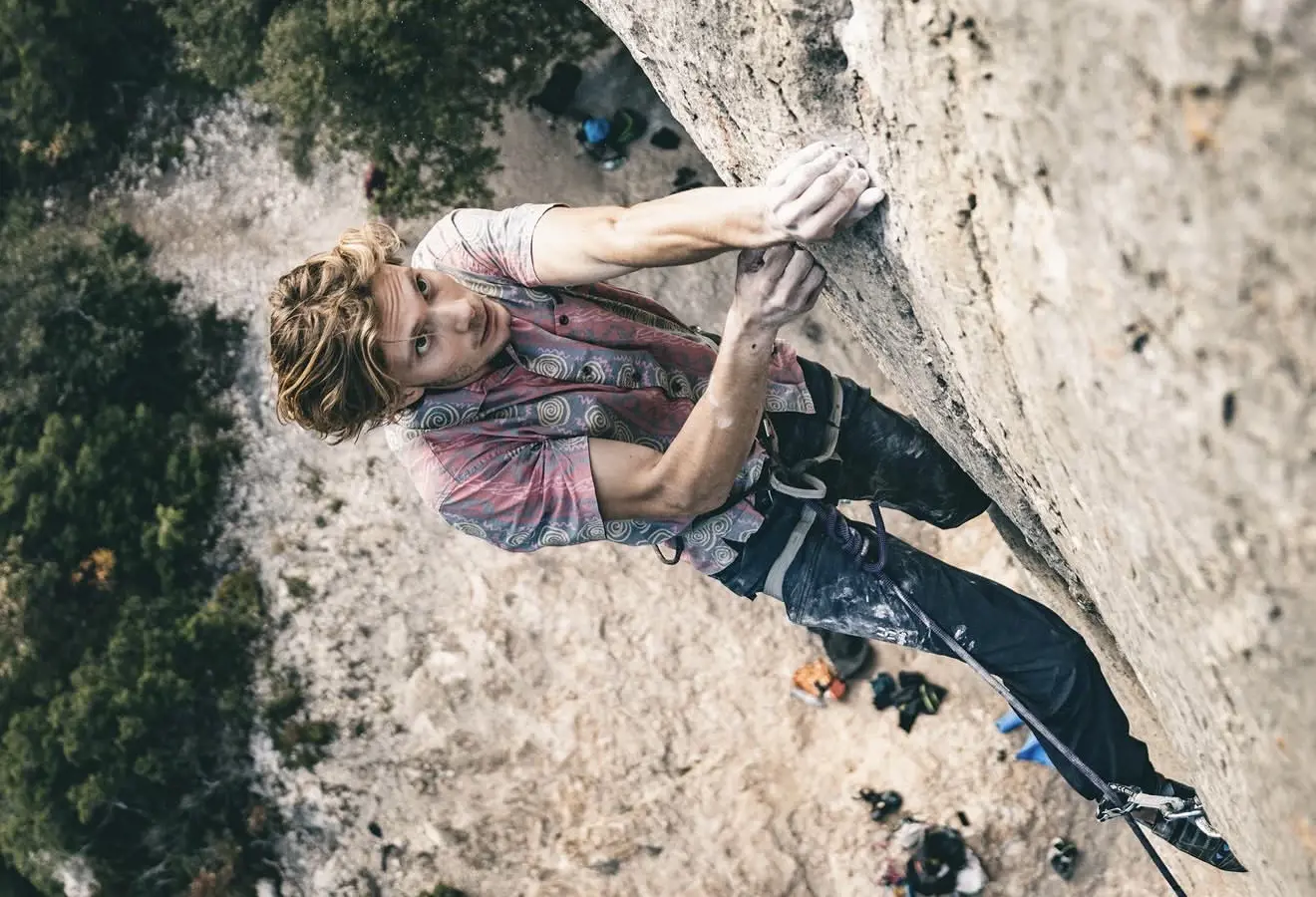
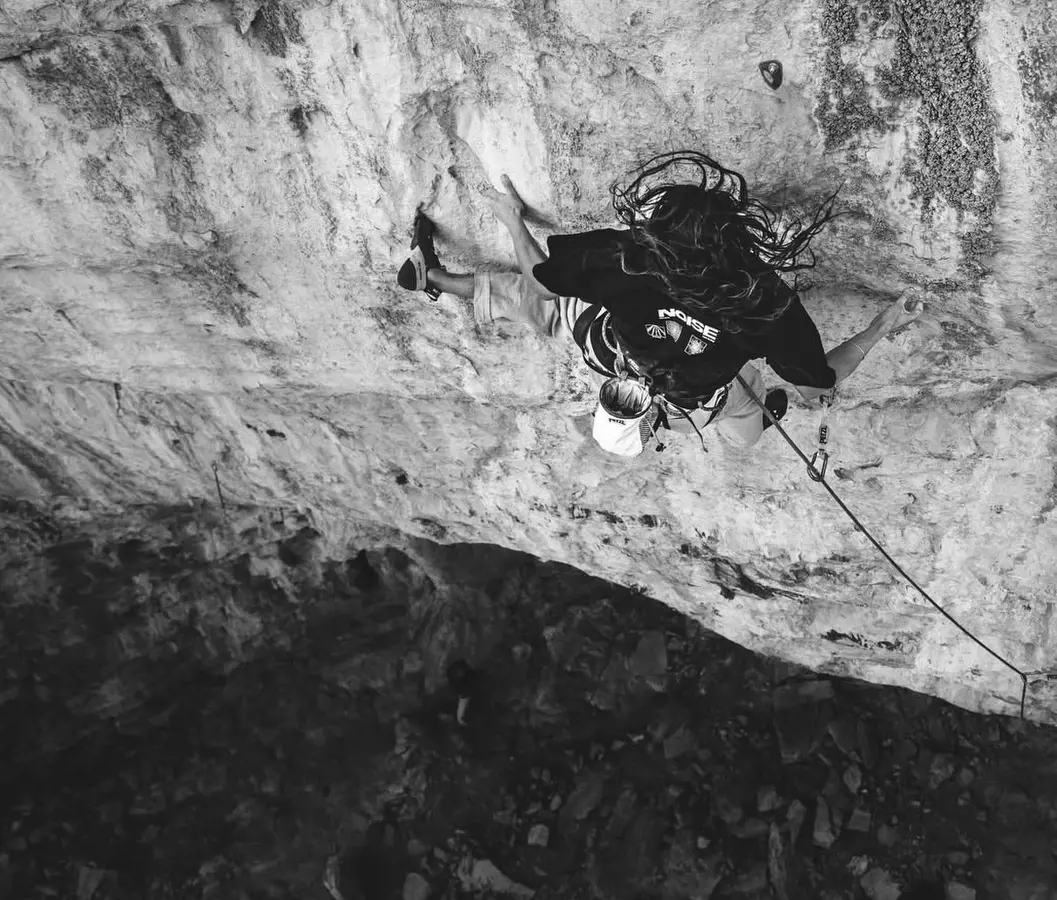
Arthur Poindefert jumps three grades and repeats
Supercrackinette (9a+) in
Saint Léger after more than 100 tries. During the two years of projecting, the alpine guide had his shoulder relocated and did undergo compartments syndrom surgery. (c) Timothée Nietschke
Can you tell us more about the ascent and what went into completing it?This project was something I had in mind during every training session for two years. I had other smaller climbing projects on the side, but this one really taught me how to detach myself from the result while still putting everything into training.
In the end, you can climb there in autumn, winter and spring, so quite often. But I also had long periods where I couldn’t go because of injuries that stopped me from climbing.
Can you tell us more about the day of the send? To tell you about that day, you first need to know that I was supposed to try the route at the end of winter, but with my shoulder injury, my delayed training, and everything else, my shape only came back at the end of May.
I was a bit alone in the process, because not many people were at the cliff in early June because of the heat. Every week, from Grenoble, I was doing day trips to put in 2 to 4 tries in the route around 8 p.m., before driving all the way back the same evening.
In the end, I kept feeling better and better in the route, but the guiding season had definitely started!
After a first Mont Blanc with two clients, I had to drive from Chamonix for one last day before being completely taken by work for the rest of June.
Two good friends were on holiday, and one of them was preparing for the 90 km du Mont-Blanc and had to run. So we planned to meet there: he would run during the day and come belay me in the evening.
I drove from Annecy that same day, with my car’s air conditioning broken. Let’s just say I didn’t arrive at the cliff feeling very fresh, and I wasn’t particularly motivated that time… I felt like I was maybe starting to fall into pure stubbornness.
So I delayed my arrival at the cliff, spent time with my friends, played some ping-pong, and the motivation came back.
Around 8 p.m., I arrived at the cliff, warmed up in 15 minutes on the ground and on the hangboard there. Then I went up to brush the holds, and by 9 p.m., the day was over, with the route done on the first try.
It felt pretty unreal. My climbing was perfect, no detail had escaped me, and the wind probably saved me. For once, I had the energy I needed for the last move, and even though the rock was still warm from the day, the strong wind made it just good enough.
Funny little anecdote: the two friends are not really climbers, and 5 minutes before sending the route, I had to explain to Thibaut how a Grigri works! I had been talking to them about the route for two years, and it was their first time at the cliff. They must have thought climbing wasn’t actually that hard after all!
What about the compartments syndrome problem and surgery?
My arms always used to ache when I was training for endurance climbing, but I thought that was the same for everyone. Over time, I realised last year that this wasn’t normal: I was finding it increasingly difficult and my performance was dropping significantly. I couldn’t even climb my warm-up routes without feeling severe pain in my arms, like tendonitis. I eventually discovered that I also had visible muscle hernias in my arms. Once we’d identified the problem, things moved quickly. I had an operation and within two or three weeks I was climbing again!
To put it simply, the tissue surrounding my muscle isn’t elastic, and my muscle kept growing without having enough space to do so.